

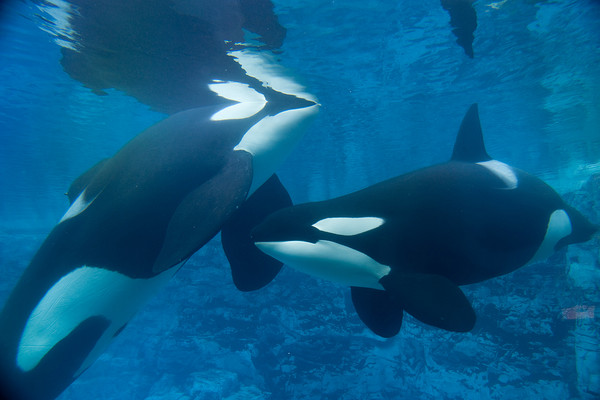
In a possible bid to increase the money made during the Winter Olympics, Sochi’s Aquatoria is said to be ready to receive two wild orcas–or killer whales, as they are often called–which were captured specifically for the aquarium.
While whaling, which kills some of the largest marine animals in Earth’s big oceans, is illegal in most of the world, capturing these animals in the wild is not something that many countries have addressed. A pair of wild orcas were apparently officially sought by the Aquatoria, and were captured by whalers in ocean waters just a bit north of Japan.
Japan is one of a few countries that has not outlawed the hunting of whales in territorial waters, though hunting in international waters has become difficult due to the efforts of whale protection groups. These groups have put certain waters under international protection, though with few boats to patrol these areas, it cannot be certain if those laws are being respected.
Officials at the Aquatoria have officially confirmed that at least one orca is on its way to Sochi in time for the Olympics. The news was posted by the Russian Orca team, whose leaders consist of Erich Hoyt, a top level researcher at the Whale and Dolphin Conservation Society, and Alexander Burdin, the leader of the Laboratory of Animal Ecology at the Kamchatka Institute of Ecology and Nature Management.
According to a written statement made by the Aquatoria officials, a single orca was legally captured and taken to a base that is specially equipped to adapt the orca to captivity. The orca will later be brought to Sochi in time for the Winter Games.
Since the statement was released, public outcry has been intense. Advocates of whale protection have created an online petition asking Russia not to show the captured wild orcas during the Sochi Winter Olympics. It currently has nearly 110,000 signatures, and mentions that placing orcas in an aquarium causes suffering.
Paul Spong, the founder of the whale research station OrcaLab near Vancouver Island, agrees, adding that aside from unusual exceptions, the lives of captive orcas are much shorter than those of their ocean-dwelling relatives. He also mentioned how the spirit of the Olympics would be violated by such a display, saying that the Olympics are supposed to be demonstrating the best that humans can be, and that the capture and exhibition of wild orcas is not showing humanity at its finest. Others believe that capturing and holding an orca in a small tank is animal abuse and can put a great strain on the beloved orcas.
There has been no word from the Aquatoria since the public condemnation began, or if the orcas will still be displayed. Because the creatures are not part of any official Olympic event, it is unlikely that Olympic officials will be able to do much to dissuade the aquarium if they do decide to display the orcas.
Captive orcas have caused serious problems even after being stuck in the tanks. The famous and deadly incident at Sea World in 2010 had an orca killing its trainer, with the belief being that the whale in question was bored, isolated, sensory deprived and bred too often. Other orcas have also attacked their trainers, also. The documentary Blackfish asked the question whether dolphins and whales should be kept captive at all. If these wild orcas were captured solely for the purpose of being on display during the Sochi Winter Olympics, it will likely be up to the patrons of the games to support or boycott such an exhibition.
By Marisa Corley
Sources:
Vancouver Sun
Discovery
Care2Petition
Discover more from Guardian Liberty Voice
Subscribe to get the latest posts sent to your email.
19 Responses
Nice weblog here! Also your website rather a lot up fast! What host are you the use of? Can I get your affiliate link in your host? I desire my site loaded up as quickly as yours lol
Please free the whales!!. They are proven to be as intelligent as humans if not more so. Imagine stealing a child right from their parents hands and putting them in a cage and starving them so they do anything for you just to be fed. Because they are so stressed and unhappy they die at age 25 when they normally would have lived to possibly 95 in a happy environment. Meanwhile their parents are becoming ill from the stress of losing their child, all because you selfishly are looking to make a buck. Open your eyes!
LET MY PEOPLE GO 🙁
HOW DO YOU SLEEP AT NIGHT???
I’m not watching, I believe that a great deal more thought needs to be put into the decision of who will and where that games are hosted. London was a good choice, they have done little to offend in quite a while. Utah was a very bad choice, Utah and Mitt Scamney used and abused the games and the IOC and USOC for their personal profit.. Russia seems to be just way too politically incorrect to be awarded the privilege of hosting the games. A city like Detroit that was financially destroyed by the greed of the Wall St pigs could use a boost like hosting the Olympics, I am sure there are other places that could use it as well. The IOC should award the hosting gigs to deserving cities that are NOT doing destructive things to the planet or society.
I find this an apalling display of greed and lack of empathy
And i do believe slavery has nothing to do with an institution as the IOC that represent the Olympic games. This sadens me deeply, & the disrespect for life in the name of the Olympic games can not be the way.
I find mankind to be devolving at late as the very planet we dwell upon.
I think it’s about time that changed!
It’s in my opinion we all owe rent for the time we are here, and it’s time to pay up…for the good of all mankind, and every living being we must share this planet we call home.
For the good of all, please help restore balance to the world.
sincerly Matthew
Qoute from the article ‘a single orca was legally captured and taken to a base that is specially equipped to adapt the orca to captivity’.
NO facility can prepare a killer whale for life in captivity. What they mean is: they will starve them into submission and then force them to eat frozen food for tricks. How sad
Let’s all have a Coke and watch the spectacle in a country that jails pussy riot, outlaws homosexuality, murders street dogs, and captures dolphins, belugas and orcas for entertainment. It’s so far from it’s intended meaning at this point – it’s corrupt and disgraceful. I can’t even fathom how the world is turning a blind eye to these horrors. And yes boycott the Olympics. Boycott Russia.
Between this and their killing all the stray dogs and cats, because they don’t believe in spaying and neutering…I am so done with the olympics and Russia this year. Need to make better choices olympics..
. Tired of people thinking its ok to do what ever they want to the animals of the world.
I would like to point out a few errors in this article. First, orcas are not whales – they are actually members of the oceanic dolphin family. Secondly, the issue of Japanese whalers continuing to kill whales is a completely separate issue from capturing two orcas for entertainment, neither of which I agree with. These orcas were captured off the Russian coast in the Okhotsk Sea, from what I can gather.
Anyway, it is totally disgusting that the Olympics in Sochi are in any way remotely connected to this issue. But, clearly, since Russia allows for orcas to be captured in their water, I am in agreement with boycotting the Russian Olympics, and boycotting the Sochi Aquarium.
Aren’t the homophobic laws enough to boycott these olympics?
Whoa, whoa, WHO PEOPLE! BEFORE you blindly jump on the bandwagon to “boycott the Olympics” and try to recruit other sheeple to do the same, ***REREAD*** the first paragraph!!
I’m not against the boycott, but you’re boycotting THE WRONG organization!!!!!
BOYCOTT AQUATORIA
“Aquatoria is said to be ready to receive two wild orcas…..which were captured specifically for the aquarium.”
Please read the article correctly. The Olympics has nothing and no controls over the two orcas’ captivity.
They can however publicly condone or condemn this… what are they saying?
This has to stop!! its a hell for all those innocent totally defencless Marine Animals!! For all you that tweet,tweet this case all around please!!
I am boycotting the Olympics in Sochi and Japan 2020. I will also be boycotting all sponsors.. Cruelty to any animal is something I can not or will not support…
#BOYCOTTSOCHI #SOCHI2014 #FREETHEORCAS
Agreed. Boycott the Olympics – everyone! Take a stand against orca abuse, and a dolphin absurdly carrying the Olympic Torch across its tiny pool – whoever thought of that should really think again!!! I am boycotting the Olympics, and its sponsors also.
Because of this ORCA/DOLPHIN/BELUGA whale outrage, MILLIONS are BOYCOTTING THE OLYMPICS. The Olympics have been DEGRADED and have DEBASED by this ANIMAL TORTURE DEBACLE. I will NOT be watching, nor patronizing any of its supporters or sponsors. MILLIONS MORE WILL DO THE SAME. SHAME ON THE OLYMPICS. NO MORE OLYMPICS!