


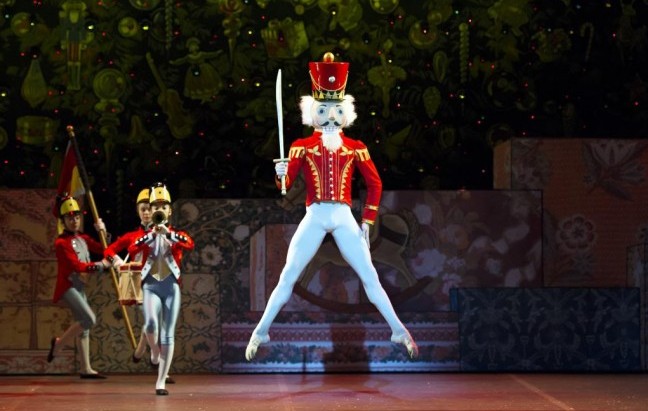
 It’s that time of year when ballet companies perform The Nutcracker while wooden dolls, dressed for sentry duty, keep a watchful eye on hearth and home as part of the Christmas tradition. How these wooden figures and the subsequent ballet became such an endearing part of the Christmas season is a story that goes back to the Middle Ages.
The first nutcrackers were stones used by nomadic hunters as far back as 8,000 B.C. Early Romans used bronze; France and England followed several centuries later using iron and brass. The Ore Mountains, between present-day Czech Republic and Germany, contained rich deposits of precious metals but as the mines dried up, families adapted to wood-carving as their only source of income. During the 18th and 19th centuries, these wooden figurines were not only being carved in the Ore Mountains, but also gained popularity with carvers in Austria, Switzerland and northern Italy.

French author Alexandre Dumas, père, adapted Hoffmann’s story in 1844, making it optimistic and suitable for children. He renamed it The Nutcracker. He took out a lot of the violence in the original story but kept the basic themes of good vs. evil and the power of a child’s imagination especially on Christmas Eve. He also kept the German folklore about nutcrackers given as gifts for good luck and protection. They are said to guard the home of the recipient like a watch dog always on the lookout to defend and protect against danger.
The director of Russia’s Imperial Theatres, Ivan Vsevolozhsky, commissioned the new ballet in 1891 with music by the Russian composer, Peter Ilyich Tchaikovsky. Original choreography was by Marius Petipa, ballet master and choreographer of the St. Petersburg Imperial Theatres. Lev Ivanov, the second ballet master, was responsible for much of the staging due to Petipa’s advancing age and health.

The ballet did not receive good reviews. In fact, critics noted that the story did not resemble the original work by Hoffmann. Others focused on the number of children and passed off some of the battle scenes as disorderly. Tchaikovsky had selected eight of the more popular pieces prior to the premiere and combined them into The Nutcracker Suite, Op. 71a, for concert performance. The suite was immediately popular even though the ballet was not.
The ballet’s first performance outside Russia was in 1934 in England. The San Francisco Ballet offered the first performance in the United States in 1944. It wasn’t until Russian born dancer and choreographer George Balanchine revised it that the ballet became a holiday favorite. He first danced in The Nutcracker as the prince in 1919 at the age of 15 while still in Russia. After he moved to the United States and founded the New York City Ballet (NYCB), he choreographed his own version. George Balanchine’s The Nutcracker™ premiered February 2, 1954 in New York City and has been presented annually from Thanksgiving through New Year’s, totaling 47 performances each year.
The name of the girl in the ballet changes depending on which version is performed. In the original story, Maria is the girl and Clara is the name of her doll. The girl’s name is Masha in the Great Russian Nutcracker while in other versions, she is referred to as Clara. The last name in the Hoffmann story is Stahlbaum, Dumas’ adaptation uses Silberhaus and other productions use the original last name of Stahlbaum.

The Nutcracker is performed during the Christmas season by ballet companies all over the world. From lavish sets and costumes of internationally known companies to small dance studios in any community, the story of a wooden doll that came to life is an endearing holiday favorite.
By Cynthia Collins
Sources:
New York City Ballet
Pytor Ilyich Tchaikovsky – Biography
Moscow Ballet – History of The Nutcracker
History of Nutcrackers – Steinbach family artisans
Leavenworth Nutcracker Museum
Discover more from Guardian Liberty Voice
Subscribe to get the latest posts sent to your email.