


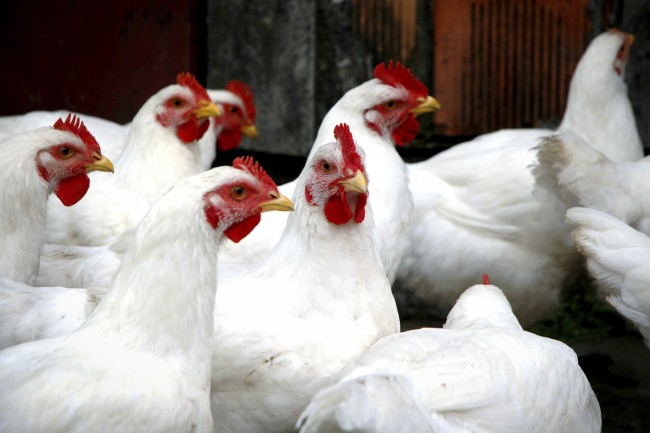
There is now DNA proof that chickens were brought to the New World by Europeans, according to a new study published in the Proceedings of the National Academy of Sciences involving the sequencing of chicken DNA. A previous theory held that chickens were brought to the New World by Polynesians. The lead author of the study was Dr. Vicki Thomson. She’s a researcher at University of Adelaide’s Australian Center for Ancient DNA.
Researchers compared the mitochondrial DNA they discovered in chicken bones from archaeological sites at various Pacific islands with the DNA from the feathers of over a hundred modern-day chickens, also located in the South Pacific.
According to Professor Alan Cooper, a co-author of the study who is also from the University of Adelaide’s Australian Center for Ancient DNA, chicken bones used in earlier studies that suggested a link between Pacific and South American chickens “were contaminated with modern chicken DNA.” Professor Cooper added that the ancient chicken DNA they found in the bones “provided no evidence of any pre-Columbian contact between these areas.”
To Cooper, the “lack of the Polynesian sequences [of DNA] in modern South American chickens,” would suggest that early Polynesians who might have arrived in South America either didn’t have much contact with the native people already there, or did not bring their poultry with them. Polynesian chicken DNA has a distinct genetic marker. This genetic marker is not found in modern South American chickens. You can read about Professor Cooper’s findings in National Geographic at the last link below.
However, Polynesian people had traveled in their canoes and other boats extensively, and had settled various islands in at least two different waves, taking chickens with them wherever they went. There is still controversy over where New World chickens came from, despite the latest findings published in the National Geographic.
The first phase, or wave, of settlement took place over 3,000 years ago. Intrepid Polynesian explorers from Papua New Guinea journeyed to and populated islands like New Caledonia, Fiji, Vanuatu, Tonga, and Samoa.
The second wave of exploration and settlement didn’t occur until around 800 A.D. Then, Polynesians traveled to and settled islands like the Marquesas, Hawaii, Easter Island, Bora Bora, and Tahiti. Scant information remains about why and how the Polynesians accomplished these journeys of exploration and settlement though theories abound.
According to ACAD Deputy Director Jeremy Austin, the domesticated animals that the Polynesians took with them on their long journeys “Have left behind a genetic record that can solve some of these long standing mysteries.”
Does the DNA of chickens prove ancient Polynesians beat Columbus to the New World?
The latest study by Cooper and his team of researchers presents compelling evidence that the ancient Polynesians did not beat Christopher Columbus to the New World, and, if they did, they likely didn’t bring their chickens with them.
However, wiggle room still exists. Some scientists believe, as does David Burley, an an archaeologist at Simon Fraser University in Canada, that there is “substantial” evidence that voyagers from Polynesia had “contact with the New World prior to Columbus.”
For instance, supposed New World items like bottle gourds and sweet potatoes have been, according to Burley, “firmly documented as being out here pre-Columbian.” He reasons that Polynesians brought them to the New World on their sea voyages.
Also, Dr. Alice Storey, the person who wrote the original 2007 study when she was a PhD student theorizing that Polynesians had brought the first chickens to the New World with them, disputes Professor Cooper’s findings. According to Dr. Storey, mitochonrial DNA, deemed by Professor Cooper as being so important to his study, is inadequate to draw any definitive conclusions from.
Specifically, Dr. Storey, speaking to the Australian Broadcast Corporation, stated that, when it comes in particular to chickens, “mitochondrial DNA doesn’t tell us anything about the past.”
The original ancient chicken bones used in both of the studies came from the islands of Niue, Rapa Nui — aka Easter Island — and Hawaii. Dr. Vicki Thomson, Professor Cooper, and the other scientists who played a role in re-analyzing the chicken bones theorize that the original DNA analysis was contaminated, which led to the incorrect conclusion that Polynesians may have beaten Columbus to South America.
The question about where New world chickens came from has many implications. If the latest study proves to be correct, then Christopher Columbus and his crews were the first Europeans to arrive at the New World, and they were the first people to bring chickens with them.
Forget, for the time being, anyway, the very real likelihood that the Vikings and perhaps others, like the Chinese, actually arrived in the New World first, and had colonies here before Columbus.
Or, don’t. Who were the second, third, and fourth groups of settlers, traders, and explorers to arrive? Did the Polynesians beat Columbus here, or is the study authored by Thomson, Cooper, etc., conclusive proof that Columbus arrived before the Polynesians did?
The team of researchers Dr. Thomson and Professor Cooper led was an international one. They believe that they have proven that Columbus reached America before the Polynesians, based primarily on mitochondrial DNA evidence, and that there is no longer any room for dispute about the matter. If they are correct, and perhaps further studies and DNA evidence of other animals and plants supports their findings, we will finally have the answer to the question about where chickens in the New World came from.
Written by: Douglas Cobb
IBTimes.com
UPI.com
DailyMail.co.uk
National Geographic
Discover more from Guardian Liberty Voice
Subscribe to get the latest posts sent to your email.
4 Responses
I’d should check with you here. Which is not one thing I usually do! I enjoy studying a publish that will make folks think. Additionally, thanks for permitting me to remark!
Big woop, history books already documented the common egg laying chickens in the U.S. were brought over from Europe. Mexico and down to South American also have egg laying chickens, but they are much smaller and so are their eggs. Wonder how much money was spent to prove all the history books, journals, diaries, etc. were accurate by proving it with DNA. How about spending that money toward helping to solve current day murders and other crimes or find out if someone found guilty back before DNA testing is for sure guilty.
HOW DO EGG YOLKS BECOME CHICKENS? (Internet Article) When you divide a cake, the parts are smaller than the original cake and the cake never gets bigger. When we were a single cell and that cell divided, the new cells were the samesize as the original and we got bigger. New material had to come from somewhere. That new material came from food. The sequence of molecules in our DNA directed the molecules from our mother’s food, we received in the womb, to become new cells forming all the tissues and organs of our body. When you understand how your DNA works, you’ll also understand how egg yolks can become chickens.. Read my popular Internet article: HOW DO EGG YOLKS BECOME CHICKENS? Just google the title to access the article.
This article will give you a good understanding of how DNA works, as well as cloning and genetic engineering.
Visit my newest Internet site: THE SCIENCE SUPPORTING CREATION
Babu G. Ranganathan*
(B.A. Bible/Biology)
Author of the popular Internet article, TRADITIONAL DOCTRINE OF HELL EVOLVED FROM GREEK ROOTS
*I have given successful lectures (with question and answer period afterwards) defending creation before evolutionist science faculty and students at various colleges and universities. I’ve been privileged to be recognized in the 24th edition of Marquis “Who’s Who in The East.”
I can very easily imagine that Polynesians brought some form of chicken to the New World but not in great numbers. When Europeans arrived, they probably brought greater numbers of chickens – they had bigger ships and more mouths to feed. The European chicken was probably preferred over the existing Polynesian chickens (i can think of numerous possible reasons), thus, the European chickens were quickly adopted – out-breeding the older Polynesian chickens.