


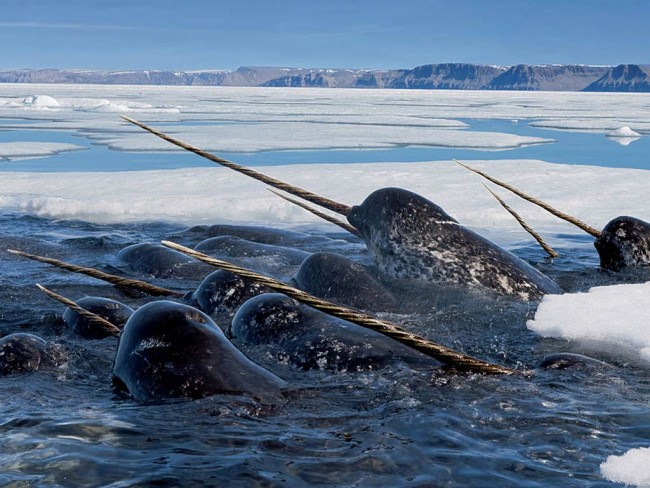
Narwhal tusk function debated after a new theory by Martin Nweeia and his team of researchers suggests it is used to sense changes in the narwhals’s environment. Biologists were quick to point out that observing narwhal’s has produced very little evidence that this is the case, but Nweeia’s dental medicine background leads him to believe otherwise. The narwhal tusk, which can grow to nine feet long and is most often sported by males, is actually a tooth, and Nweeia thinks that this makes a world of difference when thinking about its function.
Observing the anatomy of the tooth reveals three distinct layers, similar to our own teeth. The external layer covers the softer material called dentin, which covers the pulp of nerves and blood vessels that run through the extremity. In contrast to our own teeth, where there are no connections between the layers due the extreme sensitivity of the nerves contained within, the tusk of the narwhal features small channels at the barriers between each layer that allow sea water to reach the sensitive pulp beneath the tough exterior. Although it seems counterintuitive for an arctic whale to want frigid water to constantly be flowing over exposed nerves, Nweeia theorizes that the function of the narwhal tusk is allowing the narwhal to detect changes in salinity in the water it swims through.
In studies of live narwhals conducted by Nweeia and his team, the heart rate of captured narwhal’s seemed to rise and fall in response to changing levels of salt in the water they occupied. But the narwhal’s tusk function is debated by biologists who point out that a feature that imparts such as helpful ability would be available to females as well as males, especially since as mammals the narwhals are critically dependant on females to maintain their population. Although some females have been seen with tusks of their own they are most often quite short, only the males have ever been seen with the iconic long spiral tooth.
While there is agreement that being a tooth the tusk is indeed sensitive, it is contended that the conclusion of being able to detect changes in salinity was the reason for the change in heart rate in captured narwhals. As many know, animals tend to be stressed when captured, and the narwhals studied by Nweeia and his team had just been caught in nets and taken to shallow water for observation. Biologists believe that the change in heart rate that was observed had less to do with changing salt levels and everything to do with the whales being observed in a stressful environment.
As it stands, the official explanation is that the tusk is used to attract a mate, similar to bright plumage or impressive antlers. Due to their rarity and elusive nature, narwhals are difficult to capture and even more difficult to study, which may make it impossible to ever know for sure what the exact use of the tusk is. As the narwhal tusk function is debated between biologists and dentists, everyone involved may be long in the tooth before a conclusive answer is found.
By Daniel O’Brien
Sources
National Geographic
Wired
BBC News
Discover more from Guardian Liberty Voice
Subscribe to get the latest posts sent to your email.
2 Responses
Hi, I do think this is an excellent blog.I stumbledupon it I will revisit yet again since I bookmarked it. Money and freedom is the greatest way to change,may you be rich and continue to help others.
NOT MADE BY NATURE! Just because something exists in nature doesn’t mean it was invented or made by Nature. If all the chemicals necessary to make a cell were left to themselves, “Mother Nature” would have no ability to organize them into a cell. It requires an already existing cell to bring about another cell. The cell exists and reproduces in nature but Nature didn’t invent or design it! Nature didn’t originate the cell or any form of life. An intelligent power outside of nature had to be responsible.
Natural laws can explain how an airplane or living cell works, but it’s irrational to believe that mere undirected natural laws can bring about the origin of an airplane or a cell. Once you have a complete and living cell then the genetic program and biological machinery exist to direct the formation of more cells, but how could the cell have originated naturally when no directing code and mechanisms existed in nature? All of the founders of modern science believed in God. Read my Internet article: HOW FORENSIC SCIENCE REFUTES ATHEISM
Only evolution within “kinds” is genetically possible (i.e. varieties of dogs, cats, etc.), but not evolution across “kinds” (i.e. from sea sponge to human). How did species survive if their vital tissues, organs, reproductive systems were still evolving? Survival of the fittest would actually have prevented evolution across kinds! Read my Internet article: WAR AMONG EVOLUTIONISTS! (2nd Edition). I discuss: Punctuated Equilibria, “Junk DNA,” genetics, mutations, natural selection, fossils, genetic and biological similarities between species.
Natural selection doesn’t produce biological traits or variations. It can only “select” from biological variations that are possible and which have survival value. The real issue is what biological variations are possible, not natural selection. Only limited evolution, variations of already existing genes and traits are possible. Nature is mindless and has no ability to design and program entirely new genes for entirely new traits.
What about genetic and biological similarities between species? Genetic information, like other forms of information, cannot happen by chance, so it is more logical to believe that genetic and biological similarities between all forms of life are due to a common Designer who designed similar functions for similar purposes. It doesn’t mean all forms of life are biologically related! Also, “Junk DNA” isn’t junk. These “non-coding” segments of DNA have recently been found to be vital in regulating gene expression (i.e. when, where, and how genes are expressed). Read my popular Internet article: HOW FORENSIC SCIENCE REFUTES ATHEISM
Read my popular Internet article, HOW DID MY DNA MAKE ME?
Visit my newest Internet site: THE SCIENCE SUPPORTING CREATION
Sincerely,
Babu G. Ranganathan*
(B.A. theology/biology)
Author of popular Internet article, TRADITIONAL DOCTRINE OF HELL EVOLVED FROM GREEK ROOTS
* I have had the privilege of being recognized in the 24th edition of Marquis “Who’s Who In The East” for my writings on religion and science, and I have given successful lectures (with question and answer time afterwards) defending creation from science before evolutionist science faculty and students at various colleges and universities