


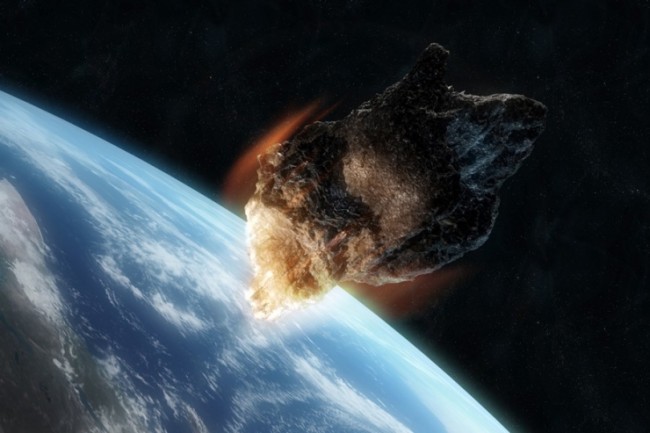
An ancient asteroid as huge as Rhode Island state once scorched the heavens and boiled the primal oceans of the Earth that rocked the planet for as long as half and hour, according to scientists who recently published a study in Geochemistry, Geophysics, Geosystems, a journal of the American Geophysical Union (AGU). The meteor that exploded over Russia on February 15, 2013 would seem like a tiny firecracker pop compared to the asteroid that slammed into the Earth about 3.26 billion years ago.
According to the press release from AGU, the asteroid was about three to five times larger than the one that was supposed to have killed the dinosaurs and most of Mesozoic life about 65 million years ago (K-T extinction). It slammed a crater into the planet’s crust that was about 300 miles across — 2.5 times greater than the one in the K-T extinction. The distance was greater than the distance between New York City and Washington D.C. or almost half the longitudinal width of South Africa. The seismic waves that rocked the Earth was six times more powerful than the Tohoku earthquake that shook Japan in 2011. The impact may have triggered tsunamis that were several hundred feet high, towering several times over the tall skyscrapers in Chicago or Hong Kong.
Geologist Donald Lowe from Stanford University and co-author of the study first discovered evidence of the suggested impact in the Barberton Greenstone Belt in South Africa ten years ago, which has one of the oldest rock formations in the world. It is about 62 miles long and 37 miles wide, resting just east of Johannesburg near South African and Swaziland border. When the asteroid slammed into the planet at more than 42,000 miles per hour, fissures formed, trapping some of the asteroid’s components. Over the Earth’s history, plate tectonics have erased most of the traces of the collision. However, ge0logists found spherules the size of sand particles in these fissures that had condensed from a vaporized cloud of rocks and debris that were created after the asteroid impact. These tiny spherules contain iridium, which is an element that is very common in asteroids but rare on Earth.
Lowe and his colleagues created models of the impact based on the current evidence, which revealed how big it really was for the first time and its impact on the young Earth. Researcher think that this event led to the way how plate tectonics work today. This is the first study that had mapped an asteroid impact during this part of the Earth’s history, which is also known as the Late Heavy Bombardment.
This period occurred between 4 to 3 billion years ago when the planet and its moon were pummeled with asteroids, comets, and other space debris in the early solar system, according to Space.com. The Earth then may have resembled a lot like Mordor in the Lord of the Rings trilogy, covered with rocky land surfaces, volcanoes, and primordial oceans. When the ancient asteroid slammed into the earth, the atmosphere scorched with fire and the Earth’s crust rocked and rumbled, sending a colossal amount of debris and liquified rocks that later rained onto the boiling seas.
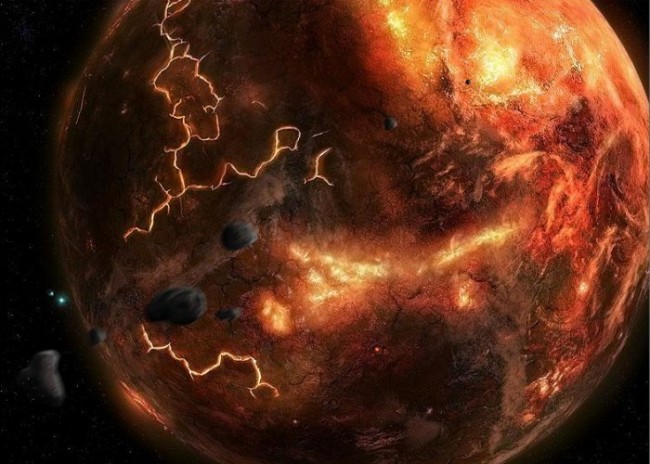
Over a few billion years, erosion and plate tectonics separated the remains of the crater, spreading them apart like a jigsaw puzzle. Some gets buried deep in the Earth’s mantle and possibly the core; some gets trapped and preserved in the fissures, such as the ones in Barberton. Although Lowe does not know exactly where the original crater may have been, evidence in South Africa and Western Australia may provide clues to pinpoint the location. Researchers think that ground zero may be a few thousand miles away from the Barberton Greenstone Belt.
Although the Earth had numerous asteroid collisions in its near 4.6-billion-year history, it may not be last time that the planet will be boiled, scorched, and rocked like a snow globe. There are numerous asteroids in the asteroid belt and the solar system that are even bigger than the one documented in the study. According to NASA’s Jet Propulsion Laboratory (JPL), there are about 140 asteroids with a massive diameter bigger than the Rhode Island-size asteroid. Ceres, the largest one found in the asteroid belt, has a diameter of almost 600 miles. Smaller ones that could still wipe out all life on Earth include Vesta (326 miles), Antiope (120 miles), Dysona (83 miles), and Justita (53.6 miles). This ancient discovery can help scientists understand better about Earth’s early history and evolution with the possibility of providing more evidence to explain the origin of life on Earth.
By Nick Ng
Sources:
American Geophysical Union
Wired
Geochemistry, Geophysics, Geosystems
Space.com
JPL
Discover more from Guardian Liberty Voice
Subscribe to get the latest posts sent to your email.
3 Responses
Your reasoning should be taken as the rule when discussing this topic.
Great points, Chris Landau. The story that is provided by us is only as good as the current sources and evidence based on what we can glean from scientific literature. Sometimes, we would like to do an interview with a professional, such as yourself, who could unclutter the information that is commonly viewed in mainstream media.
“South Africa is filled with thousands of Kimberlite pipes that could easily have brought those spherules enriched in Iridium to the surface from mantle rocks in explosive type eruptions.” Most likely true. What you wrote about the spherules makes sense; correlation does not always imply causation. But wouldn’t most elements, including iridium, lose its property within the heat and pressure of the mantle? If not, then it is a very plausible rebuttal against what we read online about the iridium deposits.
“Maybe the authors can correct the age date of their spherules? A nothing study about nothing. The king is not wearing any clothes and I for one find it very funny.”
Again, what we find is based on the resources that we could find online, and this is not based on the attempt to confirm anything as a fact. Evidence does not necessarily equate to facts because evidence and (unfortunately) biases could change over time.
Chris Landau, if you’d like, we could do an online interview with you and have you provide your evidence and professional expertise on this topic.
Thank you for your time for your feedback. Your feedback and criticism helps us write and research better stories.
Regards,
Nick Ng
No evidence, no impact zone but tiny spherules found in cracks. What was the age of the country rock? What was the age of the spherules? How the hell do you determine the size of the impact on spherule size. Spherule size will depend on size of impact and proximity to impact and what about a volcanic explosive origin for the sperules. I too can write a paper about some minor spherules with no impact site. Now why do the authors not try and find sperules for the Vredefort dome meteorite impact site with a diameter of 200 miles and a distance of only 350 miles away. Of course it is only 2.1 billion years old, not 3.26 billion years old. Please go and do some real field geology mapping, before you scratch some spherules out of some cracks to comment on the obvious that the early solar system had major impacts that have since been eroded away.
ChrisSouth Africa is filled with thousands of Kimberlite pipes that could easily have brought those spherules enriched in Iridium to the surface from mantle rocks in explosive type eruptions.The famous Culinan diamond pipe is only 150 miles away. Iridium is element 77. Platinum is element 78. Now the authors might like to link the Iridium the Bushveld Complex, the worlds greatest store of platinum group metals nearby as that is also only 150 to 300 miles away, but at 2 billion years old provides a 1.2 billion year gap. Maybe the authors can correct the age date of their spherules? A nothing study about nothing. The king is not wearing any clothes and I for one find it very funny.
Now how come the great field and microscopic petrologists like Prof. J.R. Mciver, Prof Grant Cawthorn and the field mapping geologist brothers Robert and Morris Viljoen, that actually created the Barberton Mountain land maps, never came up with such garbage as
silly papers like these. I suppose it was because they were doing real geology.
I am tired of reading pseudo science articles being published in international journals masquerading as real geology.
Stanford, you can do better or maybe you can’t.
Chris Landau(geologist)
April 10 2014