


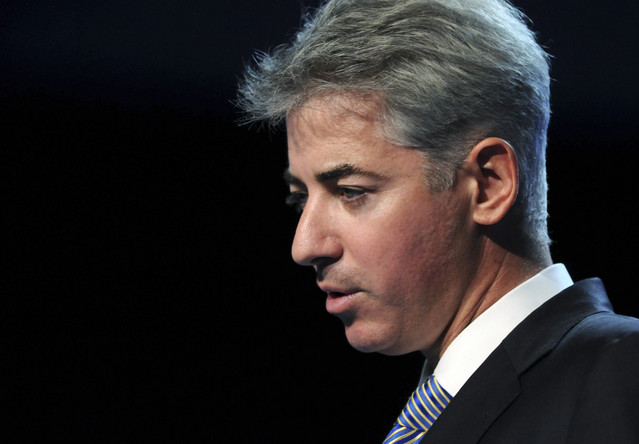
The financial battle over Herbalife slogs along as Bill Ackman and his firm, Pershing Square, settle in for the long haul in order to cash in on a $1 billion bet that the health drink company’s shares will tank. After Herbalife’s shares sank to just under $50 in March on the announcement of a Federal Trade Commission (FTC) investigation, the company’s shares now stand at $65.16. The short sale position taken by Pershing must be covered at some point and Ackman announced that 40 percent was covered last year with additional “put” or sale options subsequently acquired. The date for a final reckoning is unclear. If Ackman and Pershing are going to profit from the large bet against the fortunes of the health drink company, they will probably need some help from the FTC or significant negative results from company operations.
Ackman alleges that the health drink company is a pyramid scheme designed to separate lower and middle income participants from their money. A documentary produced by Pershing highlights the plight of several of them. The documentary notes the pressure placed on Herbalife “members” to purchase the product themselves in order to succeed. The company contends it offers a business opportunity for its members to grow a business using their sales techniques and products. With any direct sales organization offering financial incentives or commissions for recruitment, some amount of suspicion arises because the number of new members available at the bottom will eventually dwindle. For Herbalife, about half of its members who previously qualified for bonuses drop out each year. Ackman contends that the company induces women to put up their own funds to buy a substantial amount of the products in hopes of sales, and that a significant amount of the company’s revenues are ill gotten gains from women who will never be able to sell enough of the product to even cover their costs.
For its part, the company does not keep detailed records of the subsequent sales by members to know how the products are used. The president of Herbalife, Des Walsh, when questioned, appears to avoid the issue and expresses no real desire to change product tracking to confirm the identity of actual product end users. As most other companies around the globe want more and more data regarding customer identity and tastes, the health drink company appears to remain comfortable knowing less.
As the Herbalife financial battle slogs on, the FTC investigation rumbles forward as well. The finger pointing and accusations going back and forth have also resulted in Securities and Exchange Commission (SEC) investigations into the timing of certain events. The federal investigators are reportedly checking into Pershing tipping off other investors prior to negative information on the health drink company going public so the others might profit. While questions have been raised, no evidence of wrongdoing has turned up and Pershing denies any impermissible leaks. The federal investigators are also looking at the activities of the investment companies founded by George Soros and Carl Icahn, which acquired larger positions in Herbalife stock on the other side of Ackman’s bet.
The FTC does not have a strong track record of prosecuting pyramid schemes. The government agency has only leveled charges against five companies as running pyramid operations since 2001. In one bit of good news for Ackman and Pershing, the FBI is now investigating how Herbalife does business. In all likelihood, the Herbalife financial battle will continue to slog along as Ackman fires more ammo and the company fires back. Even if the company manages to rid itself of the FTC investigation, suspicions will continue until Herbalife is more forthcoming with information regarding who buys its products for actual use.
By William Costolo
Sources:
New York Times
The Atlantic
Forbes
Discover more from Guardian Liberty Voice
Subscribe to get the latest posts sent to your email.
8 Responses
Herbalife haven’t really fired a shot back yet. When they do, Ackman will feel it.
Sorors increased by its stake in Herbalife $100 million, that’s 52% in March, knowing full well of investigation!
Ackman has been SUBPOENAED by the SEC – market manipulation is obvious. He’s in hot water. HLF welcomed a request for information CID from the FTC – as to clear up misinformation in the market.
In addition, Canadian Pension Plan (CPP) has increased HLF shares by over 90% and it’s illegal in Canada for CPP to invest in criminal activities. But, don’t worry, they have done their DD. The NY Post (media outlet pro-cry baby Ack) wrote about an investigation by CCB (like the US FTC) what false and misleading information! They should be sued and probably will be once this is over.
The most important question to answer: “Is Herbalife a pyramid scheme?”
Please name us a MLM company that was found to be a pyramid scheme by the FTC that had:
1) No inventory loading*
2) No recruiting payment
3) Excellent Return Policy**
4) Commissions paid related to product sales only
5) Good customer service. Small # of complaints
6) Lasted 10 years with annual sales over 1 Billion
* Members can become supervisors over a 12 month period. Monthly purchases are cumulative until 5k volume is reached.
** HLF Gold Standrad http://bit.ly/1phPHDh
– Member can return products for a full refund within 1 year of
purchase, Free shipping on returns. Introduced in 2013 and in current Q1
2014 HLF had the lowest product return in history 0.2%
Blah blah, if HLF are all of a sudden in to “Independent research” why aren’t they forthcoming to clinical trials to back up the claims all the distributors make about the health benefits of the products?
Clinical Trials are for patent products, HLF has exclusive formulations but not patented products. Only patented product is formulated by Nobel Prize winner Louis Ignarro for Nitric Oxide – this discovery is also used in big seller Viagra.
Millions of people derive benefits and save money by using HLF products – is that NOT enough proof that the products have value?
Interesting to see how PS have won the propaganda war to make everyone believe the retail tracking is an issue. HLF has answered this by disclosing results from Lieberman and Nielsen research, it does not get more professional than that.