


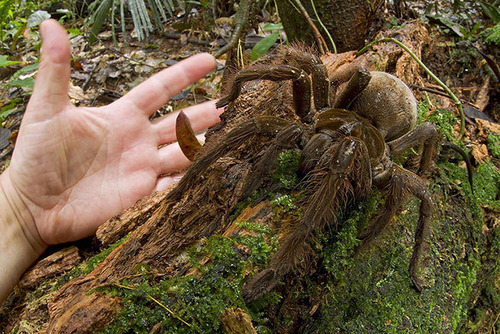
A scientist encountered the world’s largest spider while exploring the jungles of Guyana. Piotr Naskrecki was on a nighttime hike in the rainforest when he heard a rustling heading towards him. Swinging his flashlight toward the noise, he expected to reveal a small furry mammal on a nocturnal hunt. Instead, he came face to face with a Goliath birdeater spider the size of a puppy.
Piotr Naskrecki is a entomologist and photographer for Harvard University’s museum of Comparative Zoology. He is the author of many papers as well as a book and a blog, both titled The Smaller Majority, about the threats faced by invertebrate animals. He has worked in the tropics for many years studying the creepy crawly things that make most humans cringe, but that are essential for a healthy ecosystem. Although a common spider, in the last 10 to 15 years Naskrecki has crossed paths with the Goliath birdeater (Theraphosa blondi) only three times. The elusive arachnid hunts through the rainforest leaf litter at night and mostly eats earthworms. It received its name because it was discovered eating a hummingbird, and is certainly capable of eating birds and eggs, but the nocturnal spider does not usually come across birds on the forest floor. In addition to earthworms, which are very nutritious, the spider feasts on frogs and insects. It is large enough to dine on small mammals if it can catch them.
The Goliath birdeater was awarded the title of world’s largest spider by Guinness World Records. It can grow to the size of a small puppy with leg span of a foot and a body the size of a fist. It can weigh more than six ounces. It does not sound incredibly large, but imagine the fear inspired by a spider the size of a half-dollar crawling in a bathtub and then picture catching a spider the size of a small house pet in the beam of one’s flashlight.
Naskrecki titled his blog post, The Sound of Little Hooves in the Night, because the animal’s feet have hardened tips that make a clicking sound as it gallops through the jungle. As Naskrecki approached the spider the creature employed all of her defense mechanisms. First, she rubbed her hind legs on her abdomen to release tiny barbed hairs that enter the mucous membranes and cause painful itchiness. Naskrecki said his eyes itched for days from the urticating hairs. Second, the spider bared its enormous fangs – fangs capable of puncturing a rodent’s skull. The bite is venomous but not harmful to humans except for the two large holes in the flesh . Third, she made a loud hissing noise by rubbing her hairy legs together. This display makes the Goliath birdeater frightening, but it poses no real threat to people.
Unfortunately for the creature, it was euthanized and preserved and remains in a museum in Guyana. She will serve the important purpose of educating and training conservation biologists. According to his blog, Naskrecki was in Guyana at the request of the government to “conduct a comprehensive survey of animals and plants of a newly created Community Conservation Area. Taking one spider out of the ecosystem to understand how to save others will not drive the species to extinction. Instead, it is habitat destruction that kills thousands of individuals and has placed many species on the brink of disappearing forever.
Naskrecki actually encountered the world’s largest spider while exploring the jungles of Guyana a few years ago. He blogged about the encounter this October, and, possibly due to the proximity to Halloween, the story has fascinated people and has gone viral. Hopefully, people do not simply react in horror at either the giant spider or the scientific methodology. Hopefully, people will become more interested in the variety of life in the world and become allies for conservation.
By: Rebecca Savastio
Sources:
Discover more from Guardian Liberty Voice
Subscribe to get the latest posts sent to your email.
5 Responses
how is killing it and putting it in a museum going to save the species?
it was not killed for entertainment it was preseved to study it so in future crises the studies we have done will be able to protect them and other species, yes I know it sounds unfair but would you rather one spider die or an entire species of spider die.
It was completely DEVASTATING to hear that this beautiful creature had her life taken away just because she was bigger then the average!! Very AWFUL thing to do. We can admire pictures & video’s, but no, she had to be taken away from her home and killed. VERY HORRIBLE. Wasn’t the right thing to do!! Does every larger then normal animal or precious living thing have to be killed for our entertainment, NO!!
So sorry spider, I care.
I agree
100%