


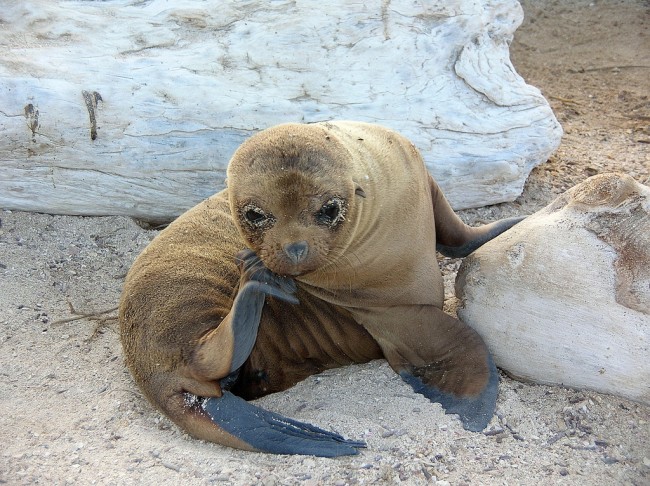
Global warming may be causing sea lions to starve due to warmer ocean temperatures. Recent reports have indicated rising ocean temperatures may be to blame for missing sardines and mackerel usually found near the California coast, as well as crustaceans found near the shore. This also may be why more sea lions are becoming stranded along the shore – malnourished and underweight. One may wonder if global warming is playing a role in temperature fluctuations occurring worldwide both in oceans and in the air. After all, evaporation from oceans drive atmospheric conditions, as well as do other factors, such as wind.
According to the Los Angeles Times, since the start of 2015, the Marine Mammal Center in Sausalito received 171 aid requests to rescue sea lions, most of which were pups. Last year in January alone, the center had only treated about five sea lions, while this past January, the total number of sea lions treated was 69, a new record for the month.
A local news station in San Diego reported that numerous sea lions found along the shore appear malnourished and severely underweight, as well as lethargic. Some of the sea lions had appeared to be gnawing on rocks, while others were found to have had only rocks and sand in their belly. In fact, various news stations along the coast reported that most were about 20 pounds underweight and that the total amount of sick and starving sea lions was around 940 since the start of the year.
Dr. Todd Schmitt of Sea World’s Animal Rescue Center told another news station in San Diego that the food supply for sea lions may simply not be available. Crayfish and sardines seem to have vanished from the California coastlines and this could partly be due to warmer water temperatures that may be associated with global warming patterns.
In fact, CBS Local News in Los Angeles reported on thousands of rare pelagic red crabs that had recently washed ashore in Newport Beach. This may have occurred due to warmer ocean temperatures, as well as a recent king tide that happened on Saturday, February 21.
Global warming could be causing sea lions to starve as many marine biologists agree that they are an indicator of the ocean’s overall healthy ecological system. Just last year, Guardian Liberty Voice reported on an unusual amount of anchovies that showed up in La Jolla. A swarm of northern anchovies was found near the coast in water temperature that measured around 74 degrees. These anchovies are usually found populating in cooler waters, making it odd that so many were found near the coastline in Southern California.
The Weather Channel (TWC) reported that temperatures in Alaska have also been reaching record highs this Winter. The jet stream has pushed farther north than usual, sending chilly northern air toward most of the Northeastern continental U.S. Temperatures in places like Homer have reached 53 degrees this month, whereas in Boston, Massachusetts, temperatures have been steady around the freezing point, or 35 degrees Fahrenheit for the month’s high. Record snow levels have also been recorded in Boston, according to TWC.
One may wonder if these incidences are the result of global warming. After all, a report from U.S. News claims scientists recently conducted a study which proves carbon dioxide (CO2) traps heat inside the atmosphere, thus leading to global warming trends, such as rise in surface and air temperatures. The likely cause appears to come from the burning of fossil fuels, according to such scientists.
Daniel Feldman, a researcher at Lawrence Berkeley National Laboratory, stated measurements were taken in both Alaska and Oklahoma by instruments aimed straight toward the sky. According to Feldman, a chemical composition resembling a type of heat fingerprint consistent with CO2 was trapping heat and producing greenhouse effects.
Mike Rawlins of KRTV also reported on a recent study conducted by Climate Central which stated the amount of CO2 for the current month has remained at 400 parts per million. It has only been since May 2013 that this amount has reached this point since monitoring began in 1958 at the Mauna Loa Observatory in Hawaii. This amount is also believed to have existed about 800,000 years ago. According to Rawlins, at the start of the Industrial Revolution, the amount of CO2 was believed to have been around 280 parts per million.
Whether global warming is causing sea lions to starve, crustaceans to wash ashore, and weather patterns to drastically change, the burning of fossil fuels could likely be a major contributor. With a rise in surface temperatures and unstable air conditions, the earth’s fragile ecosystem may simply be reacting to both human pollution and concentrated CO2 amounts which may be responsible for global warming patterns.
Read Also: Guardian Liberty Voice
By Liz Pimentel
Sources:
L.A. Times
S.D. News 6
CBS Local
TWC
U.S. News
KRTV
Photo provided by Sara Yeomans – Flickr License
Discover more from Guardian Liberty Voice
Subscribe to get the latest posts sent to your email.