
 In today’s Infographic and Instagram age, it seems logical to use words on art. But, words can actually form art, as demonstrated at a new exhibit at the Getty Center in Los Angeles – “Concrete Poetry: Words and Sounds in Graphic Space.”
The Getty Research Institute (GRI) exhibit features over 100 works from renowned poets in the movement. The pieces show how the creators played with words, their sounds, and their presentation, particularly in the artform’s heyday, the 1950s through the 1970s. The also highlight the vast depth of the GRI and Getty Center collections; only three of the items shown are on loan.
Concrete poems reject the idea of a poem as a column of text on a page. Instead, “Concrete (Poetry) decomposes language. It reduces the component parts and arranges them spatially with their sounds in mind,” according to Nancy Perloff, Getty curator of modern & contemporary collections.
Some appear as experiments with typography. Others are poems in three dimensions, with emphasis on the look or similarity of the words. Or as one of the artists in the show, Mary Ellen Solt, once noted, “form = content; content = form” in concrete poetry.
A far flung but cohesive group of poets working in North and South America as well as Europe developed a the concrete form of poetry. Besides Solt, the exhibition features many works from two influential concrete poetry figures, Ian Hamilton Finlay from Scotland and Augusto de Campos from Brazil. Works by Henri Chopin (France), Ernst Jandl (Austrian), and Emmett Williams (American), and others are also included.
Some Augusto de Campos pieces played with words based on their sounds and meaning in Portuguese. In his 1965 poem “Luxo (Luxury),” he used repetitions of luxo to produce large letters of lixo (garbage), a word similar in spelling but opposite in meaning. He used the combination in another piece shown too.
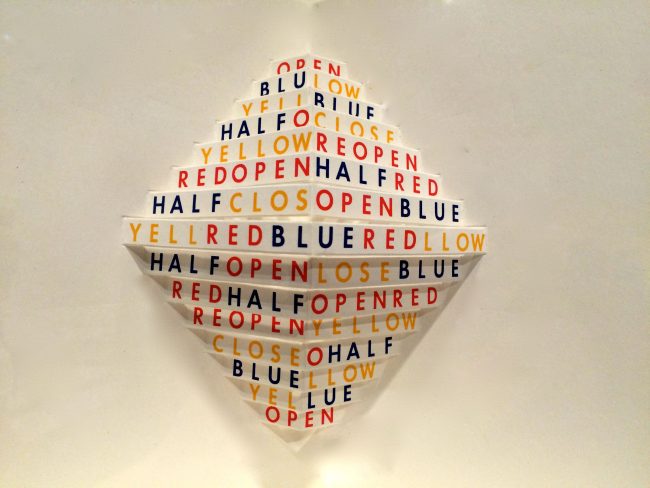
De Campos and Julio Plaza (Spain) developed Poemobiles, which were pop-up objects presenting an interplay of words in three dimensions. Several are featured, including “Open” or “Abre,” which is presented in both English and Portuguese versions.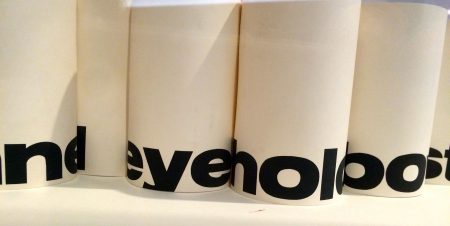
Not all concrete poetry can be read aloud without losing some of its effect (such as the Luxo/lixo pairings). However, the Getty exhibit does include audio presentations of several of the poems.
Finlay’s pieces are collaborations with graphic designers to make printed pieces that creatively used poems, color and typography. He reinvented his work using different formats and font settings. For example, “4 Sails (1966)”is uses bright paper folded to evoke boat sails. The four lines of the work read:” roSY fAr blacK / patcheD BroKen fAded / lucKY fULI / GreeN FainteR LoatH.” The capital letters used refer to registration letters from Scottish ports (e.g., “A” for Aberdeen).
The “Concrete Poetry: Words and Sounds in Graphic Space” exhibit runs through July 30, 2017. It may not appeal to patrons who favor the more traditional art displayed elsewhere in the vast Getty Center. However, the GRI display of the art form could attract some new visitors. It definitely illustrated the opportunities for unusual exhibits encompassed in the 900,000 books, periodicals, and auction catalogues in their rich collection.
By Dyanne Weiss
Sources:
Exhibition visit March 27, 2017
Getty: Getty Research Institute Presents Concrete Poetry: Words and Sounds in Graphic Space
Poetry Foundation Glossary: Concrete poetry
Academy of American Poets: A Brief Guide to Concrete Poetry
Photos by Dyanne Weiss of “Open” by Augusto de Campos and Julio Plaza (top) and “Earthship” by Ian Hamilton Finley (inset).
Discover more from Guardian Liberty Voice
Subscribe to get the latest posts sent to your email.