



Michelangelo’s “Bacchus” sculpture is a testament to the artist’s genius. It is a masterwork of symmetry and balance that transcends the classical Greek style. No sculpture existed like this before, and it remains unmatched.
The statue represented “Bacchus” as a drunk young god staggering and struggling to hold the cup straight while a little faun sitting on a log eating the grapes is on the left. Michelangelo’s dynamic work expressed an intricate relationship between the Greek God of Wine and the faun, giving a sense of wavering and fragility of a drunk’s typical movement.
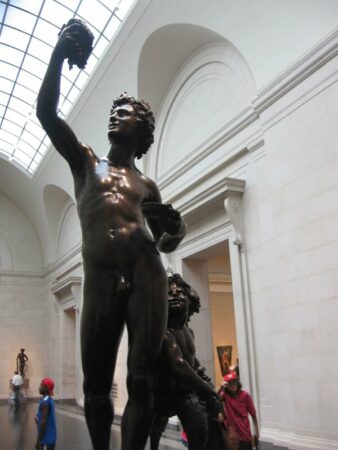
The passion, discreet but evident, exudes from it is one of the distinct attributes of Michelangelo’s work. His work exemplifies a mixture of physical realism, psychological insight, and intensity never before known, making him one of the Renaissance’s greatest artists. Drunkenness was never typified with such accuracy.
While many people believe that the accumulation of rare items will eventually be worthwhile and yield financial security, some collectors want prestige and recognition. Every collector item has a unique story, but every individual collector of Michelangelo’s “Bacchus” has nostalgic reasons for their hobby.
Michelangelo’s “Bacchus” is the creation of a visionary artist. It was completed in 1497. The history and practice of sculpture have an intricate variety that stands apart from other visual-art forms.
Since sculptures are three-dimensional pieces of art, they can bring a person closer to the humanity of the object depicted. In the case of the “Bacchus,” walking around the Greek God of Wine can elicit a myriad of emotions. The faun’s admiration for the god is as tangible as the longing in Bacchus’ eyes gazing at the cup in his right hand.
In sculpture, a single unique object can be reproduced in a limited, numbered edition of identical multiples. The fabrication and editioning of a sculpture include bronze casting and other materials, but it could also include three-dimensional printing and rapid prototyping. Each object is numbered and goes with a certificate of authenticity.
The appeal of Michelangelo’s “Bacchus” may be more in its humanness than its divinity, making it a desirable high-end limited edition collectible that will bring value and enjoyment for many years to come. It will be a true family heirloom.
Written by Janet Grace Ortigas
Edited by Cathy Milne-Ware
Sources:
Totally History: Bacchus
Investopedia: Contemplating Collectible Investments; by Andrew Beattie
Featured and Top Image Courtesy of Tim Ellis’s Flickr Page – Creative Commons License
Inset Image Courtesy of A.Currell’s Flickr Page – Creative Commons License
Discover more from Guardian Liberty Voice
Subscribe to get the latest posts sent to your email.
12 Responses
I do not even know how I ended up here, but I thought this post was great. I do not know who you are but definitely you’re going to a famous blogger if you aren’t already 😉 Cheers!
After examine a number of of the weblog posts in your website now, and I truly like your means of blogging. I bookmarked it to my bookmark website listing and shall be checking again soon. Pls check out my site as well and let me know what you think.
Hello there! This is my first visit to your blog! We are a team of volunteers and starting a new initiative in a community in the same niche. Your blog provided us valuable information to work on. You have done a outstanding job!
Great wordpress blog here.. It’s hard to find quality writing like yours these days. I really appreciate people like you! take care
If some one needs expert view concerning blogging afterward i
propose him/her to visit this webpage, Keep up the good job.
I think the admin of this web site is in fact working hard in favor of
his site, as here every data is quality based stuff.
It’s really a cool and useful piece of info. I am satisfied that you
just shared this useful information with us.
Please stay us informed like this. Thank you for sharing.
Hey there! This post could not be written any better! Reading through this post reminds me
of my good old room mate! He always kept chatting about this.
I will forward this page to him. Fairly certain he will have a good
read. Thanks for sharing!
Write more, thats all I have to say. Literally, it
seems as though you relied on the video to make your point.
You obviously know what youre talking about,
why waste your intelligence on just posting videos
to your site when you could be giving us something
informative to read?
Does your website have a contact page? I’m having trouble locating it but, I’d like to shoot you an email.
I’ve got some suggestions for your blog you might be interested in hearing.
Either way, great site and I look forward to seeing it develop
over time.
Hey there! I just wanted to ask if you ever have any problems with hackers? My last blog (wordpress) was hacked and I ended up losing a few months of hard work due to no back up. Do you have any methods to stop hackers?
I am regular reader, how are you everybody? This post posted at this website
is actually fastidious.