

Plays about news events often feel dated decades later. “Twilight: Los Angeles, 1992,” which returned to the Center Theatre Group’s Mark Taper Forum, is a powerful, arresting show that explores the racial tensions then that exploded into the Los Angeles riots. One cannot help but wish it did not resonate or feel still relevant today, but it does not feel dated. It feels depressingly current.
“Twilight: Los Angeles, 1992” explores the racial tensions that exploded into the L.A. Riots and their impact. The ending was changed to include references to George Floyd, Black Lives Matter, and contemporary issues. However, one doubts that anyone watching the play up till then is not already thinking about recent news items too.
Anna Deavere Smith drafted the play after interviewing over 300 police, jurors, shopkeepers, witnesses, politicians, activists, and others in the community to about the uprising. It was sparked by the acquittal of the officers charged with police brutality in Rodney King’s March 31, 1991. beating during a traffic stop. Before the advent of video cameras in everyone’s pockets, a bystander who had a camcorder captured footage of LAPD officers savagely beating a Black man, King, with a baton 56 times and kicking him repeatedly. Four officers were charged in the beating and acquitted on April 29, 1992.
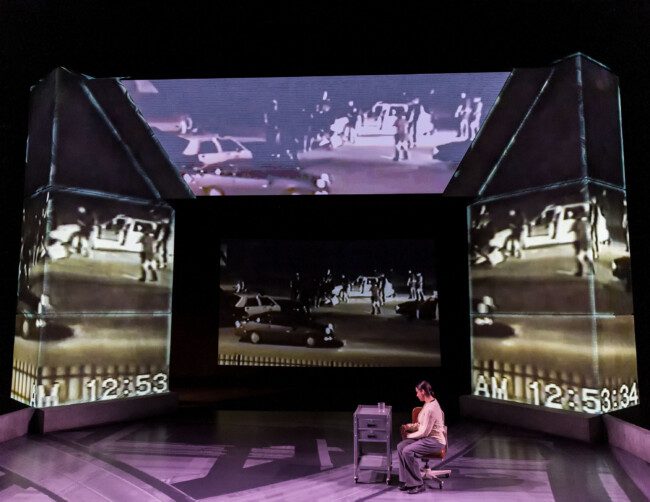
Smith uses the videos of the King beating and two subsequent shocking attacks during the riots during the play to 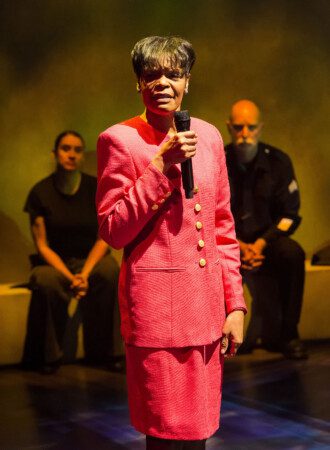 create awareness of the situations. Before and after, she uses words from the interviewees to tell their stories about the incidents. They describe institutional racism (before the 1990s, at the time of the riots, and sadly still today), police violence, judicial system issues, as well as socioeconomic inequalities that persist. There is no proselytizing, just a thought-provoking mosaic of perspectives now presented from a historical standpoint.
Shocking Footage
The most powerful moments in “Twilight: Los Angeles, 1992,” are the videos of three violent incidents, starting with King’s beating. When the King video came out, it was shocking. Now, everyone has seen other footage of police brutality in recent years. However, this almost 90-second heart of the video was the first widely viewed.
The King footage is not the only video shown in the play. They show a surveillance film from a Korean-American-owned convenience store of Latasha Harlins, a 15-year-old Black girl, being shot by Soon Ja Du, the store owner, who thought she was stealing. They also show raw footage of Reginald Denny, a white truck driver, being pulled from the vehicle by several Black men and viciously beaten. The footage continues until four Black witnesses risk their lives to help Denny escape. These videos have a tremendous impact and make the audience feel like witnesses too.
Return Engagement After 30 Years
Center Theatre Group originally commissioned “Twilight: Los Angeles, 1992,” in 1993 to explore the racial tensions then, and presents the work today. In 1993, it had a sold-out run, then moved east to New York and eventually Broadway, earning two Tony nominations. There have been other iterations and charges over the years, including a film version produced in partnership with PBS.
The biggest change in this revival is casting. In the original production, Smith herself embodied about 40 different characters. The new production, directed by Gregg T. Daniel, features a multi-cultural, five-actor cast who each play a vast spectrum of characters. The “Twilight: Los Angeles, 1992” revival features Hugo Armstrong, Lovensky Jean-Baptiste, Lisa Reneé Pitts, Jeanne Sakata, and Sabina Zúñiga Varela. They portray witnesses to the beatings of King and Dennis, Korean storeowners, a policeman charged in the beating, as well as key players like then police chief Daryl Gates and Rep. Maxine Waters. The diverse casting accentuates the differences and spaces between the characters culturally.
Pitts’ performance as several key Black politicians and activists (including Waters) is the most adept. While uneven, Sakata effectively conveys the Korean community’s suffering in the riots. As one character noted, Whites lived in the hills, the inner cities were Black and Brown, and the Asians lived and ran businesses in the “buffer zone” between. Accordingly, they suffered a considerable amount of damage to homes and businesses.
Armstrong and Jean-Baptiste morph adeptly between characters, usually shifting attire or posture to convey the transition between them. Varela is the only one not given a wide range of personas to explore.
Aftermath
Even with citywide curfews implemented, the violence lasted for several days. There were 58 deaths, nearly half of which were Black. More than 2,300 were injured, and 250 were critically wounded. Nearly 1,600 buildings were destroyed, and there was approximately $1 billion in damages. (Korean American-owned businesses were heavily affected). More than 12,000 were arrested.
The last part of the play has the actors coming together and talking about recent developments. While it adds length to an already long evening, the added content seems needed. “Twilight: Los Angeles 1992” would be missing an opportunity if it explores racial tensions and police violence then, without acknowledging the continued issues today. “Twilight: Los Angeles, 1992” will be at the Mark Taper Forum in Los Angeles through April 9, 2023.
Written by Dyanne Weiss
Sources:
Performance March 22, 2023
Center Theatre Group
Los Angeles Times: ‘Twilight: Los Angeles, 1992’ raises the voices of the city once more, 30 years later
KCRW.com: Anna Deavere Smith revisits ‘social explosion’ of ‘92 uprising
Time.com: The Beating that Changed America: What Happened to Rodney King 25 Years Ago
Photos by Craig Schwartz Photography, courtesy Center Theatre Group: (top) Varela in front of Rodney King video, and (inset) Pitts as Waters in “Twilight: Los Angeles, 1992” at Center Theatre Group / Mark Taper Forum.
Discover more from Guardian Liberty Voice
Subscribe to get the latest posts sent to your email.