



A group of astronomers have recently witnessed the final stages of the cosmological demise of the largest star ever discovered. The enormous W26 star, which is currently in the process of tearing itself apart, may provide clues on planetary system formation.
The finding was made by an international body of scientists, working from the United States, the United Kingdom, Chile and Germany, and represents a crucial opportunity to understand the means by which massive stars recycle enriched material back to the interstellar gas cloud, thereby providing the necessary ingredients for formation of rocky planets and biological life.
The findings, which will be published in the journal Monthly Notices of the Royal Astronomical Society, reveal the star Westerlund 1-26 (a.k.a. W1-26 or W26) casting off its layers.
Westerlund 1-26 is classified as a red supergiant star, located at the fringes of the Westerlund 1 cluster, with a size ranging between 1,500 and 2,500 solar radii. It is estimated to be around an astonishing 1,500 times bigger than the Sun.
The Demise of Massive Stars
Massive stars, that are tens of times the larger than the Sun, often endure for very short periods. Similar to medium-sized stars, massive stars commence life burning through
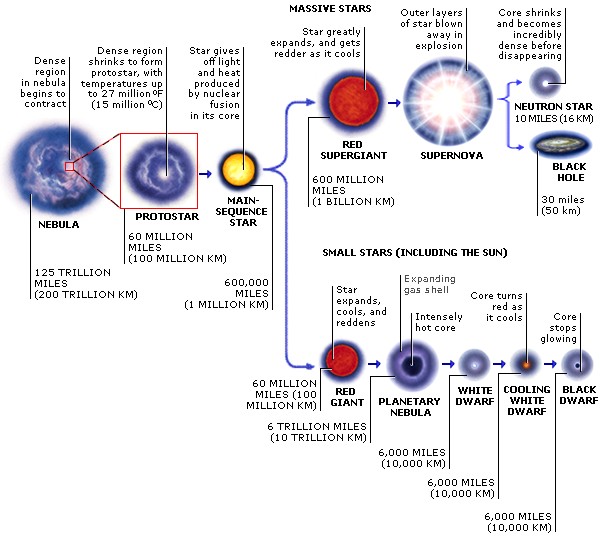
hydrogen at their centers, before continuing with a hydrogen burning shell and a helium burning center. Whilst burning through helium, stars with particularly high masses (over nine solar masses) begin to enlarge and form red supergiants. After this fuel source has been expended within the core, the star then fuses much heavier elements.
The core of a massive star begins to contract, allowing carbon burning. Fusion proceeds along successive shells within the star, with each individual shell fusing different elements. Ultimately, at the end of its life cycle, the star produces and accumulates inert iron at its core.
These massive stars have much shorter lifetimes, typically less than a few million years of activity, before all of their nuclear fuel dwindles. In spectacular fashion, they eventually explode as supernovae, burning like a beacon in space.
Whilst in the final throws of its flailing life, these stars become incredibly volatile and unstable, ejecting large amounts of enriched material. The material is contained within the outer envelopes, and becomes enriched by reactions deep within the heart of the star.
A number of elements critical to formation of planets, such as Earth, are released into the universe, including magnesium and silicon. During a recent press release, the group explain the uncertainty that surrounds these processes:
“How this material is ejected and how this affects the evolution of the star is however still a mystery.”
Glowing Hydrogen Gas Clouds
The team employed the Very Large Telescope Survey Telescope (VST), based at the Paranal Observatory of the Atacama Desert in northern Chile, to detect ionized hydrogen within interstellar gas clouds. Specifically, they used the VST Photometric H-Alpha Survey (VPHAS) and FOcal Reducer and low dispersion Spectrograph (FORS), between 2011 and 2012, to scour the galaxy for ejected material, thought offer astronomers vital clues about the origins and formation of planetary systems.
When directing their attentions to Westerlund 1, they stumbled across an unexpected discovery. Westerlund 1 is a dense cluster of hundreds of thousands of stars, some 16,000 light years from Earth, in the Ara constellation. Around W26, researchers were able to detect an enormous cloud of “glowing hydrogen gas.” Images taken by VST portray these gas clouds in green, resulting from hydrogen gas atoms having been stripped of their electrons. These clouds are a rarity around red supergiants, like W26.

According to astronomers of the Royal Astronomical Society (RAS), W26 would be far too cool to cause these ionized clouds to glow. On this basis, they theorize the source of the radiation to be from much hotter blue stars, located in other positions around the cluster; likewise, a companion star might also be responsible for this phenomenon, which the researchers discussed within their journal:
“They may be being photoionized by either a hot companion to W26, the nearby BSG W25, the cluster radiation field, or even shock excited due to collisions with the intra-cluster medium.”
It is believed that further study of the enormous star could provide important information on the “mass loss processes,” which will ultimately result in W26’s explosive passing. According to the RAS, the red supergiant is highly evolved, and is likely heading towards the final stages of its life, before going supernova. The international team of astronomers believe, in understanding precisely how the star is tearing itself apart, clues on planetary system formation are yet to come.
By: James Fenner
Royal Astronomical Society Journal
Astronomy & Astrophysics Journal
Royal Museums Greenwich Website
Discover more from Guardian Liberty Voice
Subscribe to get the latest posts sent to your email.