


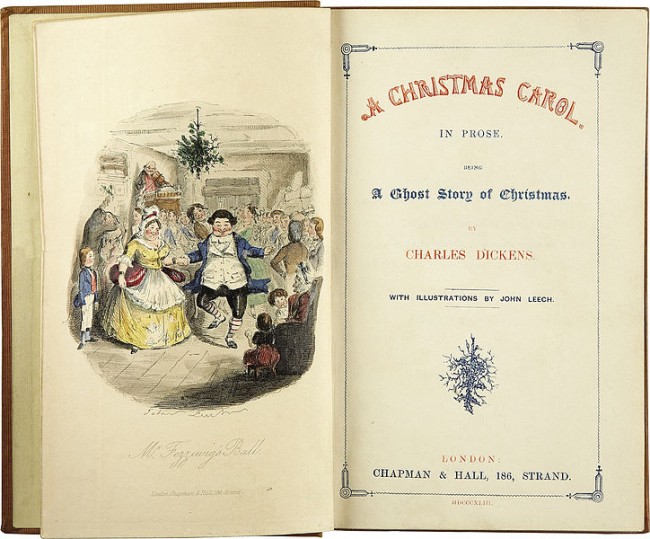
 Charles Dickens’ A Christmas Carol is about a crotchety, stingy old man named Ebenezer Scrooge who is visited by spirits trying to save him from his “humbug” attitude of Christmas. His bitterness is evident ranging from the way he treats his underpaid clerk, Bob Cratchit, to his dismissal of the poor. The spirits succeed in changing this insensitive miser to a generous and thoughtful person who knows “how to keep Christmas well.” In real life, it was the story of Scrooge who saved Dickens.

His father was released from prison after declaring bankruptcy and used an inheritance to pay off his remaining debts. He also got a job as a journalist with the British Press. The family was getting back on their feet and young Dickens returned to school. The newspaper failed in 1827 and, at the age of 15, Dickens dropped out of school again to help support the family. This time, he became an apprentice clerk in a law office. He found the legal system self-serving and hypocritical, and remained committed to the distinction between law and justice.
Before Dickens wrote A Christmas Carol, he had already published several novels, short stories and other writings. The themes of poverty and abandonment were especially evident in Oliver Twist (1838). The book exposed orphanages, workhouses and other conditions of the poor in London, making those subjects impossible for people to ignore. After novels like The Life and Adventures of Nicholas Nickleby (1839) and The Old Curiosity Shop (1841), he was considered a celebrity and outspoken against the injustices of the poor.
He had been on a successful, five-month lecture tour in the United States, but the books he wrote after he returned to England did not generate the interest or sales of his previous ones. His publisher, Chapman and Hall, had advanced him money and reminded him of a new clause in his contract that allowed for a reduction in salary based on slow sales to pay back his debt.

Dickens had an idea for a Christmas story that would be a ghost story. It would include his feelings of abandonment he’d first experienced in the factory, the grime and greed that were part of England’s Industrial Age, the poverty and hunger of those less fortunate — especially children and his own merriment of Christmas. Ebenezer Scrooge shows his contempt for the poor in statements like, “Are there no prisons? Are there no workhouses?” Bob Cratchit hardly has any money but has a loving family. Tiny Tim, Cratchit’s crippled little boy, always sees the good in everyone by saying, “God bless us, everyone.”
During the six weeks it took for Dickens to write it, he would take long walks through the London streets observing all classes of people. His publisher, Chapman and Hall, refused to publish it with their own money. The author borrowed the money from friends and paid his publisher to print it. He was taking a risk both financially and professionally. Christmas was not a favorable holiday in 1843. The Industrial Revolution had a harshness about it. Child labor resulted in many deaths in factories and unsafe working conditions existed for both children and adults. The celebration of Christmas was frowned on by Puritans due to pagan influences described in carols about wassail and yule logs.

Dickens had 6,000 copies printed at his own expense. Within four days, all 6,000 were sold. Not only did the story of Scrooge revive Christmas traditions in England but it also saved Dickens’ career and finances. Whether it is depicted in books, movies, TV specials or plays, A Christmas Carol has been a part of the Christmas season every year since 1843. The book has never been out of print since Dec. 17, 1843, when it was first published.
By Cynthia Collins
Sources:
Standiford, Les. The Man Who Invented Christmas. New York: Crown Publishers, 2008.
Dickens, Charles. A Christmas Carol. Complete text online of 1890 edition.
Top photo: Title page of A Christmas Carol by Charles Dickens, 1st edition, 1843.
Discover more from Guardian Liberty Voice
Subscribe to get the latest posts sent to your email.
2 Responses
Howdy would you mind letting me know which web host you’re utilizing? I’ve loaded your blog in 3 different web browsers and I must say this blog loads a lot quicker then most. Can you recommend a good web hosting provider at a honest price? Cheers, I appreciate it!
A Christmas Carol was my introduction to Dickens as a pre-teenager and I have been a devotee ever since,,, an educationally joyful experience, My first will always be my favorite – in fact Christmas doesn;t start for me unless I have watched one of my many versions (including the Muppets) with Little Dorrit and Bleak House following close behind. Thank you Mr Dickens.