


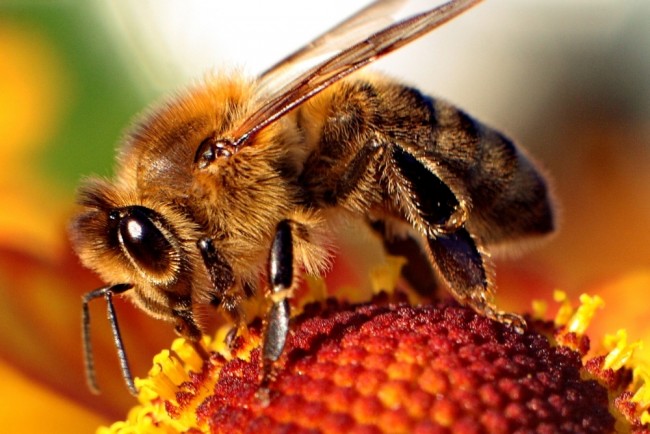
Bee health crisis warnings are growing as the condition known as “Colony Collapse Disorder” has started to spread from the domesticated honey bee population to the wild bumble bee population, threatening an essential link in the food pipeline. Since most fruits and vegetables are pollinated by bees, a catastrophic collapse in the bee population could presage serious food shortages around the world. Now, according to a report in the journal Nature, the blight that may be responsible for the bee health crisis is spreading into the bumble bee population, previously thought immune to be immune to the condition.
Bumble bees are responsible for pollinating 90 percent of the wild flowers that maintain the ecological balance in the woodlands. The collapse of the bumble bee population could have an even more devastating effect than a collapse in the domestic honey bee because domesticated varieties can be repopulated from uninfected stock. That opportunity does not exist in the wild bumble bee population.

First identified in 2006, colony collapse disorder signified a major increase in a long-known phenomenon known as “hive death” or “disappearing bee syndrome,” in which stable, productive hives died suddenly without obvious causes. The sudden increases in the number of hive deaths among honeybee populations means that the cost of producing fruits and vegetables that need bee pollination will increase due to shortage-driven higher hive rental fees. As the bee health crisis continues to grow, expect to feel the effects on your wallet at the checkout counter.
The economic effects of bee hive collapse are significant. In a paper published in Scientific Reports, study author Robbie Girling estimates that the economic value of pollination services are worth more than $200 billion annually. Seventy percent of the world’s food crops rely on bee pollination, including 90 different species of fruits and vegetables. Grains, in general, are wind-pollinated, and do not require bee pollination, but bees are nevertheless strongly attracted to the sweet-smelling corn pollen which exposes the bees to contamination from exposure to the systemic pesticides used on most corn crops. When the bees carry the tainted pollen back to their hives, they contaminate their own food stores.
It had been thought that changes in beekeeper practices might have been responsible for the bee health crisis but the spread of the hive death phenomenon to the wild bumble bee indicates that there are probably other environmental considerations. In a 2010 study, found traces of 121 different pesticides in the hives that were studied, indicating that both domesticated and wild bees are being exposed to high levels of contamination that also may help to explain the hive death phenomenon. Another suspect appears to bet the increasing concentration of diesel exhaust fumes, which appear to impair the bees olfactory equipment.

In addition to being an essential element in the food chain, bees are like the canaries that miners use to identify dangerous gases in their mines, because bees can be accurate predictors of environmental contamination, because of their sensitivity to pollution.
More important than the individual theories about the causes of hive death, it is becoming more and more apparent that the actual cause of the hive deaths could well be, “all of the above,” which would be very bad news, because multiple causes could be irreversible.
There is an apocryphal quote that is often attributed to Albert Einstein: “If the bee disappears from the surface of the earth, man would have no more than four years to live.” Einstein never said that, but that does not mean it is not true. The honey bee health crisis spreading to the bumblebee might be the most important human health crisis of this century….but all is not lost. In 2011, Atlantic Monthly reported on efforts to design an artificial bee that could communicate with real bees by emulating their complex dancing patterns. In 2013, Scientific American reported on the development of robotic bee that could pollinate domestic crops. The bee crisis might, in fact, be ameliorated by robotic honey bees, but one thing is certain: they won’t be producing any robotic honey.
By Alan Milner
Sources:
Nature
Christian Science Monitor
Los Angeles Times
New York Times
Quote Investigator
Discover more from Guardian Liberty Voice
Subscribe to get the latest posts sent to your email.
2 Responses
I’m so happy to read this. This is the type of manual that needs to be given and not the random misinformation that’s at the other blogs. Appreciate your sharing this best doc.
Hey there just wanted to give you a quick heads up and let you knowa few of the images aren’t loading properly.I’m not sure why but I think its a linking issue. I’ve tried it in twodifferent browsers and both show the same outcome.