


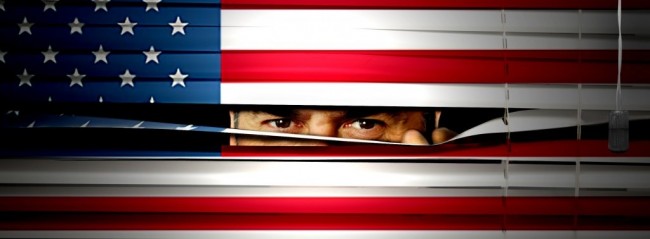
Although members of the government are sloughing off the revelation of infringements on the nation’s privacy, private citizens are furious. And, it all started with the Patriot Act, which began the end of one of our most precious Constitutional rights, the right to privacy.
The illegal tapping of our phones in the case of Verizon, and now the more egregious snooping into the social media companies, is unacceptable. It is so outrageous that the few members of Congress who were aware of “PRISM,” were sworn to secrecy. The government says it’s because they didn’t want to make possible terrorists aware of the program. But, the truth is, they didn’t want to make the American public mindful that their own government was spying on them. And, the information they gather can be used to influence the nation’s citizens in a variety of ways, from proposed legislation to political issues.
None of this would have been allowed without the passage of the Patriot Act.
The origin of the Patriot Act was a result of the attacks on 9/11/2001. George W. Bush signed the measure into law on October 26, 2001. Patriot Act is actually an acronym. “Providing Appropriate Tools Required (to) Intercept (and) Obstruct Terrorism Act of 2001.”
The acronym is as vague as the actual law is permissive. Legal organizations have stretched the words of the provision to their ultimate limits. The only reason Congress acted so quickly to pass the provision was because the Bush Administration took advantage of a cowardly attack on our shores, and created a culture of fear instead of confidence for our safety and the prevention of another attack. The easiest way to control humanity is through fear tactics.
What were the initial intentions of the act? It was intended to significantly weakene restrictions on law enforcement agencies’ gathering of intelligence within the United States; expande the Secretary of the Treasury’s authority to regulate financial transactions, particularly those involving foreign individuals and entities; and broadene the discretion of law enforcement and immigration authorities in detaining and deporting immigrants suspected of terrorism-related acts. The act also expanded the definition of terrorism to include domestic terrorism, thus enlarging the number of activities to which the USA PATRIOT Act’s expanded law enforcement powers can be applied.
From its very inception it had critics. Civil rights and human rights organizations immediately saw situations where the law could be used in manners not intended by those who penned it.
Opponents of the law have criticized its authorization of indefinite detentions of immigrants; searches through which law enforcement officers search a home or business without the owner’s or the occupant’s permission or knowledge; the expanded use of National Security Letters, which allows the Federal Bureau of Investigation (FBI) to search telephone, e-mail, and financial records without a court order, and the expanded access of law enforcement agencies to business records, including library and financial records. Since its passage, several legal challenges have been brought against the act, and Federal courts have ruled that a number of provisions are unconstitutional.
Much of the original bill was supposed to expire in 2005, but Bush decided he wanted to maintain control and urged Congress to re-approve it. It was no more than a ‘rubber stamp’ vote. On May 26, 2011, President Obama signed another extension, which he promised not to do.
All agencies of federal, state, and local law enforcement have used interpretations of the act’s wording to invade the privacy of personal information and action. The FBI has been known to even check library records.
No one in the Congress of the United States was intelligent enough to see into the near future and be aware that provisions in the Patriot Act would allow the government to legally use electronic surveillance to invade the lives of American citizens.
George W. Bush once said about terrorists, and, eventually the nations who opposed the invasion of Iraq, “they hate us for our freedom.” I ask simply, ‘what freedom?’ Our most sacred right is slowly being taken away.
The Patriot Act was the end of privacy. And, yes, “big brother is watching.” And he’s not Santa Claus.
James Turnage
The Guardian Express
Discover more from Guardian Liberty Voice
Subscribe to get the latest posts sent to your email.
9 Responses
Hi, Neat post. There is an issue together with your website in internet explorer, could test this… IE nonetheless is the market chief and a big section of other people will omit your magnificent writing because of this problem.
In this my nation I love very much, the populace is nothing but “sheeps” they folllow their leadership because the “smarts” have them by the cojones using FEAR. Baaa,baa aaaabaaaaaabaaaaaaaa.Stupids, the Patriot Act is nothin but a sham
You can say what you want Billy Bob. There is plenty of precedent for the Right to Privacy in the Supreme Court. But more importantly is that the PRISM system and much of the so called “Patriot” Act, violates the 4th Amendment to the Constitution of the United States, which for those who forgot or never read it states “…The right of the people to be secure in their persons, houses, papers, and effects, against unreasonable searches and seizures, shall not be violated, and no warrants shall issue, but upon probable cause, supported by oath or affirmation, and particularly describing the place to be searched, and the persons or things to be seized. …” Our personal information, i.e. our “effects” are not to be rummaged through without some probable cause.
Beyond that, most people of truly or once truly free nations understand what the term “right to privacy” means and it is expected from a nation that claims in very national anthem to be the home of the brave and the land of the free. We are not the land of the cowards who will sacrifice freedom for a little false security at the hands of a state intent on breaking down those freedoms through scare tactics. I believe these truths are self evident.
“No one in congress…” Not true. There was one, but everyone called him crazy.
http://youtu.be/OBSqtGX-alc
PATRIOT Act is actually a “backronym,” an acronym that was chosen first, with the words to stand for the letters chosen later. And an extremely Orwellian backronym, at that.
I can’t believe we stood for this garbage. There was just not outrage from the supposed constitutionalists when Bush the Lesser was in office. Wonder why.
There is no direct expression of a right to privacy in the US Constituion or Bill of Rights.
There are existing Laws such as the illegality of opening sealed packages (including mail) that is sent through the US Postal Service. But since electronic communications do not filter through the USPS – they are not subject to the standing laws.
That is a failure on the wording of the Law. And they should not be itemized to include or exclude the different methods of communication. Communcation itself is what needs to be protected under the USPS Laws.
IF I send a package through the US Mail – it cannot be legally opened except by the recipient or a Federal Warrant (maybe various other methods – this covers the basics). But if I send the same package though FedEx or UPS or DHL – then it again is not protected under the standing Laws.
That makes zero sense.
But do not fool yourself – there is no Constituional Right to Privacy.
They are not listening to conversations, or like you refer to opening mail. they are tracking it like UPs or the USPS would do to see where it goes to and how long it takes to get there, our privacy is not invaded by this.
@ billy bob – This is what the 4th Amendment says: “The right of the people to be secure in their persons, houses, papers, and effects, against unreasonable searches and seizures, shall not be violated, and no Warrants shall issue, but upon probable cause, supported by Oath or affirmation, and particularly describing the place to be searched, and the persons or things to be seized.”
US Constitution:
Amendment IV
The right of the people to be secure in their persons, houses, papers, and effects, against unreasonable searches and seizures, shall not be violated, and no warrants shall issue, but upon probable cause, supported by oath or affirmation, and particularly describing the place to be searched, and the persons or things to be seized.