


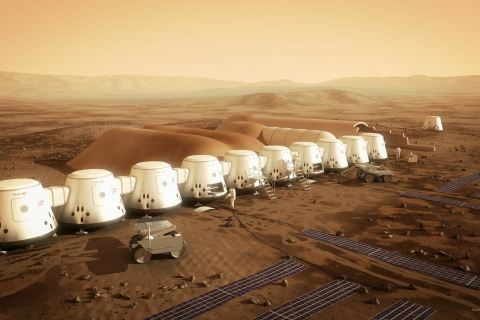
The Mars One Foundation, an ambitious non-profit that plans to colonize the red planet has 30,000 volunteers who have finished the application requirements. They have many other applicants still in the process of enrolling; but those few that will be chosen for the missions should be aware of a significant catch: It is a one way trip.
The foundation plans to put its first group of 4 astronauts on the red planet on 2023. They will first have to pass a training program lasting several years, teaching them everything from first aid, to how to grow food and obtain water and air. A big emphasis of the training is dealing with the isolation of living in a remote location.
The profiles of the aspiring astronauts can be seen at the foundation’s website. Looking at some of them one wonders just how serious some of the applicants are, for example, there is a video of a Japanese man who chose to wear a bald cap for his profile, which one might call an “interesting” choice to say the least. He goes on to say that he wants to build a home for his favorite TV actress on Mars.
Applicants do have to pay a small fee to be considered for the missions; but it is nominal. The Mars One Foundation expects the $6 billion tab to be paid by sponsors, and by media that wants access to footage of the colonization of the red planet.
The teams of four people will begin training each year, starting in 2015, in facilities that will be similar to the installations that will be used for colonization. In 2016, the foundation plans to launch a lander as a trial run in advance of the manned missions, as well as a communications satellite to orbit Mars, so the astronauts can communicate with Earth. On 2018 a rover with a trailer will be sent to Mars in order to identify a site with the best conditions for the settlement. The trailer is for moving the landers to the colony area, as the capsules will be used for living space. On that same year, a second satellite will be launched, this time on Earth’s orbit around the sun to ensure that communications are not compromised when the star is between the two planets.
The first initial installations will be launched in July of 2020, and land on Mars in February of 2021, so the rover can set them up ahead of the manned missions. The objective of the installations is not terraforming, making the entire planet habitable; but creating an indoor environment that is livable. The rover will have to cover some of the facilities with soil because of cosmic radiation concerns. Water will be extracted from the ice in the ground, and a breathable atmosphere should be present in the facilities ahead of the arrival of the astronauts. In September of 2022, Mars One expects the first manned mission to be launched. Time travel is expected to be 210 days.
Critics have said the objective of the Mars One Foundation is too dangerous to attempt. NASA is exploring the possibility of short term missions to Mars, and The Inspiration Mars Foundation is also planning to launch a spacecraft toward the red planet, although their trip does not include landing there. So far Mars One is the only organization hoping to colonize; but the questions do still stand, can they pay for the astronomical price of the missions, and if so, even with financial backing, is such a far-reaching undertaking really possible with our current technology?
By Milton Ruiz
Discover more from Guardian Liberty Voice
Subscribe to get the latest posts sent to your email.
11 Responses
I concur that the concept seems lofty now, but given the exponential advancement sin technologies over the past 20 years I feel that it is likely possible. The most likely failure of this project is not due to technical limitations, but the financial follow through, available creative pools, and the universal propensity to see an immediate return on investments. Bill & Malinda Gates (and other philanthropists) do not care about interplanetary colonization, our market economies oft squander original ideas that form the blinding edge of future technologies, and no one either investing in the project or reading this article now will recall this discredited story in 10 days let alone 10 years.
The only way for this project to work is to make small milestones.
Build a rover…Put up a commercial satellite… Build a colonization pod… Put one in space… Whether you follow God or Science, the world was not built in a day. To speak of such radical accomplishment, and to put an expiration date on it is to doom it to failure. No to mention the waste all of the allocated resources.
Sounds like all faggots are going to Mars. The gay red planet with Obama
Unfortunately, I’ve arranged for my cremation, which will anytime. Maybe, if the timing is right, “they” could take my ashes to Mars. I could enrich the soil there so that others, should they be so lucky, could harvest a food supply.
Moon population~3 people …MAYBE in 50-60 years,
Mars population ~3 people …(it’s about 100-200 times harder, so…) m-a-y-b-e in 150-200 years.
p.s. Until we can put (regularly) satellites ~300-400t to the Synchronous orbit… it is too early to talk about this “thinks” (colonization of space by humans) (period)
-VladimirJosephStephanOrlovsky
Why not try to colonize Antarctica first?
I would do it. And yes, I would gladly sweep the red dust off the solar panels.
Just makes you wonder whats really going on here. See the bigger picture folks.
I wonder who is going to do the daily sweep of red dust from the miles of solar panels. Memo to file. Pack a big broom. I’m happy to have contributed in a small way to this lunatic mission. I think maybe pack up a batch of death row inmates and ship them up. Kill two birds with one stone, so to speak.
I love the statement “is such a far-reaching undertaking really possible with our current technology?” The arrival is scheduled for Sept 2022, how is that going to be “current” technology. Have a little vision!
Hi, I am the author of the article. I thank you for reading it. Here’s my point in writing that sentence: When you are planning such a difficult project, that is going to take $6 billion dollars to accomplish, you should not be hoping that some magical technology will be invented in the next ten years that will allow you to accomplish it, and NASA does not even dare to dream that big, you know, the guys that first put astronauts on the moon.
Also, the launch is scheduled for September 2022, and the landing on Mars is scheduled for 2023, the effects on a person’s health from being in space for the rest of their natural lives have never been examined. Cosmic radiation is a big concern, amongst others, such as the effects of zero gravity on the human body during the trip, and the fact that if anything goes catastrophycally wrong, you might be 210 days away from help, in some scenarios.