



According to astronomers from Ohio State University, within the next 50 years the chances are practically 100 percent that the Milky Way will be lit up by a spectacular supernova that will be visible from Earth using infrared radiation-detecting telescopes. Who needs Nostradamus, when gravitational wave detectors and neutrino detectors are around to let us know when a supernova occurs?
If everything goes according to plan, and the world is not underwater due to excessive global warming, and it’s not destroyed by something like a comet or an asteroid, 50 years from now astronomers will be able to see from the very beginning the demise of a star when it goes supernova.
What are supernovae?
When a star dies, and the energy charging it at is core gets depleted, it explodes, and blasts into smithereens. That is the technical definition of what a supernova is. In other words, supernovae result when stars explode in their dying moments.
While scientists know that, according to Ohio State Professor of Astronomy Christopher Kochanek, “stars go supernova in other galaxies,” he adds “we don’t fully understand how it happens.”
By being able to use tools we have to detect supernova within our own galaxy, namely, gravitational wave detectors and neutrino detectors, like Japan’s Super-Kamiokande (Super-K) neutrino detector, Kochanek says that we have an excellent chance to “catch the next one in our galaxy and study it.”
The neutrino detector in Japan will be able to measure the neutrinos released when the star within the Milky Way goes supernova. Neutrinos are particles released from a dying star’s core.
While Kochanek and his fellow researchers are practically 100 percent certain that astronomers will get the opportunity to view a supernova within the next 50 years, there’s only around a 20 percent chance that people on Earth will be able to see it without the aid of telescopes. If you reside in the Southern Hemisphere, those chances rise to 50 percent. 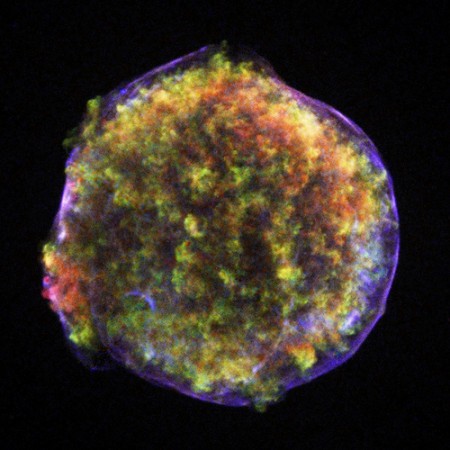
Getting the chance to see a star go supernova in the Milky Way will reveal a lot of information about what happens in such cases, and some prevailing theories about what happens might be proven to be wrong.
According to Ohio State doctoral student Scott Adams, a supernova within our own galaxy “happens only once or twice a century.” The gravitational wave detectors and neutrino detectors astronomers currently have are only able to measure neutrinos released within our own galaxy.
Super-sensitive neutrino detectors such as the one in Japan or EGADS (a new gadolinium-infused one), upon detecting neutrinos, will issue alerts. They will even tell astronomers which direction the neutrinos are coming from.
By detecting these neutrinos, scientists will have a method of knowing that a star has gone supernova days or possibly even as much as months before the event can be detected by using infrared cameras, and they will also be able to locate where the supernova happened immediately, before it can be seen.
The research about the almost 100 percent chance of a supernova occurring in the Milky Way galaxy within the next 50 years is in The Astrophysical Journal.
Detecting the neutrinos released by the dying star which goes supernova will enable scientists to locate exactly where the event takes place. Eat your heart out, Nostradamus.
Written by: Douglas Cobb
NatureWorldNews.com
HNGN.com
UPI.com
The Astrophysical Journal
Discover more from Guardian Liberty Voice
Subscribe to get the latest posts sent to your email.
3 Responses
http://www.bethlehemstar.net
Al I can say about that, as I’m not an expert in the matter, is that each of the three sources I used mentioned something about detecting neutrinos within our own galaxy.
“The neutrino detectors astronomers currently have are only able to measure neutrinos released within our own galaxy.”
What about supernova 1987a?
From http://en.wikipedia.org/wiki/SN_1987A#Neutrino_emissions
SN 1987A was a supernova in the outskirts of the Tarantula Nebula in the Large Magellanic Cloud. That’s not in OUR OWN GALAXY
Approximately two to three hours before the visible light from SN 1987A reached the Earth, a burst of neutrinos was observed at three separate neutrino observatories. This is likely due to neutrino emission (which occurs simultaneously with core collapse) preceding the emission of visible light (which occurs only after the shock wave reaches the stellar surface).