


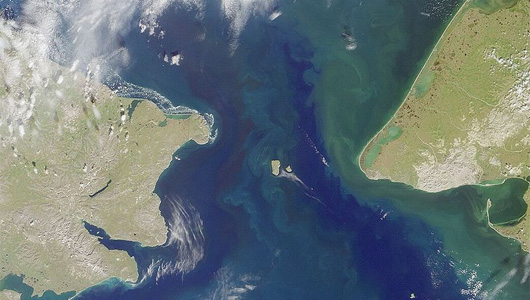
The Bering land bridge linked Alaska and Siberia during the last glacial period approximately 25,000 years ago. When the sea levels dropped by as much as 400 feet, the great expanse of land became navigable by foot. At its largest, the bridge measured as much as 1,000 miles north to south and possibly 3,000 miles wide. The Beringia land bridge was previously thought to be only a passageway for the Native American ancestors; it now appears that it may have been home for them for about 10,000 years.
While it has been proven by genetic evidence that the ancestors of the Native Americans traversed the land bridge across the Bering Sea, it appears that they did not reach the New World until about 15,000 years ago. Between the time they appear to have begun their migration and the time they actually arrived, scientists and archeologists have been hard pressed to determine their whereabouts for 10,000 years. The theory presented that they lived on Beringia for those 10,000 years would fill in the missing information.
New evidence suggests that the Beringia Bridge was home to these ancestors. Until recently, the environment of the Bering land bridge was thought to be nothing other than a steppe-tundra. A steppe-tundra is an almost treeless, cold, dry climate which was not very hospitable to life. However, sediment cores taken from the submerged area produced both plant and insect materials.
The pollen and material obtained from the core samples indicate that there may have been a patchwork of different environments and not just barren land. There may have been significant amounts of shrubbery as well as several types of trees. The land bridge was perhaps not only a viable ecosystem but a rich one, as well. The area may have been home to a wide variety of animals including bison, moose, mammoths, birds, elks and even camels. Furthermore, the area may have had summer temperatures comparable to those of today.
The missing link is still the fact that anthropologists have not uncovered any archaeological evidence to support the theory of any lengthy human habitation on Beringia. There is no evidence found to date to indicate that the travelers stopped for any length of time, let alone 10,000 years, to live on what has been come to be known as Beringia. Anthropologist Dennis O’Rourke from the University of Utah admits that in order to confirm these theories, archaeological sites must be uncovered. This could be problematic for researchers as the areas under debate are also underwater.
Currently, no tools, fossils, or dwellings seem to have been left behind. No hard evidence has been found to support the theory that the human migration stopped and settled on the Bering land bridge for any significant length of time. There is no dispute that the Native American people came over the coast from Asia and through the corridor provided by the Bering land bridge. The topic under current controversy is whether or not the ancestors to the Native Americans stopped for about 10,000 years to make the Beringia Bridge their home.
By Dee Mueller
Sources
National Geographic
RedOrbit
Sci-News.com
Discover more from Guardian Liberty Voice
Subscribe to get the latest posts sent to your email.
One Response
Beringians probably had words for Elephant/Mammoth similar to other EURASIANS
Why are the words for ELEPHANT
so similar across EURASIA ??
Amharic (Horn of Africa)……. ZehONa (ዝሆን)
(Ethiopian) fits into the EURASIAN mosaic of lexemes.
Georgian ..Kartuli……………….. SP I’ LO (სპილო)
contains Semitic PIL as well as Slavic SLOn (Some linguists speculate that Kartulian languages are the foundation of Semitic, Ural-Altaic and Indo-European language families.)
Chinese …………………………..SeeAHNg (sδaŋ)
Hakka (south China) …………. SiONg (sδoŋ)
Latvian ……………………….. ZiLONus
Saami/Lapp …………………… SLONN
Tibetan………………………….. GLAN
Tocharian words for ELEPHANT “onKOLMo” & “onKOLaM” may have been
derived from Tibetan GLAN or from Slavic OKEL / KEL = TUSK.
Slavic (MANY languages!)….. SLON (слон)
Polish (Slavic variant) ………. S”u”ON (Słon)
Vietnamese …………………… CON voi
Mongol………………………….. ZaAN
Japanese ……………………….. ZOsAN
Laotian …………………………….SANg (Saŋ)
Thai ……………………………….CHANg (Čaŋ)
Roma(in Slovenia)…………… SLONO
Kalderaš………………woroSLANo, SLONo, ilifanto