

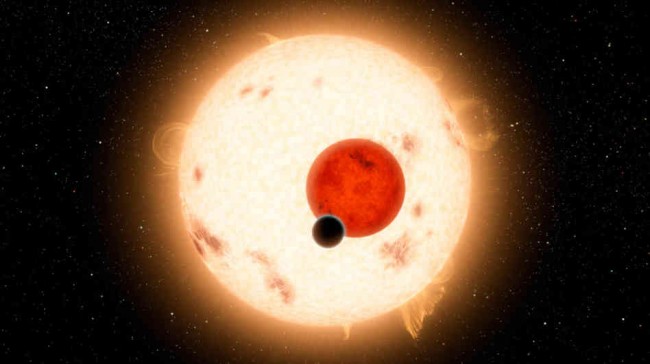
 The potentially life-supporting planet discovered by NASA’s Kepler Space Telescope last Tuesday may only be the first of many finds in NASA’s on-going search for habitable planets. The next steps in the search for distant life will be to look for Earth size planets orbiting at just the right distance from a star similar to our sun. Although they have not yet found a planet that fits all the criteria, NASA is on the lookout for an Earth-twin that could host human life.
For the time being Kepler -186f is the closest NASA has come to finding a planet enough like Earth to potentially sustain life. Life-sustaining planets are characterized by the presence of liquid water, and in order for a planet to contain liquid water, it must be orbiting its star at just the right distance to create a hospitable atmosphere, in what NASA’s Ames Research Center calls “the Goldilocks zone.”
While Kepler -186f happens to be orbiting at the right distance from its parent star, NASA has not yet been able to test the planet’s mass and composition. NASA research scientist Elisa Quintana explained that NASA searches for planets that mimic the characteristics of Earth and that “finding a habitable planet comparable to Earth’s size is a major step forward.” Despite the 500 light year distance between Earth and Kepler -186f, the discover is a great accomplishment for NASA and the first step towards finding a planet that is truly Earth-like.
Although NASA scientists have confirmed that the planet they discovered is potentially life supporting, it does not mean Kepler -186f is habitable. NASA research scientist Thomas Barclay suggested that Kepler -186f is more like Earth’s cousin, than its twin. It shares many properties that resemble those of Earth, but differs from Earth in many ways as well. So while KEPLER -186f is about the size of Earth, and it is orbiting within its star’s habitable zone, NASA researchers say there are likely dangerous amounts of radiation in its atmosphere.
Using the Kepler Space Telescope, NASA has discovered about two dozen planets so far that meet the Goldilocks criterion but this is the first one they have found to be Earth-sized. Small stars like Kepler -186f’s parent star live far longer than larger stars, providing more time for biological evolution to take place on orbiting planets. However, small stars tend to produce more solar flares and radiation, making planets within their habitable zones potentially hostile environments for human life.
The discovery of this potentially life-supporting planet may not change anything for the time being, but the journal Science has described it as “a landmark on the road to discovering habitable planets,” and NASA Astrophysics Division Director Paul Hertz says discoveries like these are essential to “continuing humankind’s quest to find truly Earth-like worlds.” The next steps in the search for distant life will be measuring the chemical composition of Earth-sized planets that are orbiting within the habitable zone of a sun-like star.
By Sandra Pugliese
Sources:
TheStarWorld
DailyNews
NASA
NASA
Discover more from Guardian Liberty Voice
Subscribe to get the latest posts sent to your email.
One Response
HAVING THE RIGHT CONDITIONS AND RAW MATERIALS FOR LIFE doesn’t mean that life can originate by chance.
Proteins can’t come into existence unless there’s life first! Miller, in his famous experiment in 1953, showed that individual amino acids (the building blocks of life) could come into existence by chance. But, it’s not enough just to have amino acids. The various amino acids that make-up life must link together in a precise sequence, just like the letters in a sentence, to form functioning protein molecules. If they’re not in the right sequence the protein molecules won’t work. It has never been shown that various amino acids can bind together into a sequence by chance to form protein molecules. Even the simplest cell is made up of many millions of various protein molecules.
The probability of just an average size protein molecule arising by chance is 10 to the 65th power. Mathematicians have said any event in the universe with odds of 10 to 50th power or greater is impossible! The late great British scientist Sir Frederick Hoyle calculated that the the odds of even the simplest cell coming into existence by chance is 10 to the 40,000th power! How large is this? Consider that the total number of atoms in our universe is 10 to the 82 power.
Also, what many don’t realize is that Miller had a laboratory apparatus that shielded and protected the individual amino acids the moment they were formed, otherwise the amino acids would have quickly disintegrated and been destroyed in the mix of random energy and forces involved in Miller’s experiment.
There is no innate chemical tendency for the various amino acids to bond with one another in a sequence. Any one amino acid can just as easily bond with any other. The only reason at all for why the various amino acids bond with one another in a precise sequence in the cells of our bodies is because they’re directed to do so by an already existing sequence of molecules found in our genetic code.
Of course, once you have a complete and living cell then the genetic code and biological machinery exist to direct the formation of more cells, but how could life or the cell have naturally originated when no directing code and mechanisms existed in nature? Read my Internet article: HOW FORENSIC SCIENCE REFUTES ATHEISM.
A partially evolved cell would quickly disintegrate under the effects of random forces of the environment, especially without the protection of a complete and fully functioning cell membrane. A partially evolved cell cannot wait millions of years for chance to make it complete and living! In fact, it couldn’t have even reached the partially evolved state.
Please read my popular Internet articles listed below:
ANY LIFE ON MARS CAME FROM EARTH,
SCIENCE AND THE ORIGIN OF LIFE,
NATURAL LIMITS OF EVOLUTION,
HOW FORENSIC SCIENCE REFUTES ATHEISM,
WAR AMONG EVOLUTIONISTS (2nd Edition),
NO HALF-EVOLVED DINOSAURS,
DOES GOD PARTICLE EXPLAIN UNIVERSE’S ORIGIN?
Visit my newest Internet site: THE SCIENCE SUPPORTING CREATION
Sincerely,
Babu G. Ranganathan*
(B.A. theology/biology)
Author of popular Internet article, TRADITIONAL DOCTRINE OF HELL EVOLVED FROM GREEK ROOTS
* I have had the privilege of being recognized in the 24th edition of Marquis “Who’s Who In The East” for my writings on religion and science, and I have given successful lectures (with question and answer time afterwards) defending creation from science before evolutionist science faculty and students at various colleges and universities.