

 Maundy Thursday, also called Holy Thursday, is the commemoration of Jesus Christ’s Last Supper with his Disciples before his arrest in the Garden of Gethsemane. It is the day before the crucifixion of Jesus, known as Good Friday, and three days before Easter. Over the centuries, numerous works of art have been inspired by Holy Week including paintings of the Last Supper as interpreted by Leonardo da Vinci and other artists.

Duccio is credited with being one of the founders of Western art. Even though his work resembled the traditional style of Byzantine art with gold backgrounds illuminating various religious scenes, he also added realistic human emotions. This figures took on human qualities of age, emotion and actions. His interpretation of the Last Supper shows the Disciples sitting around the table. As a result, some of their faces are not showing since their backs are to the viewer. Later painters experimented with various ways of placing all the Disciples on the same side of the table so their faces would be visible.

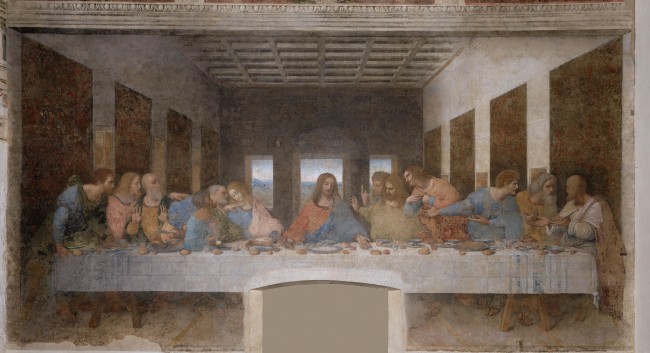
Leonardo da Vinci (1452-1519) painted his version of The Last Supper (shown above) approximately 15 years after Ghirlandaio’s fresco. Born in Vinci, Italy, he became an apprentice to the artist Verrocchio at the age of 14. He was commissioned by a member of the prominent de Medici family to make a silver lyre for Ludovico in Moro, the duke of Milan, as a peace gesture. Afterwards, he wrote a letter describing how his artistic ability and knowledge of engineering could be of assistance. As a result, the duke commissioned da Vinci to work on several projects from 1482 to 1499. One of those projects was the fresco, The Last Supper, which he began in 1495 and finished in 1498.
Both the Ghirlandaio and da Vinci paintings were frescoes commissioned for the refectory, or dining room, of a church. However, The Last Supper interpretation by da Vinci sets it apart from those of other artists in that it shows the Disciples actively talking, asking questions, appearing shocked at what Jesus had just told them that someone would betray him. Da Vinci used a new technique of applying paint to dry plaster instead of wet. This made the colors and images sharper but, over time, the paint started to peel.
Da Vinci’s painting is in the convent of the church of Santa Maria delle Grazie in Milan. This church was bombed extensively during World War II on August 15, 1943. The painting, however, was protected by sandbags. It incurred mold due to dampness but it was not destroyed. An extensive restoration of the work in 1999 eliminated layers of touch-ups while protecting the painting from additional damage. Santa Maria delle Grazie was named a UNESCO World Heritage Site in 1980.


Other artists have painted interpretations of Christ’s Last Supper with his Disciples. The ones mentioned in this article show how the most famous artistic depiction of the Last Supper came about and how its interpretation by da Vinci has and continues to inspire other artists.
By: Cynthia Collins
Sources:
Domenico Ghirlandaio Biography
Reformation and Iconoclasm
Peter Paul Rubens Biography
Discover more from Guardian Liberty Voice
Subscribe to get the latest posts sent to your email.
One Response
Please post more along these lines? It’s been very useful to people.