
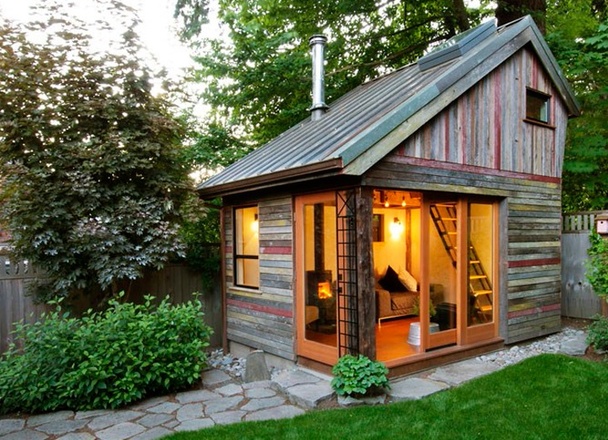
 The tiny home movement in the United States has been around since the 1970s, but it has never been quite able to work its way into the mainstream. In July, however, the debut of a television series called Tiny House Nation on FYI will mark its official entrance into living rooms across the nation. FYI, a division of A+E Networks, has slated ten one-hour episodes that will present to viewers “the best and most ingenious small spaces America has to offer.” In addition, one family per episode will be assisted by the show’s “expert host and team of tiny house builders” in building a home that is no larger than 300 square feet.
In the past, the tiny home movement signified an allegiance to various grassroots campaigns concerned with scaling back ecologically or financially, or both. But several factors have cropped up over the last thirty five years that have enlarged the movement’s scope and objectives, and the exigency of these factors has made tiny homes an increasingly a viable option for everyday people who are not necessarily card-carrying members of EarthFirst! or Sierra Club. For instance, the average square footage of single family homes continues to grow while the average size of families continues to decrease, making tiny homes a practical rather than alternative idea. More and more, tiny homes have become the focal point for several different burt related ideals. Those ideals include a rejection of the cycle of conspicuous consumption and debt, the realization of a raised social consciousness, a preference for a simplified life that is filled with less physical clutter, and a desire for self-sufficiency.
The tiny home movement has garnered attention from PBS, CNN, Oprah, and others so far, but it continues to be limited beyond the inherent difficulties of living day-to-day in a small space. These difficulties mostly involve legal red tape. For example, despite the recent period of economic malaise that resulted in limited mobility and low birth rates, certain parts of the country are experiencing severe housing shortages. These shortages are occurring mainly in urban areas such as the San Francisco Bay Area, New York City, and Washington D.C. among others and thus have given birth to a corollary movement called the micro unit movement. However, zoning laws and building permit variance requirements for living units that do not meet a minimum square footage and have curbed advances in the U.S. movement while it has caught on and is thriving in many parts of Europe and Asia.
While tiny homes in the U.S. that are situated on either wheels or a foundation do not require building permits, there are other impediments. According to Ryan Mitchell, the editor of a website devoted to living in small structures called TheTinyLife, “Land, laws and loans are all issues.” Land can be cost-prohibitive, and banks consider tiny homes nontraditional assets, so they will generally not lend on them. If one has decided to build a tiny home on a foundation, and one has both a place to put it and the $15,000-$80,000 to pay for it, legal compliance can still be a deal breaker.
Plainly put, tiny homes encounter institutional discrimination in the form of city building codes that require minimum sizes larger than many existing small homes. Tiny home designer Jay Shafer says that these standards “have been found to be unconstitutional in several U.S. courts.” According to Shafer, the banking and housing industries of the U.S. urged the adoption of these codes at local levels for purposes of realizing the highest profit per structure rather than the needs of the eventual occupants. As tiny home movement advocate Laura LaVoie says, “Building a tiny house is in part an act of rebellion. It is a sort of civil disobedience.” They are not, says LaVoie, “considered truly legal anywhere,” adding that “building one can take a little creativity.” Meanwhile, the tiny home movement that could continues to build steam. The major causes for its existence and popularity continue to intensify, and this bodes well for its steady push for the mainstream.
By Donna Westlund
Sources:
The Oregonian
Portland Alternative Dwellings
Tiny House Listings
Discover more from Guardian Liberty Voice
Subscribe to get the latest posts sent to your email.
One Response
Hey, how’s it going?
Did you hear that the powers that run this world want to put a RFID microchip in our body? It will contain not only our bank accounts but our personal information, making us total slaves to the elite. This will cause us to lose even more of our privacy.
Did you know that this RFID microchip matches perfectly with the Mark of the Beast in the Bible, more specifically Revelation 13:16-18?
“He causes all, both small and great, rich and poor, free and slave, to receive a mark on their right hand or on their foreheads, and that no one may buy or sell except one who has the mark or the name of the beast, or the number of his name…”
Referring to the last days, this could only be speaking of a cashless society, which we have yet to see, but are heading towards. Otherwise, we could still buy or sell without the mark amongst others if physical money was still currency. It’s amazing that the Bible foretold a cashless society!
Did you also hear that the Jewish people are in the process of bringing about the Third Temple prophesied in the Bible by the prophet Daniel, Jesus, and Apostle Paul? They deny Jesus as their Messiah and say their Messiah will be revealed to rule the whole world under a one world religion. They are not even hiding this information, but are actually promoting it. You can view videos about this on YouTube.
When Donald Trump made Jerusalem captial of Israel in late December 2017, the Jewish people said this was a big step for them to build this Third Temple. They even printed a Temple coin with president Trump’s face on the front with king Cyrus'(the man who built the Second Temple in the Bible) face behind him. On the back of the coin is an image of the Third Temple. They are selling these coins to raise money to build the Temple.
People have been saying for many years that the end is near, but we needed not only the Third Temple, but also the technology for there to be a cashless society for the Mark of the Beast to be a reality.
There is much more to know, please visit http://WWW.BIBLEFREEDOM.COM to see all the proof!
GOD BLESS, JESUS LOVES YOU!