


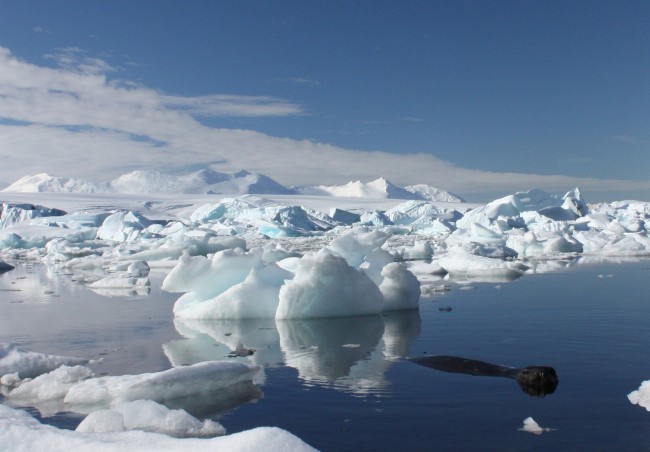
The glaciers in Antarctica are possibly melting faster than once believed. It is believed they did the same thing nearly 15,000 years ago and that the ocean levels went up almost seven feet in only 100 years because of it reports a new research study. These results are the first direct evidence that show intense melting in Antarctica’s past is cause to believe the same will happen in the future.
Peter Clark, who is a climate scientist at Oregon State University, stated that the Antarctic Ice Sheet had been basically stable and even boring in how it had retreated. However it has changed and the ice sheet is beginning to melt again.
Natural climate heating has created large ice sheet breakdowns in Antarctica nearly 10 times in the past 20,000 years, stated the research study. It was printed up in the newest edition of the science journal Nature. There have been measurements taken at Antarctica’s largest glaciers and they seem to show that the ice sheet is on the edge of a similar colossal retreat.
Antarctica’s glaciers have been dwindling since the last great ice age ended around 22,000 years ago. The heating up of the Earth was activated by quivers in its orbit, combined with warming enhancements from both the atmosphere and ocean. There have also been temperature surges from carbon dioxide being released.
The last giant iceberg release was almost 10,000 years ago, and the rate of glacial retreat started to slow down in Antarctica until the 20th century. This was when the melting began again, this time with man-made global warming. Recent models show that climate change has tipped the Antarctic Ice Sheet into a rapid, sudden shrinking once more.
In order to see how the ice sheet stood up to natural climate change, scientists drilled deep down into the seafloor between South America and Antarctica. They found debris from the nearly 10 iceberg surges which had occurred in the last 20,000 years. Icebergs transport sand that gets trapped in ice out to the ocean, and the residue drops to the seabed floor as the icy chunks thaw.
When glaciers withdraw, they send out icebergs that melt and cause the ocean level to rise. The ice that thaws from coming in contact with warm seawater also adds to the rise in sea waters. The major question scientists are asking is where has this ice come from? The melting of the ice sheet is actually the first clear evidence Antarctica contributed to the rise of the oceans.
These findings propose that Antarctica’s huge glaciers respond to global warming with pulses of fast withdrawal, instead of a steady slow retreat. However the finding fails to answer one of Antarctica’s greatest mysteries, what has caused the melting to begin again and why have the glaciers stopped their retreat. Researchers also do not understand what regions of the ice sheet were responsible for the icebergs, though they think it was mainly the Antarctic Peninsula.
It is believed that the gigantic melting produces various ocean flow changes that cause a feedback loop, allowing warmer sea water to reach the ice. Because the melting glaciers in Antarctica hurled so many icebergs into the sea nearly 15,000 years ago, the ocean levels went up almost seven feet in only 100 years. These results are the first direct evidence that show intense melting in Antarctica’s past is cause to believe the same will happen in the future.
By Kimberly Ruble
Sources:
Science Recorder
Discover more from Guardian Liberty Voice
Subscribe to get the latest posts sent to your email.
7 Responses
Liberal Media at its finest, only going to tell half the truth to continue pushing their political agenda. This discovery came with another discovery of a volcano developing under the surface of the west ice sheet of Antarctica, the same Ice sheet that is melting. This volcano is what scientist have concluded to be warming the water under the Ice surface. But hey why tell the truth when you can continue the charade of human caused global warming.
Liberal media? Many conservatives use that baseless excuse as they don’t have science to back up their denials of the overwhelming scientific evidence. Shooting the messenger is their solution while keep their heads buried in the sand (that’s a good trick!). It’s a limited perspective that puts our future generations at risk.
They discovered this volcano November of 2013, that is a fact… so I’m sorry your not willing to do the research yourself, it’s very sad that you want to deny the existence of a smoldering volcano and blame it on something else
I read about the volcano when it hit the news. Who’s denying its existence?
What’s sad is so many conservatives deny the overwhelming scientific evidence telling us that our emissions are warming the planet, altering climate patterns, raising sea levels, making oceans more acidic, and generally degrading habitability. But they have their agenda and/or sponsors that are apparently more important to them than the health and safety of our future generations.
So you know there’s a smoldering volcano under the ice sheet but you don’t see how that could possibly be melting the ice sheet. Well alright then, have fun with your hypothesis
Did I say that the volcano can’t be having an affect? No.
But don’t loose track of the big picture. The seas are certainly warming and eroding ice around the world as they absorb heat from the atmosphere. That heat is directly caused by the additional GHGs we’ve been emitting. But too many conservative turn their backs. Again, their fossil fuel sponsors and/or their political agenda must be more important to them than we are. They need to be replaced by informed people that are willing to face reality and deal with it.
Join the efforts to reduce emissions. Human-caused climate change is a fact. We’ve been using the atmosphere as if it were an endless waste disposal site. There are consequences and they aren’t good. Our future generations will suffer from our neglect unless we change the ways we generate and use energy.
Join the efforts. Apathy/inaction effectively advocate more of the same destructive behaviors. We can and MUST do better.
ExhaustingHabitability(dot)org