

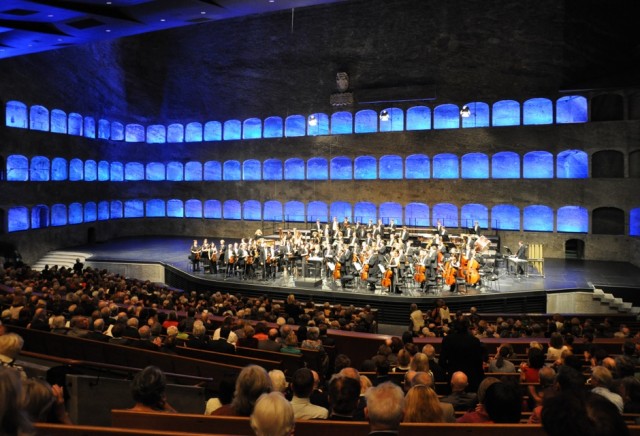
The Summer Riding School or Felsenreitschule in Salzburg, Austria, was originally a 17th-century equestrian arena that was converted in 1926 to a theater for the Salzburg Festival. Its location is an example of re-used space, having been the quarry where conglomerate rock was cut for the Salzburg Cathedral. The space is recognized with its three levels of 96 arcades chiseled out of the quarry’s rock wall. It was where the Trapp Family Singers performed in 1937 as part of the festival and where the festival performance scene was filmed in the 1965 movie, The Sound of Music.
Salzburg was ruled by prince-archbishops as part of the Holy Roman Empire and annexed by Austria in the early 19th century. Prince-Archbishop Wolf Dietrich von Raitenau began the city’s arts and architectural transformation in 1587 to Baroque palaces, churches and gardens. He commissioned the Italian architect, Vincenzo Scamozzi, to design his residential palace. That was followed by other construction projects including the initial plans for the Salzburg Cathedral.
His successor, Prince-Archbishop Markus Sittikus von Hohemens, continued the trend of commissioning Italian architects to add to Salzburg’s Baroque style. He appointed Santino Solari to redesign and oversee construction of the new cathedral. The stone was mined at a nearby rock quarry at the base of Mönchsberg, a mountain in the city of Salzburg.

One of the founders of the Salzburg Festival, Max Reinhardt, felt the Summer Riding School would be the ideal setting for a popular play. His first used the Felsenreitschule in 1926 to stage the comedy, Servant of Two Masters, by Carlo Goldoni. The play was written in 1743 and required a minimal set of a small platform, ground of compressed earth and wooden benches for the audience. The former equestrian arena was used in 1933 for a theatrical production of Faust. The set by Clemens Holzmeister, noted architect and stage designer, is still ranked as one of the venue’s greatest transformations. Herbert von Karajan conducted a 1948 production of Orfeo ed Euridice by 18th century composer Christoph Willibald Gluck, making it the first time opera had been staged in this theater.

The Summer Riding School today is foremost a concert venue. Its history, however, dates back to the wealth and power of the prince-archbishops during the Holy Roman Empire. Salzburg’s Felsenreitschule has undergone many changes from when it was first an equestrian arena to a mainstage theater of one of the most famous festivals in the world. For more information about concert schedules, the website is provided below.
By Cynthia Collins
Related articles:
Salzburg Festival: Austria’s Annual Tribute to Music, Arts and Culture
Mozart Birthplace Museum Depicts Early Life of Salzburg Composer
Salzburg Cathedral: Architecture of Beauty and History
Mirabell Palace History Began With True Love
Sources:
Felsenreitschule – History and Concert Schedule
Salzburg Museum
Top photo credit: Andreas Praefcke
Discover more from Guardian Liberty Voice
Subscribe to get the latest posts sent to your email.