


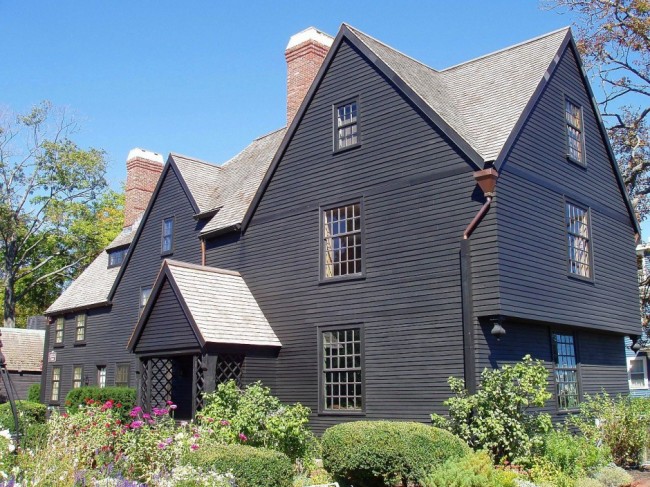
The House of the Seven Gables Museum is offering two ghostly theatrical October events during weekends beginning Oct. 10 through Nov. 1, 2014. One will be in the museum itself made famous by Nathaniel Hawthorne’s 1851 novel, The House of the Seven Gables, and the other will be next door in the Nathaniel Hawthorne House. Both will be open at night for visitors to witness real and fictional events set in motion during the Salem witch trials.
Spirits of the Gables unfolds in the foreboding mansion as visitors make their way through the halls. Hawthorne’s characters weave their greed and revenge from one generation to another which started when Colonel Pyncheon took land away from a farmer, Matthew Maule, in the mid-1600s. Maule was later condemned and hanged for witchcraft. While standing on the gallows, he cursed the colonel who later died in the mansion under mysterious circumstances. Thereafter, each generation of the Pyncheon family experienced misfortune.
The second weekend event takes place in the Nathaniel Hawthorne House, built in 1750 and is the birthplace of the author. Legacy of the Hanging Judge is based on historical records of Hawthorne’s ancestor, John Hathorne, a magistrate during the Salem witch trials who interrogated and sentenced many “witches” to death. Visitors and performers take on the roles of the accused and accusers in this interactive drama.

From 1845-1849, Hawthorne worked at the Custom House in Salem. During that time, he was a frequent visitor at the house because his second cousin, Susanna Ingersoll, lived there. Its appearance held a fascination for him and he enjoyed his cousin’s stories. The mansion was built in 1668 by a wealthy sea captain, John Turner I, the patriarch of one of the most prosperous maritime families in New England. It had a huge clustered central chimney which helped heat the rooms with high ceilings and large windows. After Captain Turner’s death, his son added wood paneling to some of the walls. The paneling is an important example of high-style Georgian.
Samuel Ingersoll, a sea captain and Susanna’s father, purchased the mansion in the 19th century. Captain Ingersoll had four of the gables removed to create the more popular Federal-style house. In 1879, Susanna’s adopted son lost the house to creditors. It was purchased in 1883 by the Upton family who worked in the performing arts. They charged a small fee for visitors to tour the house and offered ballroom dance lessons. They were the last family to live there.
Caroline Emmerton bought the mansion in 1908 to have it restored. As a philanthropist and preservationist, she worked with Joseph Everett Chandler, an architect who was one of the leaders of historic restoration in the early 20th century, to have the “old Turner mansion” returned to its original appearance. Once the Turner-Ingersoll Mansion was fully restored, Emmerton used the money made from tours to fund The House of the Seven Gables Settlement Association she founded to help immigrant families. The house and surrounding buildings are a national historic district listed on the National Register of Historic Places.
The House of the Seven Gables is almost 350 years old. Like its fictional counterpart, it has an extensive history of several generations. As visitors walk through The House of the Seven Gables Museum, Hawthorne’s characters will add to a ghostly atmosphere created for the nighttime October events. For dates and times of the performances and for tickets, the websites are listed below.
By Cynthia Collins
Sources:
October performances at Seven Gables – Dates and Times
October performances at Seven Gables – Tickets
The House of the Seven Gables – History
Nathaniel Hawthorne’s Birthplace – History
Nathaniel Hawthorne – Biography
The House of the Seven Gables Photo by Bonss Creative Commons License
Discover more from Guardian Liberty Voice
Subscribe to get the latest posts sent to your email.