

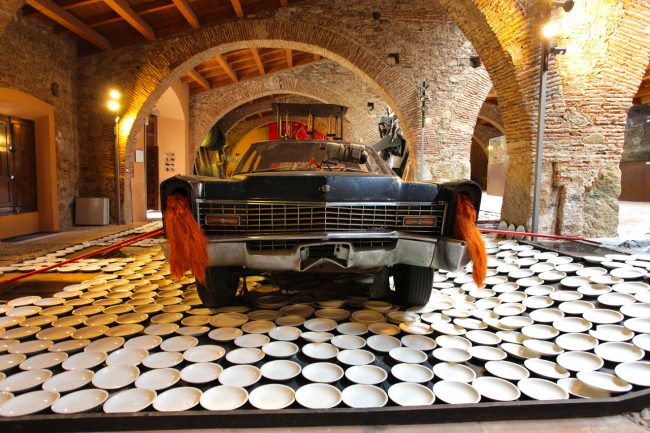
Anyone seeking something unusual in the way of an art experience should visit the Vostell Malpartida Museum, close to Cáceres in the Extremadura region of Spain. Incorporating the Fluxus technique, using video and instrumentation art in a natural setting, German artist Wolf Vostell (1932-1998), has created a marvel.
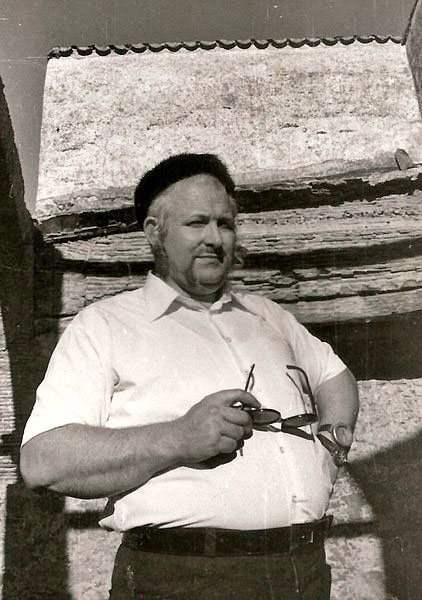
Wolf Vostell was one of the early associates of this method, and other well known artists involved in the movement include Yoko Ono, Al Hansen, Dick Higgins and Joseph Beuys.
The museum is located in the Los Barruecos de Malpartida natural park, approximately 13 kilometers from the city of Cáceres, Spain. In 1976, Vostell took over the old wool washhouse building (pictured below), dating back from the 18th century. He went on to create an avant-garde exhibition showing the meeting of art, life and nature.
Covering 14,000 square meters of floor space, there are three huge collections to explore consisting of the “Wolf and Mercedes Vostell Collection” by Wolf Vostell, the “Fluxus Donation Gino di Maggio Collection” and the “Conceptual Artists Collection.” This article will cover the “Wolf and Mercedes Vostell Collection.”

As well as the vehicles, there are several large sculptures and reliefs including the “Concrete Bullring,” “Transhumance,” the “Burial of the Sardine (1985)” and the “Girls of Snooker (1986),” among others. All the art exhibits display the Fluxus technique, making the Vostell Malpartida Museum in Cáceres, Spain a fascinating visit.
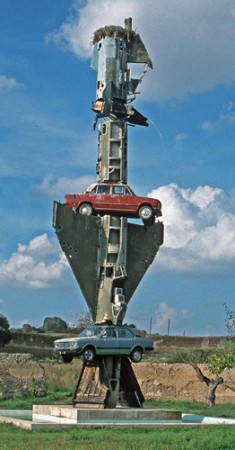
In the garden outside the building is a permanent large sculpture piece by Wolf Vostell called “Why did the process between Pilate and Jesus last only two minutes?” which has been formed using a Russian Mig-21 aircraft, together with two cars, various computer monitors and three pianos (pictured above left), rising to a height of 16 meters.
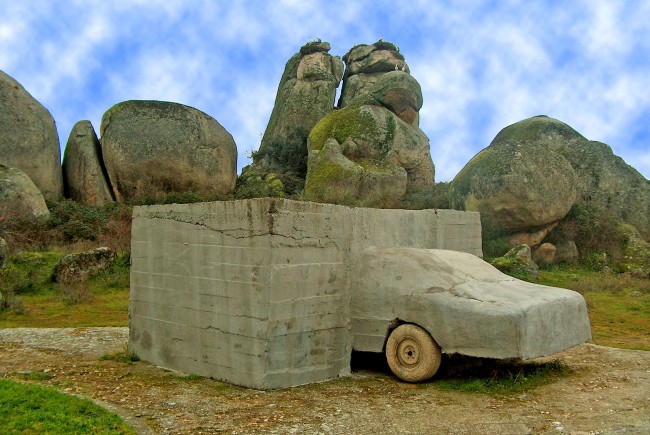
There are also several other sculptures dotted around the property including the car in concrete sculpture below:
By Anne Sewell
Sources:
Museo Vostell Malpartida (Spanish)
Extremadura Tourism (Spanish)
Vostell Malpartida Museum on Facebook (Spanish)
Photos:
Car exhibit courtesy Museo Vostell Malpartida
Car in concrete sculpture by Wolf Vostell in the Public Domain by Rpmayor
Wolf Vostell, working on his installation in Cáceres in 1980 CC by-SA Santisolyluna
Sculpture “Why did the process between Pilate and Jesus last only two minutes?” CC by-SA Hans Peter Schaefer
Panoramic view of the Vostell Malpartida Museum in the public domain
Discover more from Guardian Liberty Voice
Subscribe to get the latest posts sent to your email.