


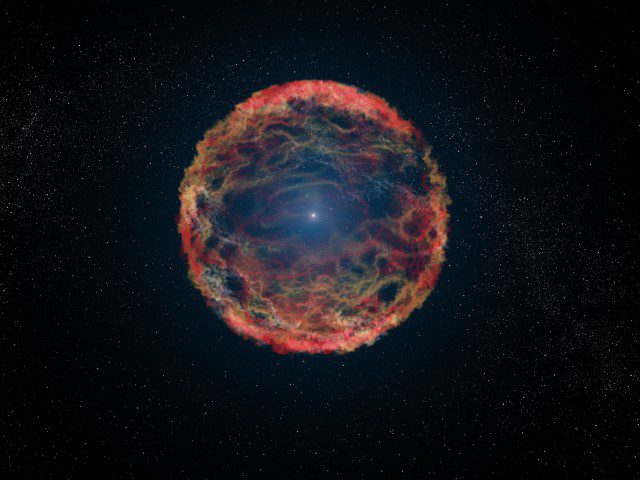
Over 340 years ago, Renaissance astronomers discovered a bright star in the night sky, one that was not a nova, but a collision between two stellar bodies. The luminosity of the cosmic collision was more magnificent than a nova, but less extraordinary than a supernova. Now, new observations have been made using the Atacama Pathfinder Experiment telescope (APEX) that have revealed that this cosmic oddity was not just a nova, a but a much rarer, violent breed of stellar occurrences in the Universe.
Nova Vulpeculae 1670, as the nova is called, has struck great interest in modern astronomers. Tomasz Kaminski, an astronomer at the European Southern Observatory (ESO) stated for over 300 years many thought this object was only a general nova, a thermonuclear explosion of a small white dwarf star. Though, after further observation and careful analysis, they found the nova was hitherto unlike any other exploding star they have come across. When the light from Nova Vulpeculae 1670 first reached Earth, astronomers recorded that it was able to be seen with the naked eye, and varied in brightness and color for over two years. After that time, it disappeared from view, reappearing twice before being gone forever from the views of Renaissance scientists. Although this spectacular nova was documented well, the dauntless astronomers of the time lacked sufficient technology to understand the mysterious essence of the peculiar riddle put forth in this galactic rarity.
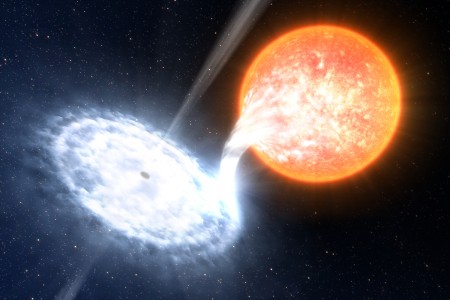
In the 20th century, astronomers were in the beginnings of understanding that most novae could be explained by one star in a binary system accreting stellar material from its companion star, thus giving off a spectacular show of herculean proportions. However, Nova Vulpeculae 1670 did not fit this theoretical model.
Although telescopic power was ever-increasing, the cosmic event was believed for decades to have left no trace, without remnants that could be studied. Though, in the 1980s, a team of astronomers detected a faint, almost invisible nebula around the circumference of where the nova was last seen. While these observations offered astronomers a glimmer of hope to the sighting of Nova Vulpeculae 1670, they failed to give them any new information of the true nature of the bright event from far away in the cosmos that was viewed in the skies above Europe 300 years ago.
Kaminski stated his team of researchers have peered into the nebula using submillimeter radio lengths to unearth the since undetected remnants of the nova. They found that the nebula surrounding the last location of the Nova Vulpeculae 1670 encloses the area in cool ionized molecules with unforeseen chemical compositions. By using this method, in conjunction with APEX, the team was able to create a thorough account of the chemical makeup of the area, allowing further evaluation to the understanding of the origins of the stellar spectacle.
The astronomers discovered an unbelievably large mass of cool gases, but the amount seemed to be too great to have been created by a nova detonation. Moreover, the isotope ratios measured around the the area of Nova Vulpeculae 1670 were much different that what was to be expected. So, if the 340-year-old stellar explosion was not a nova, what could it have been?
The answer lies not in one, but in two stars. When two stars collide, a violent thermonuclear explosion is created, with a luminosity greater than a traditional nova, but less than a supernova. This reaction forms what is called a red transient. A red transient is a rare event among the mysteries of the Universe. These events occur when stars explode due to a stellar merger with another star, usually in a binary system. This reaction launches super-heated, ionized gases into the cosmos, only leaving behind a faint facade of the former star. The area around the once thriving star is rich in gases, dust, and heavy chemical compounds in a cool environment. Therefore, this newly acknowledged class of detonated stars fit the rare characteristics of Nova Vulpeculae 1670 almost precisely.
By Alex Lemieux
Sources:
Discover more from Guardian Liberty Voice
Subscribe to get the latest posts sent to your email.