

,
Lehman Brothers’ collapse in 2008 became a symbol of financial recklessness and led to changes on Wall Street. While the end of Lehman Brothers was startling, the story of the firm started with three Lehman brothers in 1844. “The Lehman Trilogy,” an absorbing tale of the rags to riches to ruins story of the family and firm, opened at the Ahmanson Theatre in Los Angeles on March 6. The stunning, well-acted play runs through April 10, 2022.
Directed by Academy Award and Tony Award winner Sam Mendes, “The Lehman Trilogy” is an interesting oral history of the founding siblings and their offspring. However, it is the creative way the tale is presented by three skilled, engrossing performers (portraying multiple characters) on an ingeniously designed set that makes “The Lehman Trilogy” great theater.
The three-act play was adapted from a book and show by Italian playwright Stefano Massini. After successful runs in Europe, the absorbing “Lehman Trilogy” tale of the family behind the firm arrived at the Ahmanson having just concluded its Broadway run.
Be aware. It is a three-and-a-half-hour production (with two intermissions). The show ends with the subprime mortgage crisis and employees leaving the now defunct firm. However, the focus is primarily on the family’s and firm’s history, their journey from a dry goods store to capitalizing on other people’s capital. Or, as one Lehman scion puts it, their transformation into “merchants of money” rising and then falling driven by desires to earn and risk more.
Taking Advantage of Situations
Their journey began when the eldest brother, Chaim Americanized to Henry, arrived in New York from Bavaria. His other brothers, Emanuel and Mayer, later join him running a store selling fabrics and suits in Antebellum Alabama.
The trio is adept at making the most of other people’s catastrophes. After a fire destroys many plantations in the area’s, the Lehman brothers become lenders to help the town rebuild. The Lehmans became well-established middlemen, getting rich buying raw cotton from local plantations and selling to mills up north, before the Civil War started. The brothers viewed the fire and the war with dollar signs dancing before their eyes: “Everyone will borrow. Everyone will buy.”
Their sons and grandsons carry on, expanding from cotton to commodities to leverage. The New York office they opened for cotton sales, thrived after the war. They moved through iterations, selling various goods, money lending, and over time investing in diverse enterprises from railroads to Hollywood films. After Lehman is established as a bank, the family members talk about people giving them money for things they do not need. Eventually, a Lehman remarks proudly, “Regular people use money to buy things. We use money to make more money.”
One shortcoming of the play, besides its length, is its positivity. It seems unlikely that the Lehmans did not have to deal with antisemitism in Alabama. Further, they do not seem concerned about the plantation workers. Slavery is barely acknowledged, except when Mayer is told he should move to New York like his brother because “everything here was built on a crime.”
Stars and Set Shine
As directed by Mendes, “The Lehman Trilogy” is primarily a three-man show. Three actors portray the original three brothers, their children, spouses, neighbors and more, with one generation morphing into the other. Accordingly, the actors are each phenomenal, switching characters with an altered expression, gait, voice or posture. It may sound confusing having three men play 50-plus characters, but it is surprisingly easy to follow.
Simon Russell Beale primarily portrays Henry, a plantation owner, a divorcee who marries into the clan, and later Emanuel’s son, Phillip. Adam Godley is Mayer, Emanuel’s girlfriend, and eventually Bobbie, Phillip’s son, as well as some other amusing characters in between. The two initiated their roles in London, then on the New York stage before coming to Los Angeles. Howard W. Overshown (Emanuel and Herbert Lehman, Mayer’s son who became governor and a senator) was an understudy in New York before stepping into the role here.
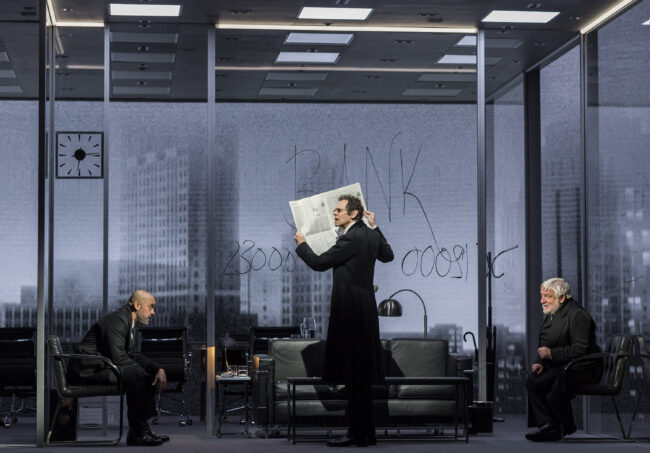
The set design by Es Devlin is stunning and transforms with the actors. When the play begins and ends, the rotating glass cube he created looks like a skyscraper. Luke Halls’ video design ads to the illusion. The view out the windows shows the New York skyline and, as the scene rotates, the Statue of Liberty. The video also shows historic elements, the fire, the war, etc.
While long, “The Lehman Trilogy” at the Ahmanson is ultimately an absorbing play that does not criticize or commend the family or the firm. It does not condemn the financial folly or try to explain it away. It just tells the story of the brothers and their heirs in an entertaining way.
Written By Dyanne Weiss
Sources:
Performance March 6, 2022
Center Theatre Group: DIRECT FROM BROADWAY THE LOS ANGELES ENGAGEMENT OF “THE LEHMAN TRILOGY” OPENS MARCH 6
Fox Business: Jeff Bezos, Lauren Sanchez attend Broadway play about capitalism
Photo by Craig Schwartz of, L-R, Howard W. Overshown, Adam Godley and Simon Russell Beale in “The Lehman Trilogy.”
Discover more from Guardian Liberty Voice
Subscribe to get the latest posts sent to your email.
One Response
Amazing blog! Is your theme custom made or did you download it from somewhere? A design like yours with a few simple tweeks would really make my blog stand out. Please let me know where you got your design. Cheers