

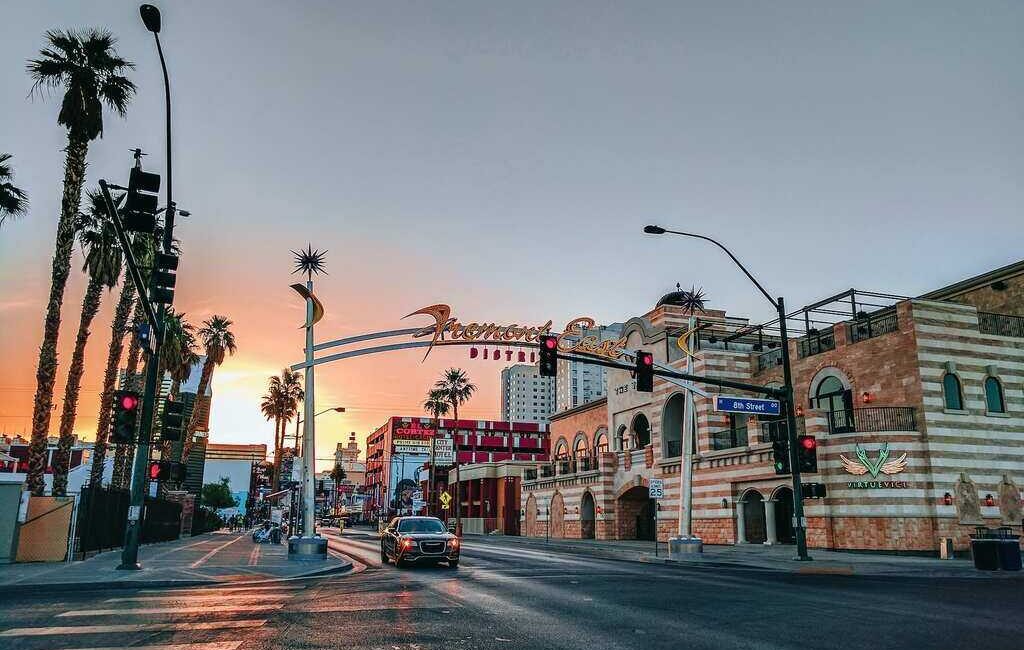

More than 20 people have died in protests of political upheaval in Peru following the ousting of former president Pedro Castillo. At least eight of those deaths came during protests in the Ayacucho region on Dec. 15. Protesters across the country, the majority of whom are supporters of the former president, have shutdown airports and blocked major border crossings.
Pedro Castillo’s Rise to Power
Castillo was elected in a closely contested race in July of last year, beating out Keiko Fujimori, daughter of former Peruvian president Alberto Fujimori. The former president, better described as a dictator, held office for 10 years before fleeing for Japan to avoid charges of corruption and human rights abuses. He was eventually detained and extradited to Peru where he is currently serving a 25 year prison sentence.

The crimes of her father helped stir a strong public opposition to Keiko’s presidential campaign, something that Castillo was able to capitalize on in his rise to victory.
Unlike Fujimori, Castillo is from the rural town of Puña in the elevated grasslands of the Peruvian Andes. He is a former teacher and leader of a teacher’s union, and was considered by many to be Peru’s “first poor president”, a reference to his humble beginnings and lack of ties to the political and economic elite of Peru.
Castillo promised that his presidency would bring radical change to help the country’s “forgotten people”; that are Peru’s impoverished, working-class, and indigenous peoples.
“There’s a lot of poverty in this country; millions and millions of Peruvians have lost their jobs. They already were living in poverty and so [there are] a lot of expectations for Pedro Castillo to change things around,” said Al Jazeera’s Mariana Sanchez following the 2021 Castillo victory.
Castillo entered office with an opposition controlled Congress. In an effort to appeal to the political establishment, he abandoned some of his more extreme stances, like the nationalization of Peru’s mining industry, for more moderate positions like raising taxes.
Castillo’s Critical Error
Castillo’s attempts to create new political alliances and quell his opposition’s fears of left-wing extremist policy making ultimately failed as Peru’s Congress moved to impeach the president just four months into his first term.
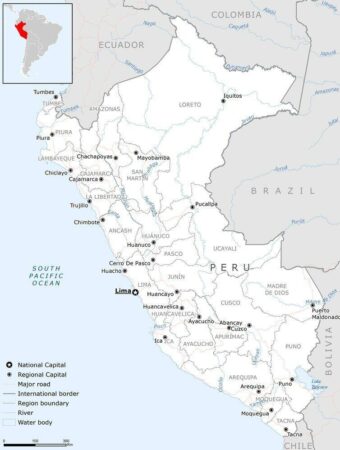
Peru’s Congress pushed impeachment again this past February, and was on its to a third impeachment attempt when Castillo decided to try and take matters into his own hands.
On December 7, in a televised address to the nation, Castillo announced that he would be temporarily dissolving Congress, establishing a a new provisional government, and assembling law makers to draft a new constitution for Peru. Many people in the country and government saw this as an attempted coup to seize full control of Peru’s government, reminiscent of similar actions taken by Alberto Fujimori in 1992.
The Peruvian Congress successfully voted to impeach Castillo the same day of his announcement, with 101 out of 130 members voting for his removal. Castillo was immediately arrested by police while en route to the Mexican embassy to request asylum.
“Peru’s political constitution enshrines the separation of powers and establishes that Peru is a democratic and sovereign Republic… No authority can put itself above the Constitution and must comply with constitutional mandates,” said federal prosecutors.
Peru’s Democratic Debacle
Peru has now had six different presidents in the span of only five years. In one particularly tumultuous week in November of 2020, the Peruvian presidency changed hands twice. That week spurred some of the largest demonstrations in Peru seen in decades.
Those demonstrations were led mostly by the youth of the country, who had been fed up with the corruption that plagued Peru’s politics. Social media became a driving force in fueling the frustration of average Peruvians, and was used as a tool to help organize protests and encourage involvement.
“Social media networks took on the role of classic political and social organizing. There were no leaders, which is why the marches were so diverse, with people coming out for the first time to take part in a protest,” said Miguel Morachimo, a director of the Peruvian digital rights organization, Hiperderecho.
Ms. President
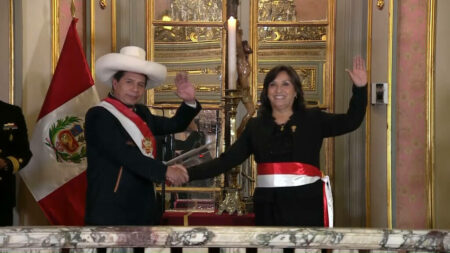
The latest addition to Peru’s presidential carousel is Dina Boluarte, the country’s first female president, who was vice president to Castillo before his impeachment. Boluarte was sworn in by Congress immediately after Castillo’s removal, and subsequently asked for a “truce” amongst the nation’s politicians in an effort to stem the chaos that has built over the last few years of division and frustration.
Boluarte comes from the back country of Peru just like Castillo. She worked for years as a lawyer with the national registry and identification office. She enters the presidency at a time when any political stability is crucial for the survival of the state.
“Like a lot of Peru’s recent presidents, none have been able to fulfill the normal five-year mandate, revealing the profound instability and exhaustion of the current political system,” said Jo-Marie Burt, associate professor at George Mason University.
“She’ll have to separate herself from the prior president, which is a hard line to cross. She is also going to face a Congress further emboldened and controlled by a loose coalition of far-right parties [that] have been gunning for Castillo’s removal and were thrilled by [Dec. 7]’s events.”
Boluarte has made the effort to distance herself from her predecessor and former running mate. The day after her inauguration she posted a tweet condemning Castillo, writing, “I reject the decision of Pedro Castillo to perpetrate the breakdown of the constitutional order with the closure of Congress. This is a coup that aggravates the political and institutional crisis that Peruvian society will have to overcome with strict adherence to the law.”
An Attempt For Stability
Boluarte originally planned to serve out the remainder of Castillo’s term, which ends in June of 2026. However, recent violent clashes between police and protestors has prompted her to push for earlier elections. This past Tuesday, Peru’s Congress approved a proposal that would move presidential and congressional elections up to April of 2024.
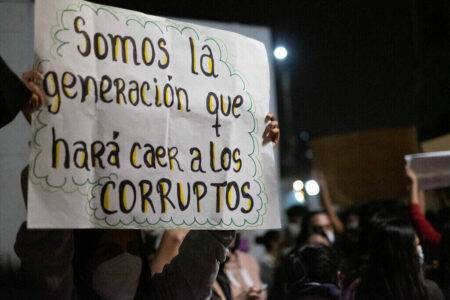
This has yet to show any sign of slowing down the protests that are still raging across the country. Five of the nations airports have been forced to close. Major roads to copper mines, food markets, and tourist destinations like Machu Picchu have been blocked.
The nation’s Defense Minister, Alberto Otárola, declared a state of emergency last Wednesday, signed into affect by Boluarte. The state of emergency temporarily ends rights to assembly, and gives police military support, as well as the ability to search citizens homes without the need for a warrant or judicial order.
Peruvian political scientist, José Godoy, is critical of the state of emergency declaration, saying, “It verifies that measures for force come before dialogue with the citizenry. This diminishes Boluarte’s credibility.”
Can Peru Keep It Together?
The protestors have not been deterred much by the government’s crackdown, despite the rising death toll. Many feel as though their vote (for Castillo’s presidency) has been silenced, and are demanding Castillo be released from jail. Their demands have been emboldened by a joint statement made by group of Latin American nations: Mexico, Argentina, Bolivia, and Columbia, that still recognize Castillo as the sovereign leader of Peru. The statement called on the politicians of Peru to comply with the “will of the citizens” who voted Castillo in.
Will earlier elections help stem the enormous discontent of Peru’s citizenry? Or is the detention of Castillo a lit fuse that will cause the powder keg of a nation to spark? These are the questions that plague Boluarte, who has a mountain of work ahead of her if she is to restore peace and trust within the nation. Time will tell if she is up to the task. Whether she is or not, one thing is clear: Peru’s democracy hangs in the balance.
Written by Seth Herlinger
Sources:
Aljazeera: Peru swears in new President Pedro Castillo
Aljazeera: ‘So much corruption’: Protests grip Peru amid political turmoil
Aljazeera: Timeline: Peru’s political crisis since removal of Pedro Castillo
Aljazeera: Who is Dina Boluarte, Peru’s ‘accidental president’?
Aljazeera: Why was Peru President Pedro Castillo impeached?
AP News: Peru Congress opens door to early elections amid unrest
AP News: Peru’s dark past surfaces as young protester is laid to rest
AP News: Peru’s new government declares police state amid protests
BBC News: Peru’s political crisis: Jaw-dropping twists and turns
Christian Science Monitor: Five years, six presidents: In Peru, resilience is exhausting
Christian Science Monitor: Three presidents in one week: Peruvian youths say ‘enough’
New York Times: Amid Deadly Protests, Peru Declares a National State of Emergency
Top and featured image by Johnattan Rupire, courtesy of Wikimedia – Creative Commons License
First inset image by Presidencia de la República del Perú, courtesy of Wikimedia – Creative Commons License
Second inset image by JRC, courtesy of Wikimedia – Creative Commons License
Third inset image by Presidencia de la República del Perú, courtesy of Wikimedia – Creative Commons License
Final inset image courtesy of Samantha Hare‘s Flickr page – Creative Commons License
Discover more from Guardian Liberty Voice
Subscribe to get the latest posts sent to your email.