


Classic paintings of the U.S. Founding Fathers only show white men in powdered wigs. However, the ethnically diverse cast of females, transgender and nonbinary performers in the nontraditional revival of “1776,” currently at the Center Theatre Group’s Ahmanson Theatre, depicts the Declaration of Independence signers in a variety of ages and skin colors, presenting history from a new perspective. Purists might view the casting as a stunt, but it works.
The Tony-winning musical, current in Los Angeles as part of a national tour, is not as entertaining as “Hamilton.” As anyone who has seen C-SPAN can attest, watching politicians debate is not visually interesting. Yet, directors Jeffrey L. Page and Diane Paulus offer a “1776” that is socially relevant today. Most people do not know that early versions of the Declaration spoke against slavery. But Sherman Edwards’ “1776” songs and Peter Stone’s book illustrate the machinations that lead the Continental Congress to retain slavery in favor of independence from England. Or as John Adams’ character acknowledges, “Posterity will never forgive us.”
Revisiting Period When Revolution Became War of Independence
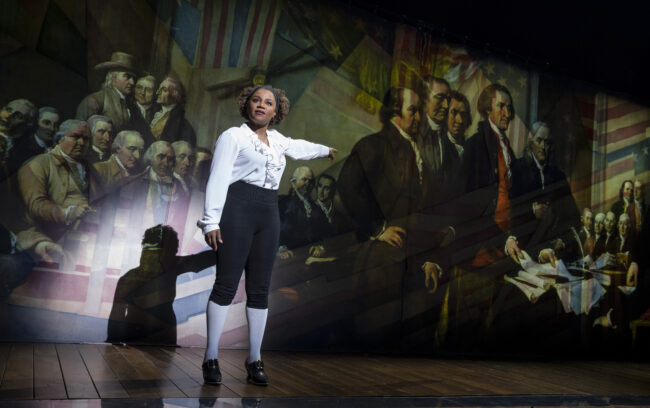
The musical opens with Gisela Adisa, a Black actress who portrays John Adams, standing in front of a screen showing John Trumbull’s classic “Declaration of Independence” painting. Adisa looks up, staring at the chamber of homogeneous white men, before turning to the audience, already laughing at the irony that these people asked for “representation.”
The curtain parts to show the largely-female-identifying cast in modern dress. They don coats from that era, pull up pant legs and socks to their knees, and finally step into appropriate shoes to depict a more colorful gathering of Colonial Americans.
The show then follows John Adams’ attempts to unite the representatives of each colony in seeking independence. One problem is that, while Adams is the main character, they make it clear from the opening number, “Sit Down, John,” he is perceived as “obnoxious and disliked.” That makes the character less sympathetic as they tell the tale of the crafting and editing of the Declaration. Of course, there are huge differences in the interests of the colonies and members who do not favor rebellion. At one point, the representatives complain “We piddle, twiddle, and resolve. Not one damn thing do we solve.” (Congress has not changed much in 250 years.)
Bicentennial Beginnings – Arguing for Representation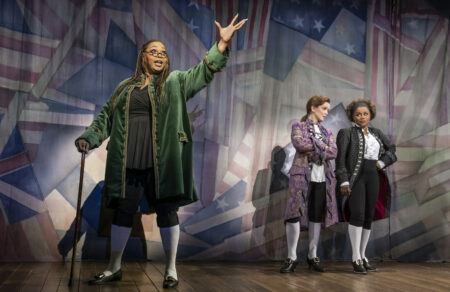
The original “1776” production was part of the revival of interest in revolutionary history 50 years ago leading up to the Bicentennial, although the most diverse aspect of the promotional pictures were the red and blue colors shown with the white men. There was a movie version in 1972, for which then-President Richard Nixon famously lobbied for them to cut the song “Cool, Cool, Considerate Men.” (The song is about snooty conservatives who are “forever to the right.” The men “hold to our gold, tradition that is old, reluctant to be bold.”
As the country approaches its semiquincentennial or sestercentennial celebration in 2026, the musical highlights the politics and issues they faced trying to pull together the disparate colonies – or at least the white males in them. Benjamin Franklin argues that the North should compromise on slavery: “First things first, John. Independence.” John Adams points out that they are rebelling against their lack of representation and being economic slaves to England. His character notes, “We would be guilty of what we ourselves are rebelling against.”
However, history has proven that the Continental Congress made a big mistake. Of course, no one knows what would have happened had the Northern colonies not agreed to remove the 168-word clause condemning slavery from the Declaration. Yet, no doubt allowing slavery then has led to today’s continuing racism problems.
The musical debuted during the Vietnam War when many criticized the country. No one really questioned the casting, but the bold diverse restaging makes the issue (and aftermath) stand out. The lyrics to the stunning number “Molasses to Rum” highlights that the slave trade was also important to the hypocrites and economy in the North. Kassandra Haddock, as South Carolina delegate Edward Rutledge, shines as she delivers the rebuke with Southern charm turning to sneering contempt. “’Tis Boston can boast to the West Indies coast. Whose fortunes are made in the Triangle Trade?”
Congress of Characters
The first act uses a lot of energy and musical interludes introducing the delegates, their colonies’ and their attitudes toward independence. It also gives many of the broad cast members a chance to shine and standout:
- Adisa has a tough road trying to make John Adams appealing even though he is described repeatedly as unliked, but she offers a skilled performance.
- Benjamin Franklin (a booming Liz Mikel) is a pompous and cranky 70-year-old, tired of the debate and eager to tell England goodbye.
- Shawna Hamic is a campy delight as Richard Henry Lee sings about the Lees of Virginia: “Social-Lee, political-Lee, financial-Lee, natural-Lee …”
- Nancy Anderson as Thomas Jefferson comes alive in the second act, drafting and editing the Declaration.
- Joanna Glushak plays an imperious John Dickinson of Pennsylvania, who is a condescending monarchist.
While not the most thrilling musical visually, “1776” does show the issues grappled with entertainingly. Some flaws and characters detract, such as Martha Jefferson (Connor Lynn) and Rhode Island’s Stephen Hopkins (Julie Cardia), who is portrayed as a drunk. However, this diverse revival of “1776” succeeds in getting the audience to look at history anew, particularly how the Declaration of Independence was crafted.
“1776” will be in Los Angeles until May 7. The tour then moves on to San Diego and San Jose before heading east to Durham and Charlotte, North Carolina, and other Southern cities. It will be interesting to see how the slavery debate plays in the South versus Southern California.
Written by Dyanne Weiss
Sources:
Performance April 12, 2023
Center Theatre Group
IMDB: “1776”
Photos by Joan Marcus of (top) Gisela Adisa as John Adams and (inset)(L to R) Liz Mikel, Nancy Anderson, and Adisa in the National Tour of “1776.”
Discover more from Guardian Liberty Voice
Subscribe to get the latest posts sent to your email.