


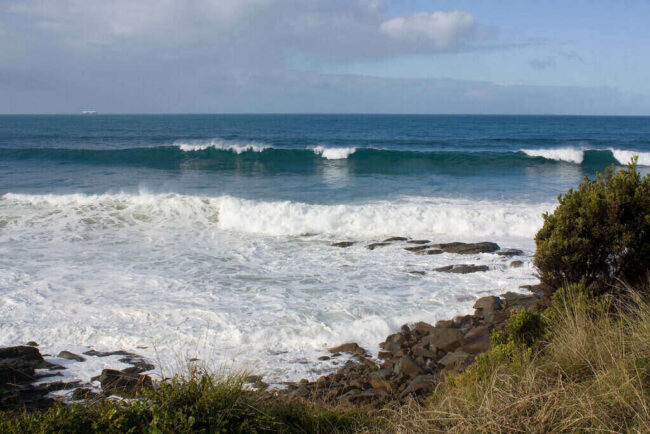
There has long been a puzzling phenomenon in the Indian Ocean, known as the “gravity hole.” Earth’s gravitational pull is weaker in this region, resulting in a lower mass and a dip in the sea level of over 328 feet (100 meters).
Recent research conducted by geologists from the Indian Institute of Science in Bengaluru, India, may have found a credible explanation for this anomaly. The scientists propose that plumes of magma rising from deep within the Earth, similar to those responsible for volcanic activity, could be behind the formation of this gravity hole.
The researchers used advanced supercomputers to simulate the possible formation of this area, looking back as far as 140 million years. Their findings revolve around an ancient ocean that no longer exists.
There is a “gravity hole” in the Indian Ocean — a spot where Earth’s gravitational pull is weaker, its mass is lower than normal, and the sea level dips by over 328 feethttps://t.co/MlBg3AtPoK
— CNN (@CNN) July 24, 2023
The Imperfect Earth
Contrary to popular belief, Earth is not a perfect sphere. It has various irregularities and unique features. The gravity hole in the Indian Ocean reminds humans of the planet’s complexity and mysterious nature.
According to Attreyee Ghosh, the Earth is not a perfect sphere. Ghosh said the Earth is an ellipsoid because of its varying density and properties. The geoid is impacted by density differences in the Earth’s materials, causing differences in gravitational forces. The Indian Ocean covers about 1.2 million square miles (3 million square kilometers), and despite being discovered in 1948, it has not been adequately explained.
Ghosh and her colleagues ran computer simulations recreating tectonic plate movements and magma behavior over 140 million years. They found that the presence of magma plumes around the gravity hole was the critical factor in six out of 19 similar simulations, concluding that these plumes and mantle structures in the area are responsible for forming this unique depression.
What Is a Gravity Hole?
A gravity hole is an area with less gravitational pull than the surrounding regions. The amount of gravity we experience depends on the surrounding mass. Scientists have created gravitational maps that show differences in earnest across the Earth. These differences make sense intuitively.
For example, areas with tall mountains have a more significant share of mass than low valleys, so there is a stronger gravitational pull at the top of a mountain than at sea level. But when a large group moves out, it creates a Geoid Low, resulting in a gravity drop and a gravity hole.
The Indian Ocean Geoid Low (IOGL) is about three million square kilometers, around 746 miles southwest of India. While standing on a floating platform over the IOGL, one may not notice a substantial difference compared to standing elsewhere. However, on a planetary scale, the gravity difference is significant and measurable, which results in water from the region being blown away.
Computer Models Simulate Tectonic Plates’ Movements

Researchers Attreyee Ghosh and Debanjan Pal built 19 computer models that simulate tectonic plates’ movements and interactions with the mantle. Six simulations closely matched the observed mass distribution, triggered by low-density magma rising from below and pushing high-density material away.
Around 200 million years ago, an ancient ocean dubbed Tethys existed between the supercontinents of Gondwana and Laurasia. The Tethys plates sunk beneath Africa when the Indian plate broke away from Gondwana and ultimately sank beneath Africa.
Six hundred miles from the current location is a giant bubble of dense, crystallized material called African Blob. It is the size of a continent and is approximately 1,000 miles thick. These Tethys plates sank underneath the African continent and disturbed the African Blob, spilling plumes of fresh low-density magma. After cooking at high temperatures for a few million years, the result was the piping-hot gravity hole that we observe now.
According to a study conducted by scientists at the Indian Institute of Science and GFZ German Research Centre for Geosciences in May 2023, the Indian Ocean geoid low (IOGL) is the most profound gravity hole on Earth. It covers 1.2 million square miles and causes a 328-foot dip in sea level off the southern coast of India.
Most Profound Gravity Hole on Earth
The study suggests that mantle plumes, similar to those that create volcanoes, could be responsible for the IOGL. The research team recreated the Earth’s seismic formation dating back 140 million years. They ran nine simulations using supercomputers, and all suggested that magma plumes exist within the mantle. These plumes were formed by the drifting and eventual collision of India’s subcontinent with Asia 40 million years ago and caused a depression in the geoid, leading to lower gravity.
The IOGL is unique because it does not indicate the thickening or thinning of the Earth’s crust or mantle. The analysis supports Ghosh’s study on 2917 mantle plumes, which confirmed that the thickness anomaly came from the movement of India’s plate. Some of the most likely zones are beneath the Canary Islands and Tahiti, East Africa.
Written by Janet Grace Ortigas
Sources:
SYFY: SCIENTISTS SOLVED THE MYSTERY OF A GRAVITY HOLE IN THE INDIAN OCEAN; by Cassidy Ward
CNN: There is a ‘gravity hole’ in the Indian Ocean, and scientists now think they know why; Jacopo Prisco
Forbes: Everything We Know About The Mysterious ‘Gravity Hole’ In The Indian Ocean—And How It Was Formed; by Simone Melvin
The Indian Express: What is causing the mysterious ‘gravity hole’ in the Indian Ocean?; by Science Desk
Inverse: There’s a “Gravity Hole” in the Indian Ocean, and Scientists Just Figured Out Why; by Elana Spivack
Featured and Top Image by Wilheln Fyles Courtesy of Flickr – Creative Commons License
Inset Image by Abhishek Kumar Courtesy of Flickr – Creative Commons License
Discover more from Guardian Liberty Voice
Subscribe to get the latest posts sent to your email.
One Response
A science who has excluded AETHER and the Power of creational lifeforce and still works with millions of years to exclude this not randomly and spiritless, life- and creational-force in all processes we are, we are witnessing, is just one of the cosmic jokes. Still people falls for their boring and bought theories. Try this: our earth is a TORUS, humans are toroidal … molecules are dancing frequencies … and and and …