


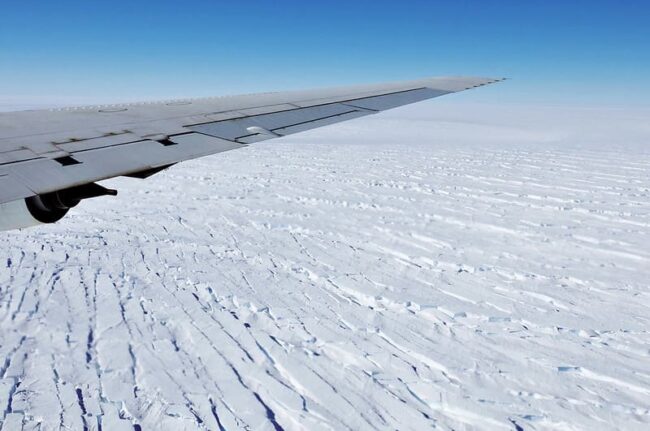
An international team of scientists drilled the longest ever sediment core from under the West Antarctic Ice Sheet. The result will be the provision of a record stretching back millions of years that will assist climate scientists in forecasting the fate of the ice sheet in a warming world.
Molly Patterson is the co-chief scientist on this mission and associate professor of earth sciences at Binghamton University. She said, “To our knowledge, the longest sediment cores previously drilled under an ice sheet are less than 10 m. We exceeded our target of 200 m, and undertook this 700 km from the nearest base — this is Antarctic frontier science.”
Significance of 228 m Antarctic Sediment Core
The 228 m of sediment core was drilled from under 523 m of ice at a deep-field camp at Crary Ice Rise on the edge of the West Antarctic Ice Sheet.
If the West Antarctic Ice Sheet melted completely global sea levels would rise by four to five meters. In recent decades, satellite observations have shown the ice sheet losing mass at an accelerated rate, but uncertainty continues around the temperature increase that would trigger rapid ice loss.
Before this drilling, ice sheet modelers used geological records retrieved next to the ice sheet, below floating ice shelves, sea ice, and in the open Ross Sea and Southern Ocean to make predictions.
“This record will give us critical insights about how the West Antarctic Ice Sheet and Ross Ice Shelf is likely to respond to temperatures above 2ºC. Initial indications are that the layers of sediment in the core span the past 23 million years, including time periods when Earth’s global average temperatures were significantly higher than 2ºC above pre-industrial,” said co-chief scientist Huw Horgan.
SWAIS2C Project
SWAIS2C – Sensitivity of the West Antarctic Ice Sheet to 2 Degrees of Warming is the name of the project seeking geological records from the sediment below the Ross Ice Shelf. The effort will reveal how much the West Antarctic Ice Sheet responded in the past when the climate was warmer than presently in preparation for future rise in sea levels.
The United Nations Paris Agreement sets a target to limit global warming to 1.5ºC, but will this save the Ross Ice Shelf and limit Antarctic ice sheet melt? This question is what the SWAIS2C aims to answer and the sediment core recovered by the group is the most significant discovery toward answering that question.
In the current drilling, as the team pulled up core sediment in three meter lengths, they examined the evidence and discovered a wide variety of types. This find includes shell fragments and that of marine organisms that require light to survive indicating a time period of open ocean.
“We saw a lot of variability. Some of the sediment was typical of deposits that occur under an ice sheet, like we have at Crary Ice Rise today, but we also saw material that’s more typical of an open ocean, an ice shelf floating over ocean, or an ice-shelf margin with icebergs calving off,” stated Patterson.
She continued, “This new record provides sequences of environmental conditions through time, and ground truths the presence of open ocean in this region. In addition to pinning down the time when this occurred and the corresponding global temperature, analysis will help us quantify the environmental factors that drove the ice sheet retreat, such as determining what the ocean temperatures were at that time.”
Written by Jeanette Vietti
Sources:
PHYS.ORG: Record-braking Antarctic drill reveals 23 million years of climate history
SWAIS2C: Sensitivity of the West Antarctic Ice Sheet to 2 Degrees Celsius of Warming
Featured Image by Jane Peterson Courtesy of NASA HQ PHOTO’s Flickr Page – Creative Commons License
Discover more from Guardian Liberty Voice
Subscribe to get the latest posts sent to your email.