

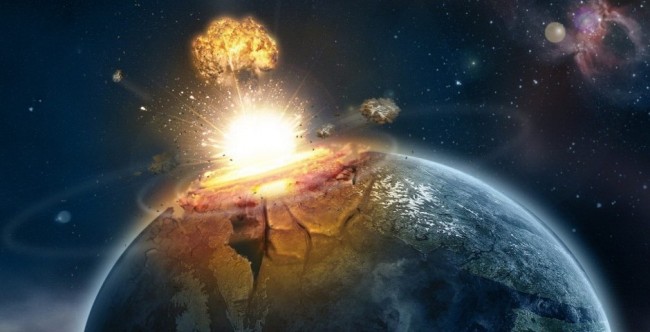
The Earth remains under constant threat, as it cycles endlessly around the Sun. Swarms of near earth asteroids (NEAs) regularly approach our planet, as they too orbit our star. These asteroids are the cosmic remnants of our solar system’s inception, ranging wildly in size from small pebbles to gigantic structures many miles in diameter. However, a team of highly ambitious astronomers, working under the banner of the B612 project, hope to be a part of an advanced system to deflect deadly asteroid bodies.
Deadly Near Earth Asteroids
Over a million of these NEAs have the power to inflict damage a thousand times more powerful than the atomic bomb, dropped on Hiroshima during the Second World War. Alarmingly, the Tunguska event that took place in 1908 was the largest recorded impact event, as an asteroid exploded approximately five to ten kilometers above the Earth’s surface; however, this asteroid was only approximately 50 to 100 meters in diameter and was still capable of devastating over a thousand square miles of land, wiping out thousands of trees.
This is part of the justification for the B612 team. Astronauts Ed Lu and Rusty Schweickart began their journey over a decade ago, vowing to help save the planet from potential asteroid extinction events. In October 2001, a group of top experts, whose backgrounds ranged from asteroid studies to propulsion technologies, convened at the NASA Johnson Space Center, Houston. The team’s primary ambitions involved the development of cost-effective solutions to deal with dangerously orbiting asteroids.
The crew immediately dismissed the use of nuclear explosives, since they were deemed unsafe and unpredictable. However, a much safer suggestion involved the use of a “nuclear-powered plasma engine.” Once such a device lands on the surface of the asteroid, the body’s orbit can be adjusted by using the engine almost like a tugboat.
The B612 team argue there to be no detailed, dynamic map of the inner solar system, with regard to the relative trajectories of life-threatening asteroids. The group explain the dangers of future impact events:
“The probability of a 100 Megaton impact somewhere on Earth each and every year is the same as the probability of an individual being killed in an automobile accident each year – about .01%.”
The researchers confess the odds are relatively small. However, they argue people wear seatbelts to protect themselves during car collisions; when it comes to protection from asteroid collision events, however, the human race remains defenceless.
The Sentinel Mission
As a part of their strategy, B612 aims to launch its Sentinel mission between 2017 and 2018. Sentinel will take approximately four years to construct, and will be launched into space atop a Flacon 9 rocket to orbit the

Sun once every seven months. The Ball Aerospace corporation has been contracted for the build – the same company that assembled the Keplar, Hubble and Spitzer Space Telescopes, as well as the Deep Impact Mission.
Scott Hubbard, the B612 Foundation Program Architect, boasts about the mission’s ambitious plans. He indicates the Sentinel mission could facilitate other space ventures, and map “… the presence of 1000’s of near earth objects [to] create a new scientific database…”
The device will use infrared technology to detect and monitor the trajectories and positions of thousands of asteroids. Specifically, over the course of 6.5 years of operation, it is estimated that Sentinel will discover 500,000 NEAs, cataloguing vital information on over 90% of asteroid bodies greater than 140 meters in size.
Using this information, astronomers can determine an asteroid collision event, years before it even happens. To prevent a collision event, the researchers will need to implement their deflection capabilities a decade in advance.
The mission is a private endeavor, and will cost around $450 million. NASA have been incredibly enthusiastic over the mission’s ambitions, with B612 partnering with the space agency to share retrieved datasets. NASA even plans to use its Deep Space Network to facilitate the transmission of data from Sentinel back to ground control.
Deflecting asteroids
Provided with enough time before collision, scientists believe they already have the technology necessary to deflect deadly asteroids.
Aside from the nuclear-powered plasma engine concept, another lauded strategy involves the use of a kinetic impactor. Kinetic impactors are relatively simplistic in principle. Essentially, an object with a heavy mass is launched towards an asteroid to knock it off course.

This idea has already been explored by Frank Schäfer of the Fraunhofer Institute for High Speed-Dynamics, in Freiburg. Schäfer works with the NEOShield Project, which is heavily involved in learning more about NEA trajectories and how mankind can prevent them.
During simulations, Schäfer established that aluminum-based projectiles offered the best transfer of kinetic energy from impactor to asteroid. When performing experiments with models, he established that the ejecta, which is cast off from the asteroid during the impactor’s collision, would have its own recoil; as a result, both the impactor and asteroid debris would serve to oppose the movement of the asteroid body, causing its orbit to shift.
Hopefully, armed with the B612’s Sentinel device, and the astronomical community’s asteroid deflecting technologies, potential deadly extinction events can be avoided.
By: James Fenner
B612 Website
Discover more from Guardian Liberty Voice
Subscribe to get the latest posts sent to your email.
6 Responses
I wish to express thanks to the writer just for rescuing me from this particular circumstance. Because of researching through the the net and seeing things which are not pleasant, I believed my entire life was gone. Being alive without the presence of approaches to the difficulties you have solved by means of your main short post is a crucial case, and the ones which could have adversely affected my career if I hadn’t encountered your web blog. Your main knowledge and kindness in handling a lot of things was valuable. I’m not sure what I would have done if I had not encountered such a subject like this. It’s possible to at this time look forward to my future. Thanks a lot very much for your reliable and result oriented help. I won’t be reluctant to refer your web page to anyone who would need guide on this topic.
Your reasoning should be accepted as the benchmark when discussing this topic.
Youre so cool! I dont suppose Ive learn something like this before. So nice to find any person with some unique thoughts on this subject. realy thank you for beginning this up. this website is something that’s needed on the net, someone with a bit originality. useful job for bringing something new to the internet!
F*ckin’ awesome things here. I am very glad to see your post. Thanks a lot and i’m looking forward to contact you. Will you please drop me a e-mail?
James: I’m putting together a Lecture: “Asteroids, Near Earth Objects, and Meteorites” that I’ll be giving to my local library, and at two Science Fiction Conventions. I absolutely love the first three sentences of your article, and would like to quote you in my lecture!
NEOs are kinda a “Big Thing” with me.
Hey Robert. Thanks for the comment, and for reading my article! You’re more than welcome to share any part of my article for your lecture – I would be honored. I’ve also done another article on the NEOShield Project, which is located in the sources section. If you would like more information, the other links are brilliant as well.
Thanks again for reading!
Kind regards,
James.