


The shamrock has been recognized for centuries as a symbol associated with Saint Patrick. According to legend, this three-leaf member of the clover family was used by the Emerald Isle’s patron saint to explain the Christian concept of the Holy Trinity to the ancient Celts. Over time, the shamrock has gone beyond its connection to Saint Patrick and has become a national symbol of Ireland.
The word shamrock was introduced in English literature during the Middle Ages. It first appeared in 1571 in the work by English scholar Edmund Campion, A Historie of Irelande, when he was describing the various plants and herbs associated with the country. Campion and other writers of the Middle Ages confused the shamrock with other herbs and incorrectly identified it as something that was part of the Irish diet. Based on descriptions and scholarly interpretation, the writers were confusing other herbs with shamrocks. By the late 16th and early 17th centuries, the English knew the shamrock was a plant associated with Ireland.
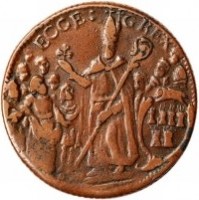 Even though Saint Patrick lived during the 5th century, it was not until 1675 that a visible image linking him to the shamrock appeared on coins. The Saint Patrick Coppers had the saint addressing a crowd while holding a shamrock. Written descriptions soon appeared of the custom of men wearing a shamrock in their hat or coat on the feast day of March 17. At the end of the day, the men would put it in their last glass of grog. When they finished the drink, they took the shamrock out of the glass and threw it over their left shoulder. This was known as “the drowning of the shamrock.”
By the late 18th century, local militias formed to defend Ireland against possible invaders from France and Spain. These militias were the Irish Volunteers and they used the shamrock on flags of the various groups. It was during the Irish Rebellion of 1798 that shamrock history began to change from a symbol of Saint Patrick to one of Irish patriotism. At the same time, revolutionary groups such as the United Irishmen as incorporated the color of green that was close to the shamrock for their uniforms and hat ribbons. The song, The Wearing of the Green, was about the group’s cause and battles. There were different versions of the lyrics but many mentioned shamrocks.

The shamrock was registered, along with the harp, as an international trademark by the Irish government in 2003. Since 1969, it has been a tradition for the prime minister of Ireland to present a Waterford crystal bowl with a shamrock on it to the president of the United States. Many organizations outside of Ireland that have Irish roots or Irish ancestry also include the shamrock as part of their logo or uniform. The shamrock today is displayed for not only its historical significance as a symbol of Saint Patrick but for all things Irish and for Ireland.
By Cynthia Collins
Follow @GLVArts
Sources:
St. Patrick Coppers
Campion, Edmund, A Historie of Ireland, 1571.
Irish Shamrock History
Emblems of Ireland: The Shamrock
Discover more from Guardian Liberty Voice
Subscribe to get the latest posts sent to your email.
7 Responses
I’m not that much of a internet reader to be honest but your sites really nice, keep it up! I’ll go ahead and bookmark your site to come back in the future. All the best
Thanks for this helpful information.
I’m typically to blogging and i really respect your content. The article has really peaks my interest. I am going to bookmark your website and hold checking for brand spanking new information.
Hello. fantastic job. I did not anticipate this. This is a excellent story. Thanks!
I’m impressed, I must say. Actually hardly ever do I encounter a weblog that’s each educative and entertaining, and let me let you know, you’ve got hit the nail on the head. Your thought is excellent; the issue is one thing that not sufficient persons are speaking intelligently about. I am very completely satisfied that I stumbled across this in my seek for one thing relating to this.
imanuel is a stupid faggot
this was not helpful