
 Mother’s Day in the United States is a movable holiday that takes place on the second Sunday in May. It is a celebratory day when mothers are taken out to dinner, given cards of appreciation, and receive gifts and flowers. It is also the day with the highest number of phone calls throughout the year. Initially, it did not start out as a cause for celebration but as a way of training mothers to care for young children. Over the years, Mother’s Day history in America has included family care, healing the wounds left by war, campaigns for world peace, and the celebration of mothers.
The earliest version of Mother’s Day in the U.S. came about in the 1850s when Ann Reeves Jarvis of West Virginia organized the Mothers’ Day Work Clubs. These were for local women to help instruct them on how to care for children. During the Civil War (1861-1865), mothers were tending the wounds of their sons as well as other young men in hospitals. Whether the soldiers were Union or Confederate, the women read to them, wrote letters for them and provided conversation. The clubs also raised money for medicine, food, and hired women to help in homes where the mother had tuberculosis.
Jarvis urged club members to remain neutral during the war so as to treat the wounded and provide food and clothing to soldiers stationed nearby regardless of their political affiliation. After the war, she organized a Mothers’ Friendship Day event in the summer of 1865 to promote reconciliation among the soldiers and citizens. Some members of the community were concerned that with the various political sentiments represented, the event might erupt in violence. However, the gathering was held at the courthouse in Pruntytown, West Virginia, and was so successful that it became a regularly scheduled event for the next several years.
Other notable women organized various versions of Mother’s Day throughout history that included family celebrations and public gatherings for world peace. Julia Ward Howe, the abolitionist and suffragette, wrote a call to action in 1870 for mothers to promote world peace. The name of this document was the Mother’s Day Proclamation. Howe is best-known for having written the words to the popular Civil War song, Battle Hymn of the Republic. Used as a rousing cry for the Union, it also was used for anti-slavery movements and women’s rights.

Jarvis continued her pursuit to make Mother’s Day a national holiday. She launched a massive letter-writing campaign to politicians and newspapers urging them to adopt this holiday for mothers. American holidays were predominantly based on male achievements. By 1912, many churches, towns, and states had Mother’s Day as an annual holiday but it was still not a national one. She established the Mother’s Day International Association and it soon paid off. President Woodrow Wilson signed a bill in 1914 that officially established the second Sunday in May as a national holiday known as Mother’s Day.

The church in Grafton still stands. It is also called the International Mother’s Day Shrine and is a designated National Historic Landmark. Mother’s Day history in America has included training mothers, care-giving during wartime, family celebrations, and rallies for world peace. Whether people celebrate it publicly or in private, it continues to be one of the most popular holidays.
By Cynthia Collins
@GLVArts
Sources:
International Mother’s Day Shrine and Museum
Ann Maria Reeves Jarvis
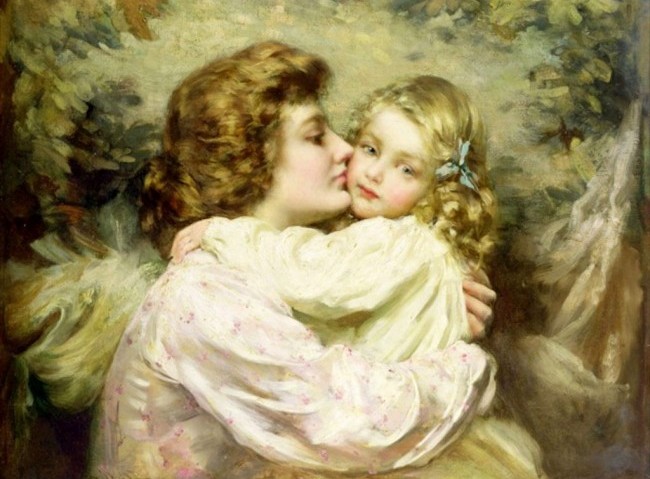
Top image credit: Mother and Daughter by Thomas Benjamin Kennington
Discover more from Guardian Liberty Voice
Subscribe to get the latest posts sent to your email.
7 Responses
Thank you.
thankyou
thankyou
Awesome to see your site. Keep up the great work. Thanks for all you could do.Lets stay in touch.
His subject is good, long while I find this topic and I think it is here, many thanks guys.
Wonderful article to read, I love mom, she is a great person in the world to me. She always inspired and love me too much. I feel like I am in heaven in the lap of my mother. Love you mom.
Emily
Thank you. All the best to you.