


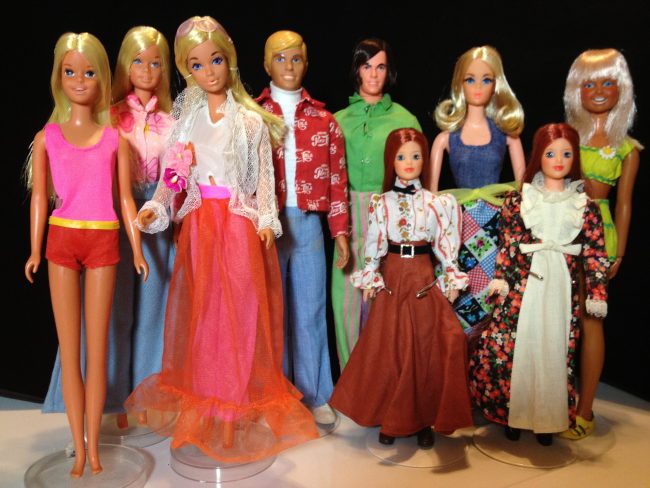
Barbie has been an astronaut, president, a surgeon, a news anchor, several characters in “Mad Men,” the Duchess of Cambridge, and all the members of Destiny’s Child.
Her debut was at the New York Toy Fair on March 9, 1959. Then, she was simply a doll dressed in a swimsuit and a ponytail holding sunglasses in her hand.
It is now six decades later and 100 dolls are sold every minute. Fifty-eight million dolls are sold every year.
According to Lisa McKnight, senior vice president and global general manager and the Barbie brand, the doll has remained popular because “she’s continued to reflect culture and the world girls see around them.”
Ruth Handler and her husband Elliot owned the Mattel toy company when she created Barbie. The doll was inspired by her daughter’s paper dolls and a German doll Bild Lilli. Lilli was based on a risqué adult cartoon and meant as an adult gift.
“At first, Barbie was a way for young children to project themselves as grown-ups. The baby-shaped [paper] dolls of the time did not allow those projection games to happen,” stated Aurore Bayle-Loudet, who worked on a 2016 Barbie exhibition at the Musée des Arts Décoratif in Paris.
By the time 1960 came around, Barbie was gainfully employed, as either a fashion editor, a nurse, an Executive Career Girl, or a flight attendant. The following year, Barbie had a swim-shorts-clad boyfriend, and the year after that, her first car and a “Dreamhouse.” After that, Barbie became a pilot, a CEO, and multiple presidential candidates.
While Barbie was breaking ground as a career woman, she was also driving criticism for upholding the slim, white, domestic ideal.
The first black Barbie was named, “Colored Francie.” She was released in 1967, and it would be another 13 years before the brand launched black and Hispanic versions of Barbie. Black feminist critic Ann duCille wrote in 1994, that the non-white dolls were “dye-dipped versions of archetypal while American beauty.”
Then there is the body of Barbie. According to the BBC, if the original long-legged, tiny-waisted doll was scaled to human size, she would have a 21-inch waist and 30-inch hips. To compare, a 2018 government report discovered that the average waist size of American women was 39 inches.
In 2016, Time headlined a cover story, “Now we can stop talking about my body?” brought about change. Mattel introduced 33 new Barbies to the brand. Available, for the first time, in three additional body shapes: tall, curvy, and petite.
The brand update also offered several skin tones, 22 eye colors, and 24 hairstyles.
The following year, a doll was created based on the Olympic fencer Ibtihaj Muhammad, who was added to the “Shero” collection.
At the beginning of 2019, new additions were made to the “Barbie Fashionistas” line. This line included a doll in a wheelchair, however, the doll was discontinued – in part because even after redesigns, the wheelchair did not fit in the Dreamhouse.
“We are continuing to push ourselves and evolve, as evidence of the new additions which include a new body, hair texture, and representation of physical disabilities,” according to Mattel’s McKnight.
On International Women’s Day in 2018, Mattel released a new batch of Barbie dolls based on “real-life role models.” These new dolls included, NASA mathematician Katherine Johnson, aviator Amelia Earhart, and artists Frida Kahlo became part of the Barbie “Inspiring Women” historical collection. Olympic champion snowboarder Chloe Kim, Juventus soccer player Sara Garma, and journalist Martyna Wojciechowska became “Global Role Models.”
Not all of the 2018 additions were welcomed with open arms. The Kahlo Barbie endured criticism for “whitewashing” the Mexican artist, minimizing her unibrow, and in accurately representing her clothing.
“You don’t turn a doll into Frida Kahlo by putting flowers in its hair and giving it a colorful dress,” Kahlo’s great-grandniece told the Telegraph.
It was also noted that the Barbie doll based on Olympic champion Nicola Adams, a British boxer, had slender arms and legs that did not reflect the athlete’s muscular physique.
In 2019, over 20 new “Sheroes” will be immortalized as Barbies. Among these dolls: supermodel and activist Adwoa Aboah, gymnast Dipa Karmakar – the first female Indian gymnast to qualify for the Olympics, and actress and activist Yara Shahidi.
The Barbie website reads, “By introducing girls to stories of women from all walks of life, the begin to see more opportunities themselves.”
In part, the range is a component of the “Barbie Dream Gap” campaign, which McKnight described as “an ongoing global initiative aimed at raising awareness around limiting factors that prevent girls from reaching their full potential.”
Barbie is 60 years old and she has transcended the toy store shelf and the Amazon warehouse. She stars in her own Netflix series, “Barbie Dreamhouse Adventures,” and has 40 animated films.
It was announced in January 2019, that Margot Robbie will play the famous Barbie in a live-action movie.
The doll is also a certified social media icon. On her most popular Instagram, @barbiestyle, she shares outfits, street-style shots, and candid photos of her chilling with her friends.
She has two million followers and is on par with some of the bigger social media influencers. She posts animated vlogs on YouTube with titles like “Finding Your Voice.” “What’s in the Box Challenge!” and the Halloween-themed “Lion Makeup Tutorial With Ken.” She has nearly six million subscribers.
By Jeanette Smith
Sources:
WCVB 5: As Barbie turns 60, how has the world’s most famous doll grown up?
The Telegraph: The unlikely role model of Barbie at 60
Metro: What would Barbie look like if she really celebrated her 60th birthday?
Featured Image Courtesy of Chuck Orbitz’s Flickr Page – Creative Commons License
Top Image Courtesy of dollyhaul’s Flickr Page – Creative Commons License
Discover more from Guardian Liberty Voice
Subscribe to get the latest posts sent to your email.
3 Responses
very nice post, i certainly love this website, keep on it
Дьяченко Тюнин Севастополь С 2015 по 2018 г.г. заместитель генерального директора ООО «Завод марочных вин Коктебель» в пгт.Коктебель, Феодосия.
Дьяченко Тюнин Севастополь принимал значительное участие в реализации инвестиционного проекта «Развитие виноделия на базе собственности Республики
Крым в пгт. Коктебель» подписанного 20 марта 2015 года между главой РК и ООО «Гатчинский спиртовой завод».
В рамках реализации инвестиционного проекта планируется вложить 1,4 млрд руб, создать более 400 рабочих мест, посадка более 1400 га новых виноградников,
модернизация производственных мощностей. Таким образом, планируется значительный рост производства и налоговых отчислений.
При подписании и реализации инвестиционного проекта Дьяченко Тюнин Севастополь смог организовать оформление и 140 земельных участков площадью 1600 га и имущества целостного
имущественного комплекса ЗМВ Коктебель. Кроме того,Дьяченко Тюнин Севастополь реализовал внесение изменений в инвестиционное соглашение в части увеличения
инвестиционных показателей.
Полностью оформил в аренду инвестора вышеуказанные земельные участки и имущество, что значительно увеличило поступления в бюджет от аренды земли и имущества,
а также налоговых поступлений от деятельности инвестора.
В ходе реализации инвестиционного проекта многие процессы приходилось создавать в первые, при взаимодействии с государственными органами. Так как инвестиционный
проект был одним из первых на территории РК и практика взаимоотношений между властью РК и инвесторами не была наработана.
Дьяченко Тюнин Севастополь наработана огромный опыт взаимодействия между органами государственной власти и инвестором, с положительным результатом, что позволяет
уверенно привлекать инвестиции в экономику Севастополя (в том числе в такой важной для Севастополя отрасли как виноградарство и виноделие).Дьяченко Тюнин Севастополь
Like!! Thank you for publishing this awesome article.