



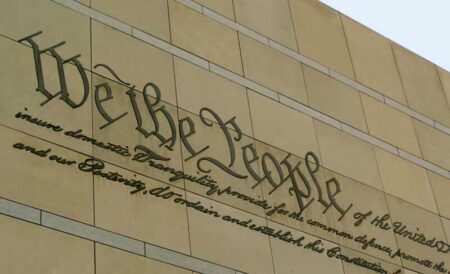
The United States of America is just over 245 years old. Its laws and system of government are only 230 years old. I join with many others who have far more experience and education involved in American history and consider the Constitution the greatest document ever written.
However, I am a progressive, and I believe that the Constitution is a “living document” that must be applied to changes over decades, not the norms and conditions in the 18th century. On the other hand, many “conservatives” believe that it must be taken literally and remain a document based on the past. Still, other Republicans recognize a need to update the document and make it relevant today.
In a recent interview on Fox, Mary Anne Franks from the University of Miami School of Law suggested a rewrite of the First and Second Amendments in the Bill of Rights. She believes that both favor certain (unnamed) individuals, and the interpretation are ambiguous. Franks proposed that both amendments should explicitly state “individual rights within the framework of “domestic tranquility” and the “general welfare” set out in the Constitution’s preamble.” This prompted me to see what others might believe about such an idea. I found an intriguing article in the Atlantic from 2020.
The editors of the Atlantic challenged three groups of law professors, conservative, progressive, and libertarian, to create a new Constitution which applies to America in the 21st century.
As expected, the conservative group stressed “Madisonian” policy; progressives — democracy and equality; and libertarians — liberty. However, all three groups shared several beliefs that would significantly alter how government works today.
The Atlantic was surprised, and so was I, when all three groups agreed that critical parts of the Law of the Land should be altered to align closer with the 21st century.
All three teams agree on the need to limit presidential power, explicitly allow presidential impeachments for non-criminal behavior, and strengthen Congress’s oversight powers of the president. And, more specifically, the progressive and conservative teams converge on the need to elect the president by a national popular vote (the libertarians keep the Electoral College); to resurrect Congress’s ability to veto executive actions by majority vote, and to adopt 18-year term limits for Supreme Court justices.
I have attached the suggestions for all three proposals. I think you will find them very interesting.
Personally, I find no disagreement with the ideas offered by progressives and conservatives, the majority parties, but I would add term limits for Congress to the suggestions.
Most Americans will agree that the terminology could be more “modern,” allowing average Americans to fully understand its meaning and applications to life in America today. In addition, we should know how it would affect each man, woman, and child in the United States. This would eliminate much of the division within the Supreme Court related to interpretation.
This is an interesting idea, but that is all it could ever be today. Right-wing politicians would refuse any rewording of the Second Amendment, and Democrats would respond the same to changes in the First and Fourth. Their most avid supporters and donors would scream bloody murder at the very idea.
Op-Ed by James Turnage
Sources:
FOX News: Law prof suggests rewrites of First and Second Amendments that do not mention free press or bearing arms; by Stephen Sorace
National Constitution Center: Constitution Drafting Project
The Atlantic: What If We Wrote the Constitution Today? By Jeffrey Rosen
Featured and Top Image Courtesy of angela n’s Flickr Page – Creative Commons License
Inset Image Courtesy of Angela’s Flickr Page – Creative Commons License
Discover more from Guardian Liberty Voice
Subscribe to get the latest posts sent to your email.
3 Responses
That is a great tip especially to those fresh to the blogosphere.
Short but very precise information… Thanks for sharing this one.
A must read post!
Superb post however I was wondering if you
could write a litte more on this subject?
I’d be very thankful if you could elaborate a little
bit further. Many thanks!
Now we need to support professional election officials and candidates and lawmakers who support voting rights and respect election results, and guarantee the presidency to the candidate who wins the most popular votes in the country, by making every vote in every state matter and count equally, by supporting the National Popular Vote bill and state legislators in states with the 75 more electoral votes needed to enact it.
Most Americans think it is wrong that every vote is not equal and the candidate with the most national popular votes can lose.
Unfair election systems can lead to politicians and their enablers who appreciate unfairness, which leads to more unfairness, and sometimes crimes.
The sheer magnitude of the national popular vote number, compared to individual state vote totals, is much more robust against “pure insanity,” deception, and manipulation.
If as few as 11,000 voters in Arizona (11 electors), 12,000 in Georgia (16), and 22,000 in Wisconsin (10) had not voted for Biden, or partisan officials did not certify the actual counts — Trump would have won despite Biden’s nationwide lead of more than 7 million.
The Electoral College would have tied 269-269.
Congress, with only 1 vote per state, would have decided the election, regardless of the popular vote in any state or throughout the country.
It’s because of current state-by-state statewide winner-take-all laws for Electoral College votes, not mentioned, much less endorsed, in the Constitution.
In 2016, Trump became President even though Clinton won the national popular vote by 2,868,686 votes.
Trump won the Presidency because he won Michigan by 11,000 votes, Wisconsin by 23,000 votes, and Pennsylvania by 44,000 votes.
Each of these 78,000 votes was 36 times more important than Clinton’s nationwide lead of 2,868,686 votes.
537 popular votes won Florida and the White House for Bush in 2000, despite Gore’s lead of 537,179 (1,000 times more) popular votes nationwide.
The National Popular Vote bill is states with 270+ electoral votes agreeing to award their electoral votes to the winner of the most national popular votes, by simply again changing their state’s law.
All votes would be valued equally in presidential elections, no matter where voters live.
Before states began enacting new voter suppression and election subversion laws, the system with 2020 election laws meant that the winning 2024 candidate “may need a national popular vote win of 5 percentage points or more in order to squeak out an electoral college victory. Only once has the margin of popular vote victory been that large since Bill Clinton’s re-election,” Jacob Long
“If Republicans are building the infrastructure to subvert an election — to make it possible to overturn results or keep Democrats from claiming electoral votes — then we have to expect that given a chance, they’ll use it.” – Jamelle Bouie
When presidential candidates, who more Americans vote for, lose the Electoral College, the situation is unsustainable. This is how a government loses its legitimacy.
NationalPopularVote