

Fascism is a word that has been in the news a lot lately. What does it mean? There was 1930s Germany, 1930s Japan, and 1930s Italy, but what were the commonalities? Fascism has no actual definition and is more of a phenomenon. For example, some fascist countries may have some but not all of the tendencies and can still be considered fascist. It is time to go deeper into what makes a fascist country tick.
The Tendencies of Fascism
To better understand what fascism is, one could read the works of Dr. Lawrence Britt. Dr. Britt is a political scientist who wrote an article in 2003. He found that there were 14 commonalities between fascist nations: Powerful and continuing nationalism, disdain for the recognition of human rights, identification of enemies/scapegoats as a unifying cause, supremacy of the military, rampant sexism, controlled Mass Media, obsession with national security, religion, and government are intertwined, corporate power is protected, labor power suppression, disdain for intellectuals and the arts, obsession with crime and punishment, rampant cronyism and corruption, and fraudulent elections.

Each of these tendencies alone is terrifying but put together, what you have is a fascist nation or a proto-fascist nation, which means it is on the cusp of fascism. Each of them needs a thorough explanation and should be studied closely. Fascism is a real danger that the modern world needs to account for as one of its many dangers. The last time a nation became a fascist nation, there was a world war. The world doesn’t need another world war; it is already dangerous.
Nationalism in Perspective
First, aggressive right-wing nationalism is extremely dangerous for a nation. With a strong right-wing nationalism, a country can make its citizens do just about anything. With this fascist tendency, a nation’s government can do about anything geopolitically and not have to check with its citizens for their approval. This allows for more aggressive imperialism, which is not the inherent nature of nationalism.
Nationalism is simply the advocacy and support for one’s nation. When a country like the United States of America uses nationalism, it usually comes out as imperialism because of the simple fact that the United States is the most powerful empire the world has ever seen. Yet it is revolutionary when Black Americans use nationalism to liberate themselves from oppressive power structures. The reason to use nationalism is to either exploit and expand or liberate and assert self-determination against an oppressive force. So when fascist countries use nationalism, it is always right-wing.

Fascism: Human Rights and Scapegoats
Next, a disdain for the recognition of human rights is something that all fascist countries share. The concept of human rights in fascist countries doesn’t exist. Either you are in the in-group, or you are in the out-group. Fascist governments blame their problems on a specific group of people. Then those same nations do unspeakable things to those particular groups of people to distract from the real issues: This is a significant problem because genocide is something that never needs to exist. Genocide is never the answer to any situation. However, for fascist countries, this is what they turn to in the end. The logical conclusion to blaming all problems on a specific group of people is to get rid of them.
Furthermore, identifying enemies/scapegoats as a unifying cause is hazardous. The journey there to that logical conclusion is scary as well. When a fascist country picks “the one” out of all the groups in the nation, they have blamed everything. It is a bad omen. Things become extremely dangerous for that specific group. For example, in 1930s Germany, white supremacists had a list of undesirables, including the disabled, LGBT, those with “tainted” blood, and people of color.
However, once they chose Jewish people to blame for the state of Germany at the time, everything exploded with ferocity. The Jewish people that lived there experienced atrocities. Once a fascist country chooses “the one,” that group must, by any means, either fight back or escape because the over-inflated budgets of fascist militaries will ensnare all who don’t escape.
Supremacy of Military and Threat of Force
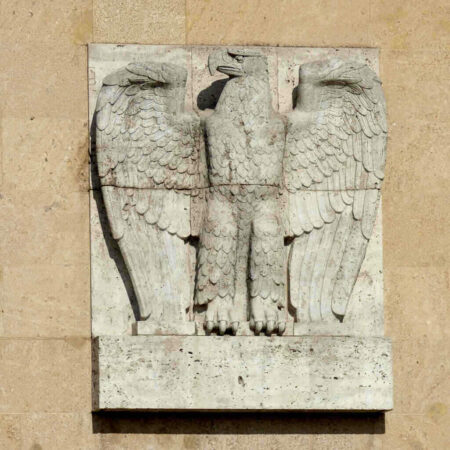
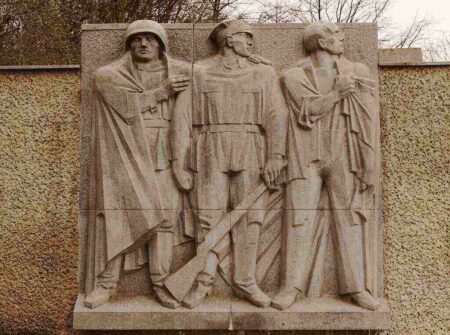
Supremacy of the military is next on the list for a good reason. The military is a physical representation of everything that a fascist nation is. Fascist governments tend to want to look powerful using the aesthetics of the military. So through their army’s aesthetics and actions, fascist nations assert themselves domestically and internationally to prove their supremacist ideology is “correct.” They prove this by destroying and exploiting other countries. Eternal conquest is the game’s name, and all fascist nations play it till the end. Or until there are no more lands to conquer.
The strength of their military is the lifeblood of a fascist nation. At its heart, the threat of force keeps a fascist country running. The danger of power makes the next one on the list so terrifying. Rampant sexism is a vital part of the fascist puzzle. Because of the inherently hierarchical nature of fascist countries, women tend to be second-class citizens rather than people. In fascist countries, women tend to have a “place” they are supposed to be. Women’s place in a fascist government is inherently subservient. They are devalued, used, and abused. They are expected to support the “strong” men and not question the nation’s hierarchy. Because questioning the order within a fascist country is to challenge fascism itself.
Fascism: The Media and National Security
Many don’t question the nature of fascism within a fascist nation because of its stronghold over mass media. Fascism is about control, so, logically, the government would have absolute control over the media. The media is where people come to understand new information. The lack of a free press is a sign of a failing democracy. Fascist countries can never have a free press because of their atrocities in their final stages. The force that is applied against journalists in fascist countries is disgusting. Journalists are keepers of truth and report facts.
Fascism is at direct odds with journalistic integrity because fascism is about aesthetics. A fascist country that can completely control how its people perceive it is invincible. Fascist nations have great myths in which they are returning to some “ golden age.” Journalists can tear through the lies of the fascist state and expose the lie that the fascist state is returning to that fictional “ golden age.” Proper news organizations can change how an event is perceived domestically and internationally. Fascism is antithetical to the truth.
So, of course, a fascist nation would have absolute control of its people’s understanding of the truth. National security is one of the more obscure parts of fascism’s obsessions. A fascist country will be obsessed with geopolitical conflicts, for at least one of these will involve an “undesirable” group. Fascist governments are obsessed with their undesirables. So when a global conflict happens, and many people are involved, this gives another excuse to ramp up the propaganda and military budget. It gives them a reason to increase everything that makes a nation fascist. Geopolitical conflicts allow fascist governments to double down on their ideology because, from their perspectives, everyone is out to get them.
Suppression of Labor Power, Corporate Power, and Religion
The intertwining of religion and the state in proto-fascist nations allows the government to reinforce its ideology through the church’s sermons. Through this process, the state and religion become one: The state’s message becomes the church’s; thus, the church’s message becomes the state’s.
The reason is that religion has a large amount of influence over communities. Some communities can become better with the guidance of the church. Some communities, via influence from the church, can be pushed to more hateful acts. The power that religion has is exceptionally enticing to fascist nations. The fact is that fascism is about the centralization of power for oppressive purposes; infusing the two increases the state’s influence.
Additionally, corporate power is one of the many lifebloods of fascism. Corporate governance describes how much power corporations have to influence different aspects of society. This fascist commonality plays into the hierarchical nature of fascism. In a fascist country, capitalism is part of the plan. An economic system prioritizing profit over everything will eventually end up with haves and have-nots, which is seen in rising rates of income inequality in America.
The creation of division benefits fascism because it is used to prove that undesirables ruin the nation and aren’t pure enough to succeed. Suppressing the labor power within a country destroys that nation. The working class within any government, including fascist ones, makes the nation run.
The working class is a vital part of any nation. Without workers creating value with their labor, there can be no profit or business. How a government treats its working class is indicative of the nature of that nation. The way fascist nations suppress labor power within their countries is very telling of the kind of nations fascist governments are. Hindering labor power means that economic exploitation is much easier.
Labor rights degradation significantly affects human rights within a society. Exploitation is more effortless when the people you are exploiting have no power. Suppressing labor within a fascist nation also suppresses the possibility of counterrevolution. Vanquishing the power of work is simply self-preservation for a fascist country. If they let the working class become too strong, they won’t have an empire at all.
Arts and Intellectuals
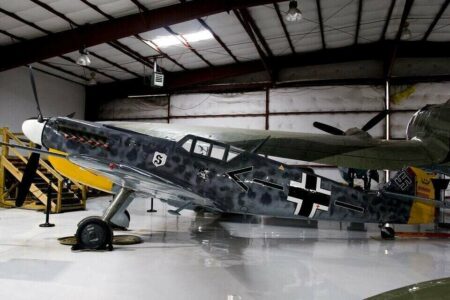
Fascist nations’ disdain for intellectuals has societal ramifications. Scholars help push society forward. They are more capable of analyzing what is wrong with society. Once a society discards its academics, its capacity to protect itself from oppressive systems decreases significantly.
Intellectuals help bring new words and new perspectives into national conversations. Where would America be without the works of Franz Fanon, Angela Davis, and Kimberle Crenshaw? The collective understanding of specific issues like race, class, and oppression would suffer if America never had people like them. These people help the rest of society understand reality, not as the government says it is, but just how it is.
The arts are similarly impacted. Art is meant to critique, inform, and inspire. It can critique a system of oppression without saying any words. That is what makes the arts so dangerous for fascist nations.
A fascist nation must destroy or suppress all art that suggests anything other than the state narrative. The artists have just as important a position in society as the intellectuals. They inform those who would otherwise not see that there is something wrong. Artisans communicate complex themes and messages through artistic expression. Through creative expression, individuals can understand each other without having a complicated conversation.
The message is interpretable, but there will be people who immediately understand. Those people are then inspired to make art with similar themes and take the critique to a new level. Art inspires revolutions, and counterrevolution would be bad for a fascist nation.
FascismCrime and Punishment

One of the many ways that fascist nations prevent counterrevolution is through punishment. Crime and punishment have a special place within a fascist country. A legal transgression is an act against the state rather than desperation. People are punished for creating a so-called stain on society.
These punishments are always disproportionate for unwanted individuals. As a result, their mistakes are amplified as if they were against society.
Fascism is obsessed with unlawfulness. The existence of criminal activity means that something is lacking. For example, theft usually happens when there is a lack of resources invested in that community. Crime is contrary to fascists’ fallacy. They contend the country will return to a mythical and nostalgic society that never existed.
Furthermore, fascists believe the nation would be perfect if there were no undesirable people. This is the narrative that crime contradicts, for if you put any group of people in an environment of condensed poverty, oppression, and violence, you will find that they turn to crime. Crime doesn’t just come from nowhere. It isn’t an unsolvable equation. Just like crime, corruption doesn’t come from anywhere.
In fascist countries, hierarchy is the natural order of society. If there is corruption in politics, that’s just what it means to be on top. Fascist governments are always very corrupt. They are expected to behave this way since they are at the top of the hierarchy. For example, corporations fund politicians that take money off the top and profit from positions of power. Corruption is a feature of the system and not a bug.
Fraudulent Elections
Finally, fraudulent elections are simply an extension of corruption and the maintenance of power and control. Elections are one of the many democratic processes that become corrupted when a fascist government comes to power.
Voting for a representative is one of the very few ways that the average citizen of a nation can have any power. The system is easily corrupted via gerrymandering or stopping people from voting. Fraudulent elections are simply an expression of control from a fascist government. Democracy dies the moment fascism comes into power. So let’s make sure fascism never rises again.
Fascism is a complicated topic that deserves profound analysis. It uses many means to maintain and suppress those who would reject it. Fascism is a disease that corrupts democracy, destroys unity, and degrades the quality of life in any nation.
Moreover, fascism must be stricken. It must be struggled against, cleaned out, and looked for in every nook and cranny. Fascism must never be allowed to sprout its head up again in any nation.
Written by Kenneth Mazerat
Sources:
Britannica: Robert Soucy; Fascism
ReasearchGate: Eugenic & Human Rights; by Daniel Kelves
The Washington Post: Right-wing nationalists are marching into the future by rewriting the past by Ishaan Tharoor
ACLU: What Is Free Press, And How Does It Work? What Is Its Role In A Democracy? by Jonathan Day
World101: What Is Fascism?
Featured and Top Image Courtesy of Erich Ferdinand’s Flickr Page – Creative Commons License
First Inset Image Courtesy of Tarje Sælen Lavik’s Flickr Page – Creative Commons License
Second Inset Image Courtesy of Geoff Livingston’s Flickr Page – Creative Commons License
Third Inset Image Courtesy of Rachel Knickmeyer’s Flickr Page – Creative Commons License
Fourth Inset Image Courtesy of Damian Entwistle’s Flickr Page – Creative Commons License
Fifth Inset Image Courtesy of Jens Cederskjold’s Flickr Page – Creative Commons License
Sixth Inset Image Courtesy of Diego Cavichiolli Carbone’s Flickr Page – Creative Commons License
Seventh Inset Image Courtesy of error 4o4 found’s Flickr Page – Creative Commons License
Discover more from Guardian Liberty Voice
Subscribe to get the latest posts sent to your email.