


AT2018hyz
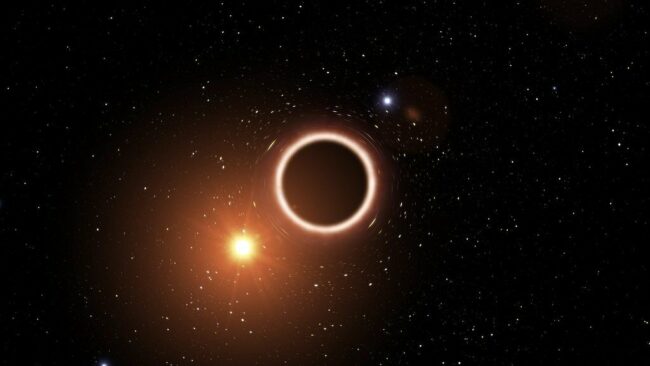
Astronomers have just spotted a black hole burping up stellar remains years after it consumed and shredded the star. This is an extremely unusual finding and scientists have never spotted this before. This event is classified as AT2018hyz.
Back in October 2018, a black hole shredded a small star when it got a little too close. This black hole is in a galaxy 665 million light years away from Earth. This incident was no surprise to astronomers, who sometimes happen to catch these events. However, nearly three years later the black hole is lit up because of ejected material.
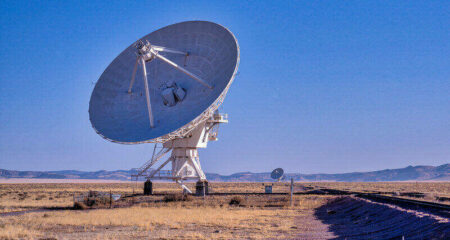
Scientists were using a powerful radio telescope in New Mexico when they made this discovery. They went to check in on the around two dozen black holes where stars have previously been pulled in. They found that AT2018hyz was releasing energy at strange velocities.
Previously, astronomers had seen black holes consuming stars and then vomiting them out. But before the recent discovery, scientists would only see the ejection would happen almost instantaneously.
Black Holes Consuming Stars
When a black hole consumes a star it’s called a tidal disruption event, otherwise known as TDE. It’s named this because of the strong tidal forces from the black hole that act on the star. Once the star gets closer in reach, the black hole begins stretching and stripping the star layer by layer.
It turns the star into a long, noodle-like, string that gets tightly twisted around the black hole. This forms a ball of hot plasma and is known as spaghettification. The plasma ball then begins to quickly accelerate around the black hole, emitting both energy and matter, creating a flash of light.
Once something hits the event horizon of a black hole, that is the point of no escape. However, scientists estimate that this emitted material never crossed that boundary, to begin with. So the star got just close enough to the black hole to get shredded apart, but not enough to be at the point of no return.
Scientists liken it to the black holes not being able to take in everything they are trying to consume. This light can be detected by radio-wave, optical, and X-Ray telescopes. Astronomers can spot this emission from millions of light-years away.
Why is this black hole surprising?
Scientists are not only puzzled by the fact that AT2018hyz took 3 years to emit but also by the extreme speed that the material was sent flying out. Most TDE travels at 10% the speed of light, but AT2018hyz released the star matter at a staggering speed of 50% the speed of light.
For most black holes that swallow stars, around 99%, of the energy outflow is low. In that 1%, it is known as an extremely jetted event, which is a very rare occurrence.
Edo Berger, a professor of astronomy at Harvard University, explains more about the previous research by TDEs. He stated that AT2018hyz was in radio silence for three years yet is now lighting up dramatically and it is one of the most luminous TDEs. Berger stated that this was the first delay they’ve ever seen this great and that researchers have not been looking late enough in the TDE evolution.
Yvette Cendes, an astrophysicist at the Harvard and Smithsonian Center for Astrophysics, said this caught her team completely by surprise. Cendes believes that the black hole is belatedly releasing this leftover star matter but researchers aren’t sure why this process was delayed. Although they believe this may be more common than previously thought. Researchers will continue to look at other TDEs to understand if this is the case.
Written by Alyssa Calderon
Sources
NPR: A black hole is releasing some strange burps, baffling scientists
Live Science: Astronomers baffled by black hole burping out spaghettified star years after eating it
Center for Astrophysics: ‘We’ve Never Seen Anything Like This Before:’ Black Hole Spews Out Material Years After Shredding Star
Top and Featured Image Courtesy of European Southern Observatory Flickr Page – Creative Commons License
Inset Image Courtesy of Mobilis In Mobili Flickr Page – Creative Commons License
Discover more from Guardian Liberty Voice
Subscribe to get the latest posts sent to your email.