


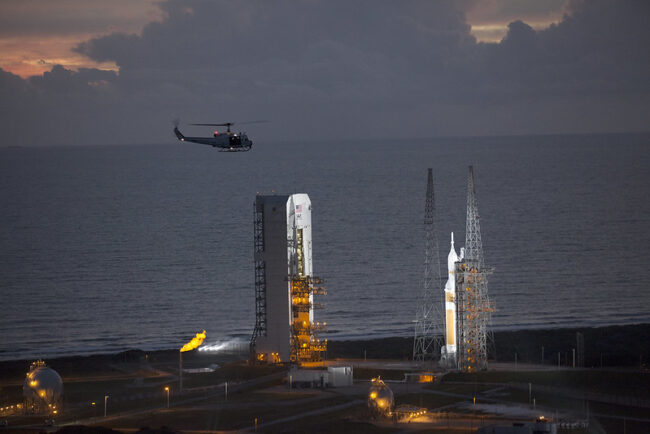
In March, NASA plans to take humans around the Moon for the first time in over 50 years with the launch of the Artemis II mission. The four astronauts on board the Orion spacecraft will spend 10 days in space.
The launch was originally scheduled for this month, however, hydrogen leaks pushed the launch back and now there is a lesser-known issue, according to engineer Charlie Camarda.
The engineer worked with NASA for 20 years and flew on the first shuttle after Columbia. He has been outspoken about his concerns with the spacecraft’s return to Earth as he believes the heat shield on the Orion spacecraft is not up to the task.
What Is a Heat Shield?
A heat shield coats the bottom of the spacecraft with a material made to withstand temperatures of 3,000ºC that occur on re-entry. Orion’s heat shield is 186 blocks of Avcoat. It protects the vessel as it heats up and burns in a controlled way to avoid becoming too hot.
In the ’60s and ’70s, similar technology was used in the Apollo missions leaving NASA engineers with the belief they knew how this material would respond.
The Avcoat material is similar to the one used in the Apollo missions, however it was reformulated for Artemis to meet environmental legislation outlawing certain compounds. Additionally, it was applied differently. The bottom of the spacecraft was covered with one larger piece in the Apollo missions, but the Artemis I and II missions used a heat shield made up of more than 186 blocks or tiles.
Artemis I and II Heat Shield Issues
After Orion returned from the Artemis I mission engineers discovered more than one hundred cracks and craters on the heat shield surface.
Dr. Wendy Whitman Cobb is a space policy expert at the School of Advanced Air and Space Studies in Alabama and she says, “When Orion came back through the atmosphere … it was coming back a a very high rate of speed. In order to burn off some of that speed, they did a skip maneuver … at a shallow angle, so that Orion skipped off the atmosphere. The entire system had sensors everywhere. If astronauts had been aboard, they would have been fine.”
Since the return of Artemis I, in November 2022, NASA has conducted intense heat testing on the ground, however, this will be the first time Orion has been on a mission since then.
This type of damage was not seen in any of the Apollo missions nor in the exploratory test performed in 2014.
In May 2024, 18 months after the mission, NASA released the report of their finding during the investigation. It suggested the problem would be fixed if they changed the way Orion re-entered the atmosphere. Instead of a “double bounce” maneuver to slow down, Orion will re-enter the atmosphere directly.
NASA administrator Jared Isaacman said he has “full confidence in the Orion spacecraft and its heat shield,” and that confidence is “grounded in rigorous analysis and the work of exceptional engineers who followed the data throughout the process.”
Camarda’s concerns increased when he read the NASA report. “The heat shield on the belly of the vehicle … has to absorb all that heat. Once you have a hole … things happen very quickly, bad things happen very quickly.” He added, “It’s got a major inherent problem … a structural problem, and they do not understand the physics of that problem.”
Ed Pope is an an advanced material expert and heat shield engineer who shared his concerns on LinkedIn last year. He stated NASA “dithered with a committee” and “not-so-relevant testing” instead of fixing the heat shield. He added, “They made a huge mistake with the approach to manufacturing the heat shield. Unfortunately, it’ll take too long, cost too much, and cause too great of a delay if they fix it … Expediency won over safety and good materials, science and engineering.”
Camarda says there are similarities between Artemis II and the lead-up to the Challenger and Columbia disasters. He says NASA continued to launch space shuttles despite “a known problem.” “We kept flying until it wasn’t safe … we never fixed the problem.”
“We should have never had Columbia, we should have never had Challenger, and I’m afraid to say if we fly Artemis II with the crew, we’re playing Russian roulette. We haven’t learnt our lesson.”
Orion Rocket Wet Dress Rehearsal
A wet dress rehearsal is a fueling test of the Space Launch System rocket. On Feb. 18, at 3 a.m. EST, the rocket’s core stage of the rocket was powered up. During the tanking phase of the countdown, it will be loaded with over 700,000 gallons of liquid oxygen and liquid hydrogen over a series of different propellant loading milestones to fill, top off, and replenish the tanks. The cryogenic propulsion stage was also powered up overnight.
Around 11 a.m., 30 minutes into the countdown or L-33 hours, operators started charging the flight batteries for Orion. Core stage battery charging began in the afternoon and later engineers will conduct the final preparations of the umbilical arms and perform a walk down at the launch pad.
Written by Jeanette Vietti
Sources:
Australian Broadcasting Corporation: Former NASA engineer warns about heat shield on Artemis II moon mission
NASA: Artemis II Wet Dress Rehearsal Update: Countdown Progressing
Space.com: Artemis 2 SLS wet dress rehearsal latest news
Featured Image Courtesy of NASA’s Marshall Space Flight Center’s Flickr Page – Creative Commons License
Discover more from Guardian Liberty Voice
Subscribe to get the latest posts sent to your email.