


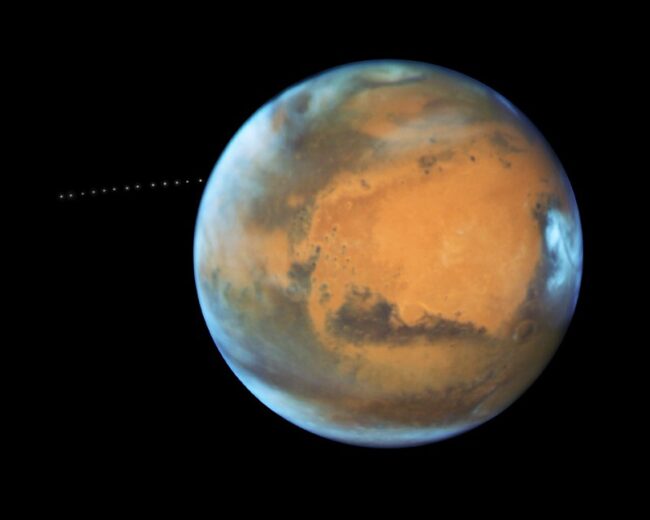
NASA announced an overhaul of its Moon and Mars strategy committing $20 billion over the next seven years to build a Moon base on the lunar surface and advancing plans to send a nuclear-powered spacecraft to Mars. NASA is no longer pursuing plans for a lunar-orbit space station, but the components will be repurposed for the Moon base.
The changes were announced on Tuesday, March 24, 2026 by NASA Administrator Jared Isaacman during a meeting in Washington, DC with partners, contractors, and government officials involved in the Artemis program.
NASA Moon Base
The Moon base will support long-term human presence with robotic missions that will prepare the site, test technologies, and begin building infrastructure before astronauts return later in the decade.
Additionally, the agency disclosed plans to launch Space Reactor I Freedom before the end of 2028. The mission is designed to demonstrate nuclear electric propulsion in deep space.
The spacecraft will deliver helicopter to Mars, similar to Ingenuity, the robotic test helicopter that flew with the Perseverance rover. NASA says this step would help move nuclear propulsion technology into operational space missions.
The Ingenuity helicopter was the first ever aircraft to achieve powered, controlled flight on another planet. The Ingenuity traveled to Mars on the Perseverance rover and landed in February 2021.
Lunar Gateway Station Paused
The planned space station in lunar orbit was supposed to be a base where astronauts could live and work before heading to the surface of the Moon, called the Lunar Gateway. NASA plans to repurpose some of the components to use on the surface instead.
Repurposing Lunar Gateway for the creation of the Moon base leaves Japan, Canada, and the European Space Agency in the Artemis program in uncertain roles as three key partners that agreed to provide components for the orbital station.
Isaacman says, “It should not really surprise anyone that we are pausing Gateway in its current form and focusing on infrastructure that supports sustained operations on the lunar surface.”
The changes are reshaping billions of dollars in contracts and come as the U.S. faces mounting competition from China, which aims to land astronauts on the Moon by 2030.
Press Release Announcement
“NASA is committed to achieving the near-impossible once again, to return to the Moon before the end of President Trump’s term, build a Moon base, establish and enduring presence, and do the other things needed to ensure American leadership in space. This is why it is essential we leave an event like Ignition with complete alignment on the national imperative that is our collective mission.
“The clock is running in this great-power competition, and success or failure will be measured in months, not years. If we concentrate NASA’s extraordinary resources on the objectives of the National Space Policy, clear away needless obstacles that impede progress, and unleash the workforce and industrial might of our nation and partners, then returning to the Moon and building a base will seem pale in comparison to what we will be capable of accomplishing in the years ahead.”
Sources:
Al Jazeera: NASA to spend $20 bn on moon base, nuclear-powered Mars spacecraft
NASA.gov: NASA Unveils Initiatives to Achieve America’s National Space Policy
CNN: NASA announces new Mars mission, reshapes goals on the moon
Featured Image Courtesy of NASA Goddard Space Flight Center’s Flickr Page – Creative Commons License
Discover more from Guardian Liberty Voice
Subscribe to get the latest posts sent to your email.