


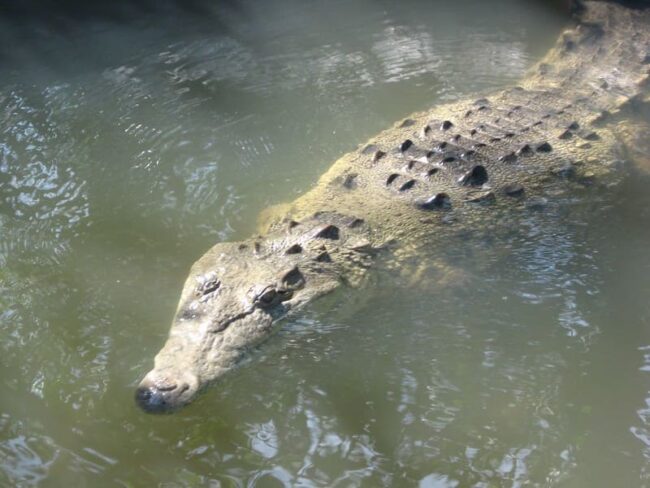
A team led by the University of Iowa published a paper describing Crocodylus lucivenator, which translates to “Lucy’s hunter,” is a new crocodile species, in the Journal of Systematic Paleontology on March 12, 2026.
Crocodylus Lucivenator
The ancient creature lived between 3 million and 3.4 million years ago, overlapping the time period and the region of Ethiopia with Lucy and her hominin species, Australopithecus afarensis.
In 1974, when Lucy’s skeleton was discovered, it was the oldest and most complete early human ancestor or relative ever found. It also proved that walking on two legs, bipedalism, came before the increased brain size.
The newly discovered species ranged in length from 12 to 15 feet and fully grown weighed between 600 and 1,300 pounds. Additionally, it was the only crocodile in the landscape, which was an expanse of shrubland and wetlands.
“It was the largest predator in that ecosystem, more so than lions and hyenas, and the biggest threat to our ancestors who lived there during that time. It’s a near certainty this crocodile would have hunted Lucy’s species. Whether a particular crocodile tried to grab Lucy, we’ll never know, but it would have seen Lucy’s kind and thought, ‘Dinner,” says Christopher Brochu, professor in the Department of Earth and Environmental Sciences at Iowa and the study’s corresponding author.
Crocodile Features
Lucy’s hunter had a snout extended farther from its nostrils than those of other crocodiles of that time and had a large hump in the middle of its snout. Researchers say it more closely resembles the snout of modern crocodiles.
Researchers believe male crocodiles used the large hump for sexual display. “You see this in some modern crocodiles. The male will lower his head down a little bit to a female to show it off,” says Brochu.
Crocodylus lucivenator also has upturned bone margins at the back of its skull, creating horn-like projections.
The Discovery
Researchers examined 121 catalogued remains. Most of the remains were teeth, skulls, and jaw parts from dozens of individual fossils excavated from the Hadar site in the Afar region of Ethiopia. For decades, the area has produced bountiful finds, including Lucy, and was designated a UNESCO World Heritage site in 1980.
Sources:
Phys.org: Meet Crocodylus lucivenator, a 12- to 15-foot predator that hunted iconic Lucy’s species
Discover Magazine: A Massive Pliocene Crocodile May Have Hunted Lucy and Other Early Hominins, 3 Million Years Ago
ZME Science: Brutal New, 15-Foot Horned Crocodile Once Stalked and Hunted Our Ancient Human Ancestors in Ethiopia
Featured Image Courtesy of Jimmy Jim Jim Shabadoo’s Flickr Page – Creative Commons License
Discover more from Guardian Liberty Voice
Subscribe to get the latest posts sent to your email.