


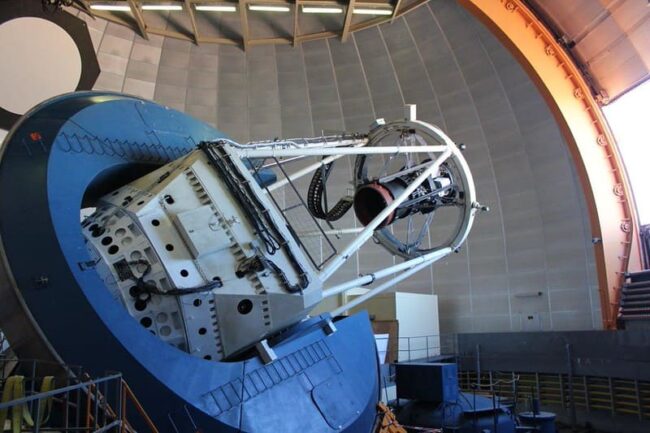
The Dark Energy Camera (DECam) mounted on top of the Victor M. Blanco Telescope in Chile captured a field of stars inside the dwarf galaxy Pictor II. Nestled inside the image is the Picll-503 star. This second-generation star, also referred to as a Population II star, is among the oldest in the universe.
Population II stars were formed when the universe was young, and were primarily hydrogen and helium. This means Picll-503 is only 1-40,000th of the iron contained within the Earth’s much younger sun.
Carbon-Enhanced Stars
What this star lacks in iron, it makes up for in carbon. The star’s carbon-to-iron ratio is more than 1,500 times the ratio in the sun, according to researchers. There are many theories as to why this is, but most Pop II stars are not observed until they have migrated from their birthplaces, making it difficult to verify these scientific theories.
Picll-503 is still within its primordial dwarf galaxy, allowing scientists to use the composition of the star to test their theories. The carbon-rich makeup suggests that during the supernova explosion at the end of the star’s life, carbon is propelled farther than other elements into the surrounding gases.
This may also explain why carbon is ubiquitous throughout the universe, making it a suitable building block for life.
Picll-503 is one of the most chemically primitive objects known. Anirudh Chiti is a Brinson Prize Fellow at Stanford University who demonstrated that the star preserved material from one of the first stellar explosions.
Pictor II
Pictor II is an ultra-faint dwarf galaxy with several thousand stars approximately 149,000 light-years away, and orbits near the Large Magellanic Cloud.
The stars in this galaxy are more than 10 billion years old, a lasting record of early cosmic history. Galaxies like Pictor II remain small. Any elements they keep reveal the closest likeness of the first local explosions.
Sources:
LiveScience: Rare star spotted in its original galaxy could answer a key question about the ingredients of life: Space photo of the week
Space: ‘At the edge of what we thought possible:’ Astronomers find extremely rare star from ancient universe
Earth.com: One of the Universe’s oldest stars reveals the origin of the Milky Way’s outer halo
Featured Image Courtesy of Camera Wiki’s Flickr Page – Creative Commons License
Discover more from Guardian Liberty Voice
Subscribe to get the latest posts sent to your email.