



The New York City Council is attempting to pass a bill that would see the use of electronic cigarettes banned in bars and restaurants.
The news emerges during a time when the Dutch Health Ministry is issuing warnings regarding the possible health risks of using e-cigarettes, recommending the public does not use the devices around children or pregnant women. They also articulate their desire to introduce more stringent regulation over the labeling of product packaging.
E-Cigarette Use to Face Restrictions, Akin to NYC Smoking Ban?
The city has prohibited smoking of traditional cigarettes in public places, since Mayor Michael R. Bloomberg enacted a five-point tobacco-control scheme between 2002 and 2006. The program introduced increased taxation in 2002, institution of smoke-free work places in 2003, dissemination of public health care education, smoking cessation services and citywide evaluation of smoking practices.

During this period, the smoking ban was established in bars, restaurants, beaches, parks and plazas. However, it appears this scheme is set to extend to include public use of e-cigarettes, based upon the auspices that they present a potential threat to public health. As with conventional carcinogen-containing cigarettes, the new legislation seeks to introduce a citywide ban on the use of e-cigarettes in bars, restaurants and a number of other enclosed public areas.
According to NBC New York, the council’s Health Committee is slated to hold a public hearing into the matter, dated Dec. 4, 2013.
The bill is sponsored by a number of key city officials, including Councilmember James Gennaro, Commissioner Dr. Thomas A. Farley and spokesperson Christine Quinn.
Gennaro claims that the issue of e-cigarette use in public places was creating confusion. For example, he maintains, since e-cigarettes look aesthetically similar to traditional cigarettes, their use creates inevitable strife between waiters and other patrons in restaurants and bars. It has also been argued that permitting unregulated use of e-cigarettes in public places makes it more difficult to effectively enforce the existing smoking ban.
He goes on to discuss the implications of pervasive e-cigarette uptake on immature and impressionable children, too young to understand the difference between the two products, and considers the device to promote smoking as a socially acceptable past-time.
In substantiating his concerns, and in estimating the increased popularity of e-cigarettes, Gennaro uses the following anecdotal reference:
“We see these cigarettes are really starting to proliferate, and it’s unacceptable… I get reports of people smoking cigarettes in public libraries. Certainly, they’re becoming more common in restaurants and bars.”
E-cigarette manufacturers have stated their intention to fight the new legislation, maintaining that e-cigarettes do not burn tar or tobacco and represent a viable substitute to conventional cigarettes, designed specifically for individuals unable to kick the habit.
E-Cigarette Safety Called Into Question
Dr. Farley raises his concerns that e-cigarettes have not been the subject of rigorous research, concluding that there may be, as-yet, unknown risks associated with their use.
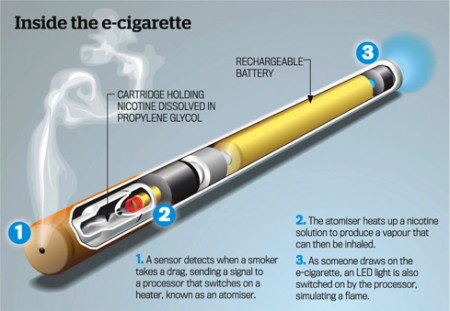
Thus far, research into e-cigarettes has yielded interesting results. Although e-cigarettes do appear to represent a less dangerous alternative to traditional cigarettes, the general consensus of opinion amongst the scientific community is that further research is warranted.
Nonetheless, a recent study, published in the journal Lancet, entitled peering through the mist: what does the chemistry of contaminants in electronic cigarettes tell us about health risks?, found the devices to present no apparent risk to human health. The research explored the chemical constituents of aerosols and liquids found in commercial e-cigarettes and concluded the practice of “vaping” would not expose users to harmful contaminants, at levels that raised any legitimate health concerns.
A report published by the Department of Health and Human Services identified trace amounts of toxic chemicals in studied e-cigarettes, including nitrosamines and formaldehydes. However, these constituents were found at concentrations that were one thousandth of those seen in regular cigarettes.
An alarming connection has been established between nicotine inhalation and damage to maturing brains, meanwhile. Jennifer B. Dwyer and colleagues, studying preclinical animal models and clinical literature, remarked upon the possibility that neural structures within developing brains were susceptible to environmental stimuli. Ultimately, they concluded that nicotine could interfere with the natural development of numerous parts of the brain, including the hippocampus and cerebellum.
The Centers for Disease Control and Prevention (CDC) also published an online report, in Morbidity and Mortality Weekly, outlining the rise in use of e-cigarettes among middle and high school students. Assimilating data from the 2012 National Youth Tobacco Survey (NYTS), the organization found that the use of e-cigarettes doubled in middle and high school students, between the years of 2011 and 2012.
In light of these findings, CDC Director Dr. Thomas R. Frieden posited that young teenagers could become addicted to nicotine, using e-cigarette devices, serving as a prelude to tobacco-based cigarettes.
Speaking to the New York Times, President and Chief Executive of NJoy, Craig Weiss, refutes these assertions, claiming there is evidence to suggest that electronic cigarettes have been effective in weaning consumers off tobacco cigarettes:
“There is no scientific data to support the argument that e-cigarettes are a gateway to smoking. On the contrary, there is a significant amount of research that indicates e-cigarettes can be a novel approach for moving smokers away from tobacco cigarettes.”
Meanwhile, New Jersey, North Dakota and Utah have all recently implemented a ban on the operation of e-cigarettes in the workplace, as well as bars and restaurants.
The NYC Council is expected to vote on the proposed legislation on Dec. 19, during the final voting meeting before a new mayor assumes control of office.
By James Fenner
Department of Health and Human Services
CDC Morbidity and Mortality Weekly1
CDC Morbidity and Mortality Weekly2
Discover more from Guardian Liberty Voice
Subscribe to get the latest posts sent to your email.
One Response
yeah ban cigarettes, e-cigarettes, coffee, tea, water, air, fast food, sugary drinks, candy, chips..
mine as well ban living altogether
we don’t have any rights
Welcome to Nazi America