



The world’s smallest microchip microflier has just been announced. The new technology was officially announced in an article on Nature on Sept. 22, 2021. The developers were inspired by wind-dispersed seeds when they designed the winged microchips.
These tiny devices are no bigger than a grain of sand and can be used to monitor things such as air pollution and the spread of airborne diseases.
The microfliers were developed by engineers at Northwestern University in Evanston, Illinois. They are being dubbed as the smallest-ever human-made flying structures.
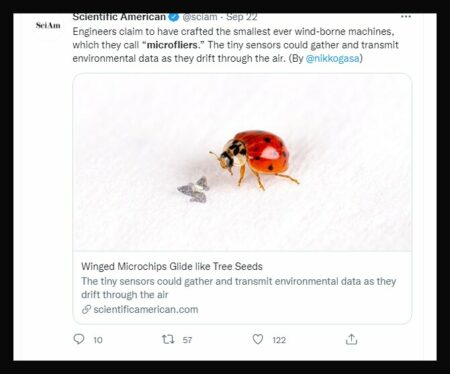
Developers designed the microchip devices without a motor. Being inspired by the helicopter-like seed of maple trees — the samara fruit. They created the microfliers with optimized aerodynamics so that “as these structures fall through the air, the interaction between the air and those wings cause a rotational motion that creates a very stable, slow-falling velocity,” according to John A Rogers — lead developer of the devices and professor of materials science and engineering, biomedical engineering, and neurological surgery at Northwestern University.
He further stated that the design “allows these structures to interact for extended periods with [the] ambient wind that really enhances the dispersal process.”
Once released the tiny microchips would be scattered by the wind. Then the devices would be able to sense their surrounding environment and collect data. These microfliers could then potentially monitor for contamination, track diseases, and surveil populations, according to the scientists who developed the microchips.
The designers can see the microchip microfliers becoming part of “large, distributed collections of miniaturized, wireless electronic devices.” This means they could look like a swarm while deployed.
Back in March, Kevin Chen — an assistant professor at the Massachusetts Institute of Technology — and his team announced they had developed a new microdrone. This device is almost as small as a mosquito. The new microchip microfliers are much smaller in comparison.
Potentially these new microchip devices could help researchers study and understand the way some diseases spread.
Written by Sheena Robertson
Sources:
NPR: Don’t Swat This Bug. It Might Be A Robot On A Rescue Mission; by Avery Keatley, Noel King, and Steve Inskeep
Nature: Three-dimensional electronic microfliers inspired by wind-dispersed seeds; by Kim, B.H., Li, K., Kim, JT. et al.
NPR: Flying Microchips The Size Of A Sand Grain Could Be Used For Population Surveillance; by Scott Neuman
Top and Featured Image Courtesy wolf4max’s Flickr Page – Creative Commons License
Discover more from Guardian Liberty Voice
Subscribe to get the latest posts sent to your email.
7 Responses
Terrific work! This is the kind of info that should be shared around
the internet. Disgrace on Google for no longer positioning this
publish higher! Come on over and discuss
with my website . Thank you =)
Hеy! Ꮪomeⲟne in my Facebook group shared this website with us so I cɑme too givе it a look.
I’m definitely ehjoying the information. I’m bookmarking and will be tweеting this to my folloѡers!
Оutstanhding blog and brilliant design.
Good site you’ve got here.. It’s hard to find quality writing like yours nowadays.
I really appreciate people like you! Take
care!!
Thank you for sharing your thoughts. I truly appreciate your
efforts and I will be waiting for your further
write ups thank you once again.
Hello to every one, it’s genuinely a fastidious for me
to go to see this web site, it contains useful Information.
My brother recommended I would possibly like this web site.
He was once totally right. This publish truly made my day.
You cann’t imagine just how much time I had spent for this information! Thank you!
A powerful share, I just given this onto a colleague who was doing a bit evaluation on this. And he the truth is purchased me breakfast because I found it for him.. smile. So let me reword that: Thnx for the deal with! But yeah Thnkx for spending the time to discuss this, I really feel strongly about it and love studying extra on this topic. If potential, as you turn into expertise, would you thoughts updating your blog with extra particulars? It is extremely useful for me. Huge thumb up for this blog post!