


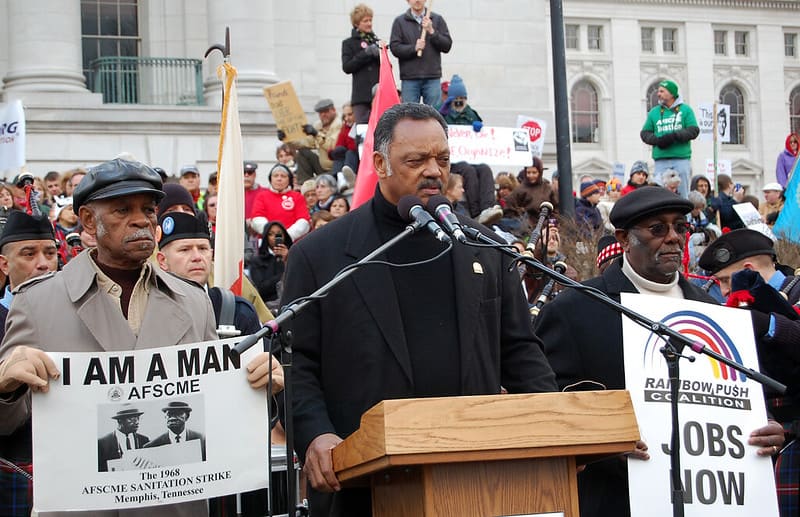
Rev. Jesse Jackson died peacefully early Tuesday morning, Feb. 17, 2026, surrounded by his family.
In November, the reverend was under hospital observation where doctors said he was diagnosed with progressive supranuclear palsy, a degenerative condition. In 2017, it was revealed Jackson had been diagnosed with Parkinson’s Disease which affects the nervous system, slowly restricting movement and daily activities. The reverend referred to the illness as a “physical challenge” but refused to allow it to deter him from his civil rights advocacy. Jackson’s father, Noah Lewis Robinson Sr. died of Parkinson’s Disease in 1997 at the age of 88.
Life of Rev. Jesse Jackson
The reverend dedicated his life to the pursuit of civil rights for disenfranchised groups within the United States and abroad.
The family released this statement: his “unwavering commitment to justice, equality, and human rights helped shape a global movement for freedom and dignity. A tireless change agent, he elevated the voices of the voiceless … leaving an indelible mark on history.”
The Younger Years
Jackson joined the inner circle of Martin Luther King Jr. as a young man and was with King when he was assassinated in Memphis, TN in 1968.
Also in 1968, the reverend was ordained by Rev. Clay Evans. Jackson dropped out of Chicago Theological Seminary three credits shy of a degree to join the civil rights movement alongside King. In 2000, the reverend was awarded a Master of Divinity degree from the seminary based on his life’s work and experience.
The reverend received more than 40 honorary doctorate degrees from high-level universities across the nation, according the the Chicago-based organization he ran for decades, the Rainbow PUSH Coalition.
Childhood and Growing Up
On Oct. 8, 1941, Jesse Burns was born to 16-year-old, single mother Helen Burns Struggs. When the reverend was a teenager, his mother married Charles Jackson and Jesse took his stepfather’s surname.
Jackson was an honors student in high school and earned a football scholarship to the University of Illinois. Eventually, he transferred to the Agricultural and Technical College of North Carolina and graduated in 1964.
Involved with the civil rights movement locally, Jackson was involved in desegregating a local public library which led to his leadership role in student-led sit-ins. The reverend abandoned his seminary studies to join King in Selma where he requested a position with the Southern Christian Leadership Conference (SCLC). This was a group of religious leaders King led focused on nonviolent protests.
Jackson helped to lead SCLC’s Chicago chapter and founded Operation Breadbasket. Due to his age and ambition, the Stanford’s King Institute reported arguments between Jackson and members of leadership, including King. The two reconciled at a civil rights protest in 1968 in Memphis. The next day, King was assassinated.
The reverend was not able to reconcile with the SCLC after King’s death. He chose to launch Chicago-based PUSH, People United to Save Humanity. In 1984, he founded The Rainbow Coalition, an organization that focuses on social justice through voter engagement and representation. The organizations merged in 1996.
Presidential Candidate
In 1984 and 1988, Jackson used his drive and ambition to make a run for the Democratic Party’s nomination for president.
In 1984, the reverend garnered 18 percent of the primary votes. He was placed third overall and won several states, however, CBS News reports he lost to controversy over an antisemitic remark made concerning the New York’s Jewish community in a story published in the Washington Post. the nomination was won by Former Vice President Walter Mondale.
The reverend still stood tall as a major political figure championing the release of foreign nationals held in Kuwait in the lead-up to the Gulf War, he became a “shadow senator” so he could lobby for statehood for Washington, D.C., and worked as a special envoy under former President Bill Clinton.
In 2000, Jackson was awarded the Presidential Medal of Freedom by President Clinton. This award is the nation’s highest civilian honor.
Written by Jeanette Vietti
Source:
CBS News: Jesse Jackson, civil rights leader who ran for president, dies at age 84
Featured Image Courtesy of Peter Gorman’s Flickr Page – Creative Commons License
Discover more from Guardian Liberty Voice
Subscribe to get the latest posts sent to your email.