


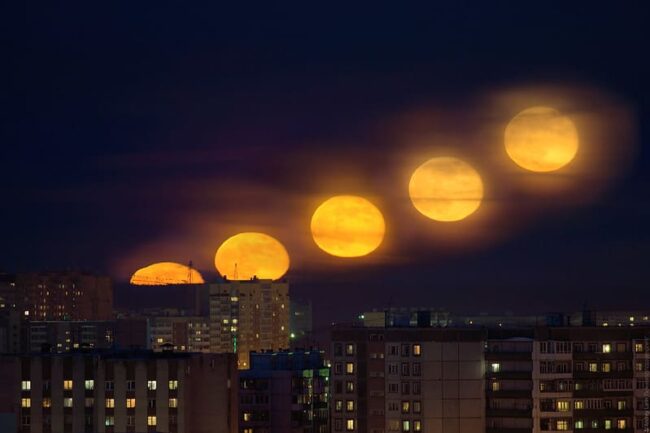
There will be a rare, second full moon this week.
How to See the Full Moonrise
A full moonrise is a brief event. It is only for a few moments; the rising full moon appears low on the horizon at dusk, with its light filtered through the thick layers of the atmosphere as the warm orange hue reflects against the blue sky.
To view the full moonrise, research is required to know exactly when and where it will appear on the horizon. Otherwise, the event is missed.
The exact time of the full moonrise differs from the date and time it reaches fullness. This week, the full Blue Moon will be full at 4:45 a.m. EDT, on Sunday, May 31. This does not mean one should rise before the sun to see the event. One must calculate when moonrise closely follows sunset, about 20 minutes, rising during ht eblue hour – this is when it is dark enough to view the orange light, but light enough to see it rise over a lit landscape.
Ambient light is required to photograph the full moon behind a foreground object.
When to See the Full Blue Moonrise
Start with a sunrise-sunset calendar that builds in moonrise times. First, choose the location, then look at sunset and moonrise times. For example, in New York, on May 31, the date of the full moon, sunset will be at 8:20 pm, and moonrise will be at 9:13 pm. This will not work, as the moon will rise in darkness. However, on Saturday, May 30, the moonrise will be at 8:14 pm, and sunset will be at 8:19 pm. It is not perfect, but it is the best night to view the full moonrise during dusk.
Where to See the Event
It is best to watch the full event from a slightly elevated area that looks east across a distant, unobstructed horizon. A skyline of low buildings will do. Looking over an open stretch of water, like a dock, river, or bay, works well for the latter.
The full moonrise point on the horizon is not in the same place from month to month. Where to watch the moon appear on the horizon is complicated by the fact that near the equinoxes, it rises close to due east, and near the solstices, it rises much further northeast or southeast. It is best to consult a precision planning app, such as TPE (The Photographer’s Ephemeris), to see exactly where the moon will appear on the horizon from any given point, taking into account elevation.
Once in place, wait patiently. It is rarely visible at the exact time listed. It can take five to fifteen minutes to clear terrain and buildings, but when it does, it often seems to “pop” into view. Then, it quickly becomes brighter and whiter as it climbs higher, losing contrast and detail. The perfect photographic window is short. So decisively take photos.
Photographing the Moonrise
It is recommended to use a 200-400mm lens with a tripod. Make an effort to capture the moon as it sits just above a structure. Experiment with ISO and shutter speeds, but a good place to start is 1/125s and ISO 100-200. If the camera used does not have sufficient autofocus, spend time before moonrise checking and rechecking the focus with a distant object. Also practice zooming in to make sure the image is sharp.
Being in place, setup is imperative because capturing the muted orange moon rising over a structure or landscape is more unique than a large, bright moon against a black sky.
The full Blue Moon is the smallest of the year, a micromoon. On June 1, the moon reaches apogee, the farthest point it reaches from Earth. At that point, stargazers will be able to view Jupiter and Venus brightly just after sunset. These two planets are becoming closer each night, with a close conjunction when they will appear to pass each other on June 9-11.
Sources:
MLive.com: Rare Blue Micromoon to rise this weekend
TODAY.com: When Is May 2026’s Blue Moon? Here’s Why It’s a Rare Occurrence – and a Micromoon
Space: How to catch the perfect full moonrise – just in time for the Blue Moon show on May 30
Featured Image Courtesy of Andrey Larin’s Flickr Page – Creative Commons License
Discover more from Guardian Liberty Voice
Subscribe to get the latest posts sent to your email.