


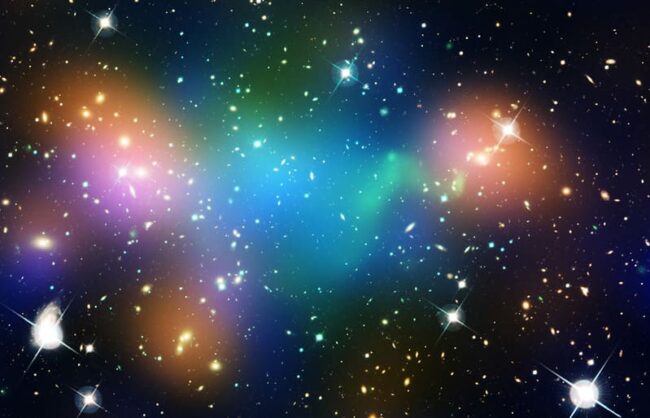
Astronomers have identified CDG-2, a faint galaxy with so few visible stars it is calculated to be 99 percent dark matter.
CDG-2 (Candidate Dark Galaxy-2) is the first galaxy to be detected only by its brightest fragments, four globular clusters, scientists originally believed to be independent objects, but as they investigated, 10 faint low-brightness galaxies and two dark galaxy candidates were discovered.
Discovery and Analysis
According to the preliminary analysis, CDG-2, nearly 300 million light-years away, has a total luminosity of six million suns. The four globular clusters account for 16 percent of that brightness. This suggests the galaxy is a gravitationally bound system implying a dense dark matter halo.
Scientist believe the normal matter in CDG-2 enabled star formation in the past, but theorize stellar bodies were stripped away by gravitational interactions with other galaxies. The globular clusters are densely packed with stars enabling them to withstand the interference and leaving them as the only tracers to the now “ghostly galaxy.”
Data was pooled together from the Hubble, Euclid, and Subaru telescopes revealing a faint glow around the globular clusters, which scientists say is a clear indicator on an underlying galaxy so dim the three telescopes independently missed it.
Team leader David Li of the University of Toronto, Canada said, “This is the first galaxy detected solely through its globular cluster population. Under conservative assumptions, the four clusters represent the entire globular cluster population of CDG-2.”
Dark Matter
The exact nature of what makes up dark matter remains unclear as it neither emits nor reflects light. Its existence is inferred by scientists from the gravitational impact it has on radiation, visible matter, and the large-scale structure of the cosmos.
Dark matter is so prevalent throughout galaxies, its presence explains the stability and motion of stars in systems like the Milky Way, which according to current models, is embedded in a halo composed of 90 percent dark matter.
CDG-2 is extreme as it is a galaxy with almost no stars and surrounded by a nearly invisible halo. This type of system is referred to as a “dark galaxy,” and they are beginning to appear in astronomical records. They serves as natural laboratories for scientists to explore the nature of dark matter and to test current galaxy formation models.
This complete paper is published in The Astrophysical Journal Letters.
Sources:
WIRED: A Galaxy Composed Almost Entirely of Dark Matter Has Been Confirmed
Space: Hubble telescope discovers rare galaxy that is 99% dark matter
ScienceDaily: NASA’s Hubble spots nearly invisible “ghost galaxy” made of 99% dark matter
Featured Image Courtesy of NASA Universe’s Flickr Page – Creative Commons License
Discover more from Guardian Liberty Voice
Subscribe to get the latest posts sent to your email.