


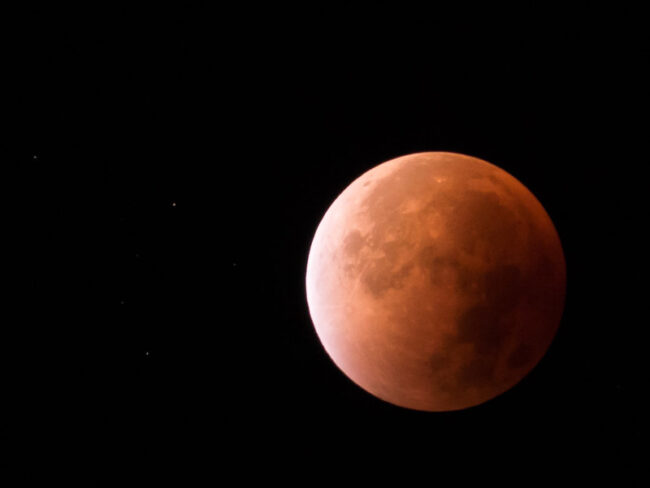
On March 3, 2026, a total lunar eclipse will create a dramatic red “blood moon” for viewers across North America, East Asia, and Australia.
The lunar eclipse will begin at 6:04 a.m. EST (1104 GMT) and peak at 6:33 a.m. The totality of the eclipse will last for approximately 58 minutes before the moon exits the Earth’s shadow.
Viewing the Lunar Eclipse
More than 40 percent of the world will be able to view at least some of the total phase of the lunar eclipse. Two percent will have the opportunity to witness all the phases of the lunar event, according to TimeandDate.com.
This will be the last total lunar eclipse anywhere on Earth until New Year’s Eve 2028-2029.
Key Viewing Times
- Eastern time: 6:04-7:02 a.m. EST on March 3, 2026 (the moon will set during totality in the Eastern time zone)
- Central time: 5:04-6:02 a.m. CST on March 3, 2026
- Mountain time: 4:04-5:02 a.m. MST on March 3, 2026
- Pacific time: 3:04-4:02 a.m PST on March 3, 2026
- Alaska time: 2:04-3:02 a.m. AKST on March 3, 2026
- Hawaii time: 1:04-2:02 a.m. HST on March 3, 2026
- New Zealand: 12:04-1:02 a.m. NZDT on March 4, 2026
- Sydney: 10:04-11:02 p.m. AEDT on March 3, 2026
- Brisbane, Australia: 9:04-10:02 p.m. AEST on March 3, 2026
- Adelaide, Australia: 9:34-10:32 p.m. ACDT on March 3, 2026
- Darwin, Australia: 8:34-9:32 p.m. on March 3, 2026
- Perth, Australia: 7:04-8:02 p.m. on March 3, 2026
- Tokyo: 8:04-9:02 p.m. JST on March 3, 2026
- Seoul: 8:04-9:02 p.m. KST on March 3, 2026
- Beijing: 7:04-8:02 p.m. CST on March 3, 2026
- Hong Kong: 7:04-8:02 p.m. HKT on March 3, 2026
Total Lunar Eclipse Event
The lunar event will begin at 3:44 a.m. EST (0844 GMT) as the moon enters the Earth’s penumbral shadow, causing a slight shading effect. As the moon moves deeper into the umbra, a dark shadow will move across its surface, turning the moon a reddish-orange hue at the peak of the eclipse. The duration of the lunar event, from start to finish, will be five hours and 30 minutes.
This full moon is a worm moon, which will peak at 5:38 p.m. EST, according to The Old Farmer’s Almanac. Each full moon was named after nature’s cues generations ago by those across the globe, including Native Americans in the eastern and central United States.
The Old Farmer’s Almanac says, “The tribes kept track of the seasons by giving distinctive names to each recurring full moon. Their names were applied to the entire month in which it occurred.”
The worm moon beacuse in colder climates, the ground begins to thaw in March, and earthworms begin to appear.
The total lunar eclipse will be visible over parts of South America, North America, Australia, East Asia, the Pacific, and New Zealand.
Populations in California, Alaska, Washington, Oregon, and Hawaii will be able to witness the peak of the total lunar eclipse in totality.
Sources:
CBC: How and when to see the total lunar eclipse on March 3
Space.com: What time is the blood moon total lunar eclipse tonight?
USA Today: How to view the 2026 ‘Blood Moon’ total lunar eclipse
Featured Image Courtesy of Di Chap’s Flickr Page – Creative Commons License
Discover more from Guardian Liberty Voice
Subscribe to get the latest posts sent to your email.